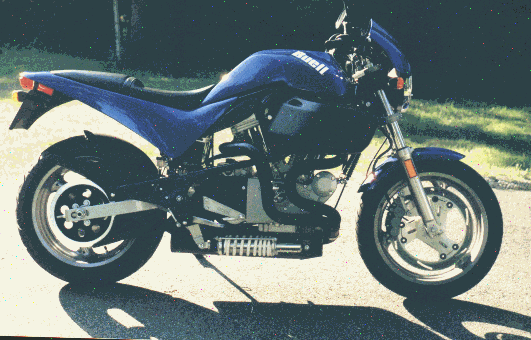
Here is a shot of my Buell M2 before modifications!
Lucky Kiezer likes V-Twins but he prefers his in 5000cc displacement!
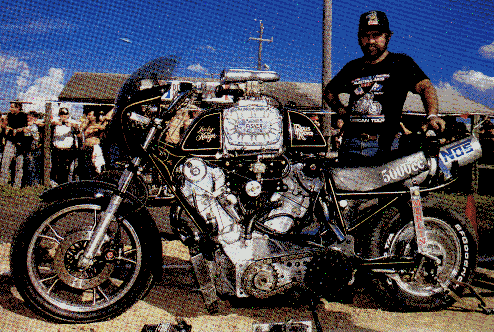
Lucky built this himself from the first two cylinders of a Rolls Royce Merlin engine. Rorty to say the least.
One of my long since gone projects was this GS1100 Suzuki.
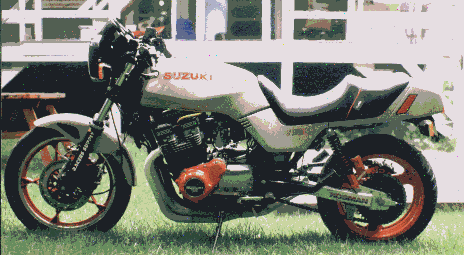
Now that it's gone I can reveal that the GSXR-11 rear wheel fits when 3/8 of an inch is removed from the stock right hand GS wheel spacer. The GS cush drive is used along with the standard GS sprocket carrier. I used an 86 GSXR 750 rear rotor along with a 90 zx-6 rear caliper. The Kosman swing arm came from Vance and Hines and was actually made by Cal-Fab. A Kosman 3/8 offset front sprocket was used.
The engine featured an S&K head with 25% more flow than the stocker. RS 36 flat slides breathing through K&Ns fed fuel and air into the aforementioned head. VHR cams (.348 @257) cams actuated Mega-cycle rocker arms, Orient Express Pro-Stock valve springs, Orient valve seals, and Orient screw adjusters. A Tsubaki chain, tensioned by an Orient adjuster spun the cams.
New England Performance welded the crank and undercut all five speeds in the trany. It took five weeks to get the trany back and twelve weeks to get the crank out of them! Slow delivery and machine work I could have done myself. I have not been back for any additional machine work or parts.
Exhaust gasses were expelled by a VHR comp series exhaust w/comp baffle (LOUD), that was Spray Aluminum coated by New England Spray Metal. Great work -great price- fast turn around.
Wieseco 1170 pistons pumped the mixture on stock connecting rods (stock rods can handle 300 hp no problem).
Orient oil pump gears added pressure and volume to the oil flow. A Barnett clutch beat the crap out of the clutch basket with its supper thin razor like plates. Later standard clutch plates were used with far better results. A VHR Super Hub clutch hub was employed to keep explosions in the cases to a minimum.
As a final stop light racer overkill guarantee an NOS Systems 4 cylinder Nitrous Oxide kit was hooked to the horn. The standard 20 and 22 jets were swapped and after experimentation 22 and 26 (nitrous - fuel) jets were used.
Dynamometer testing was quite positive. A stock GS11 makes approximately 88 -90 hp at the rear wheel. The first chassis dyno reading with nitrous put this motor combo at 178 hp. Later tuning and testing resulted in much bigger gains. The highest out put from this engine was 218 hp on a Dynojet model 100 dyno using 24 and 28 jets in the nitrous system with a cam timing set at 106 intake and 106.5 exhaust, ignition timing retarded 3 degrees and one step colder plugs than normal.
The 178hp dyno run was used by NOS systems in their 1994-1996 ad campaign.
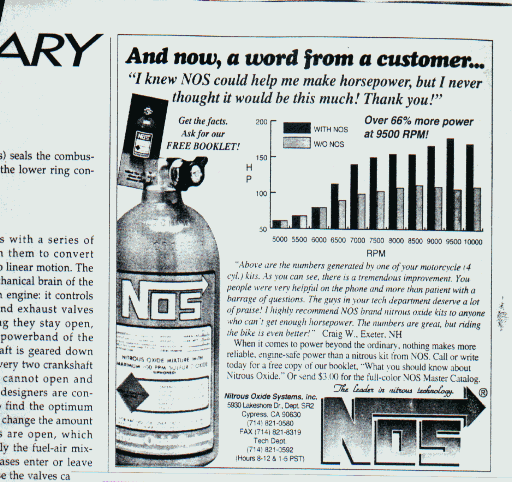
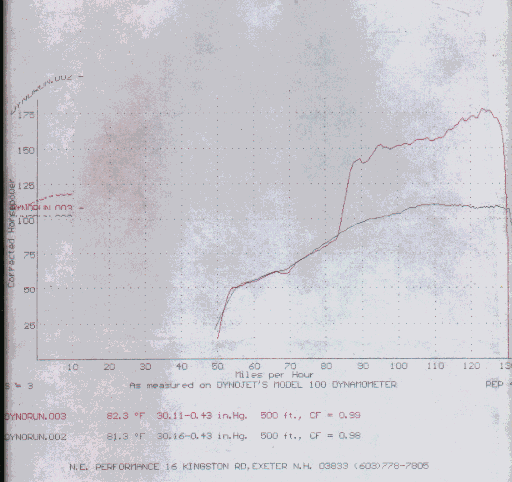 The bumpy chart is due to overly rich mixture and severely retarded timing. Better safe than sorry? Not very impressive, but it got me in the ad!
NOS made me a "jobber" which allowed me to sell and install nitrous kits from my garage. Later I got bored with "Hot Rodding" standard kits and developed my own kits. Click
Here to go see my own nitrous kits.Below is a shot of the
Ed Ryan Racing Buell Blaster! (formerly known as Relentless)
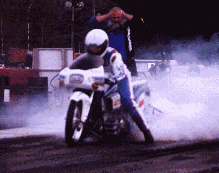
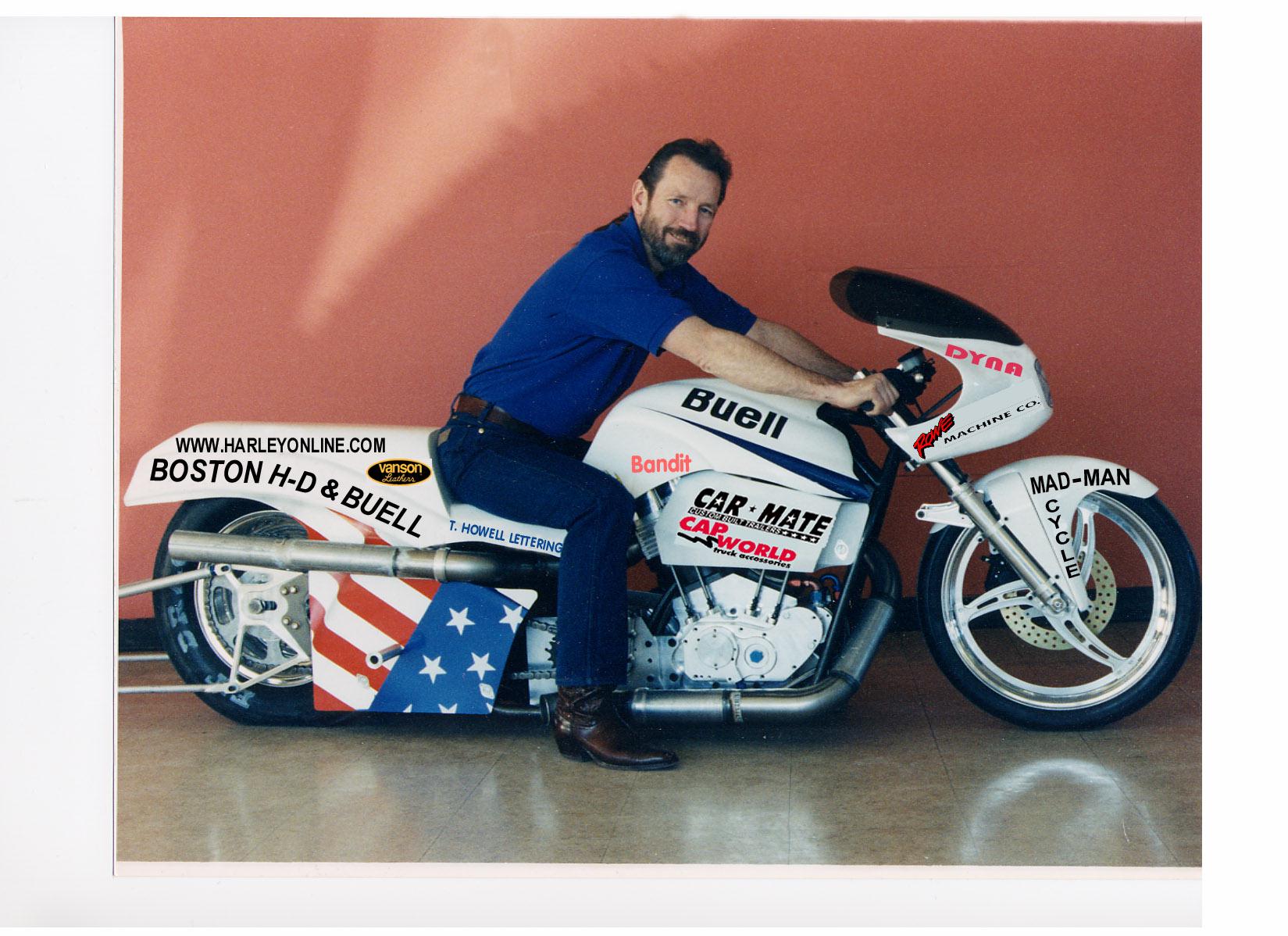 This is a shot of Ed at New England Dragway at the end of last season.
There are a number of things about this bike that must be kept secret for competitive reasons.
I can reveal that the engine is unlike any other. Yes, you hear that all the time, but how many engines have you seen or worked on with a one of a kind $12,000 crank shaft?
We believe the pistons are the largest ever run in a racing motorcycle. The piston manufacturer assured us they had never been requested to create anything like this before. Like wise the cylinders took some time for delivery because there were no "blanks" of this size. Big bore, short stroke, high RPM.
The machine uses heads made by Mark Rowe of Rowe Machine. The design is derived from Jim McLure's Master Performance Top Fuel heads, but the first couple of sets required so much rework to the combustion chambers (to run gasoline - not nitromethane) and even more to the ports (far more RPM than Big Twin Fuelers), that Mark decided he could make his own with far less work.
The cases are Reworked Over Kill units heavily modified for use in a Pro stock bike (again- derived from Fueler parts).
Carb(s) and intake…… can't tell you.
Chassis….Rowe machine Pro-Stock Harley 2000.
Body work….Buell S3 carbon fiber.
Forks….Koenig
Wkeels …..RC
Rear tire….15 inch by ten inch wide Mickey Thompson.
Exhaust….two into two Rowe Machine Pro Stock Harley
Tach….none…Dyna shift light.
Shift lever…..Right hand actuated T-handle….only used for burn outs and finding neutral. Under power an air shifter button is actuated by right thumb to fire each gear change.
Trany…..Pro Stock automatic….meaning the engagement dogs and ramps are fully undercut to allow full throttle, no ignition kill shifts. Power is never cut to the rear tire. The engagement dogs and ramps are angled so steeply, shutting the throttle off in 2nd , 3rd or 4th gear can and will engage two gears at once and destroy the several thousand dollar transmission.
Clutch….Bandit Machine Works lock up. RPM sensitive for positive lock up force.
Data acquisition….on board system logs engine rpm, clutch rpm, rear wheel speed, exhaust temp, exhaust O2 content, clutch actuation, throttle position….and a whole bunch of stuff I can't tell you.
Cams….can't tell you.
Displacement……140 Cubic inches.
Horsepower…..can't tell you ( let's just say three Buell X1s have nothing on this thing).
Here's what my M2 turned into after a little while.
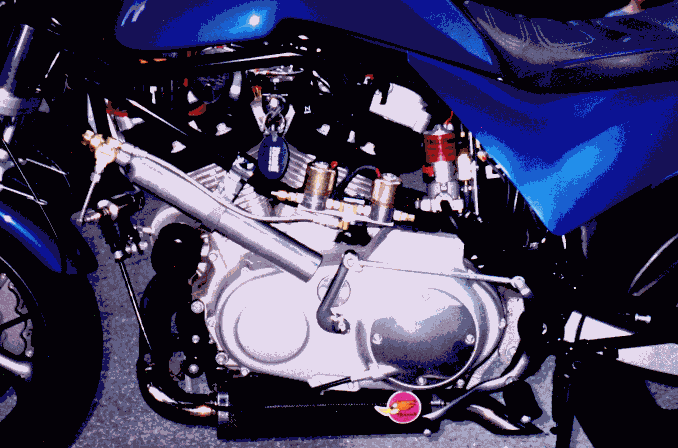
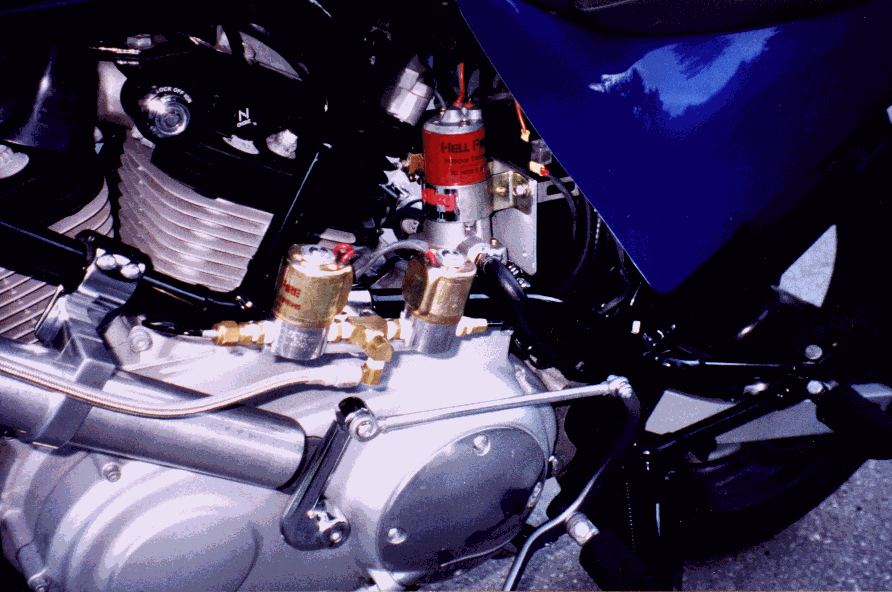 Here's a better shot of the twin nitrous solenoids and fuel pump.
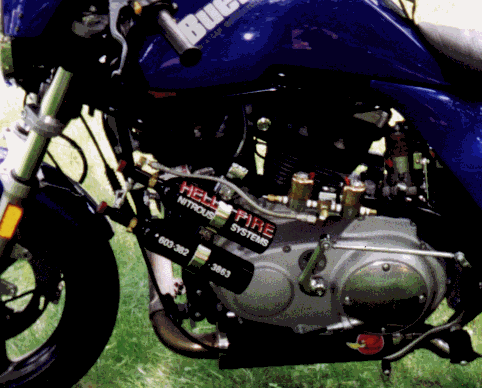 Here's a shot of the siamesed 12 oz. Tanks.
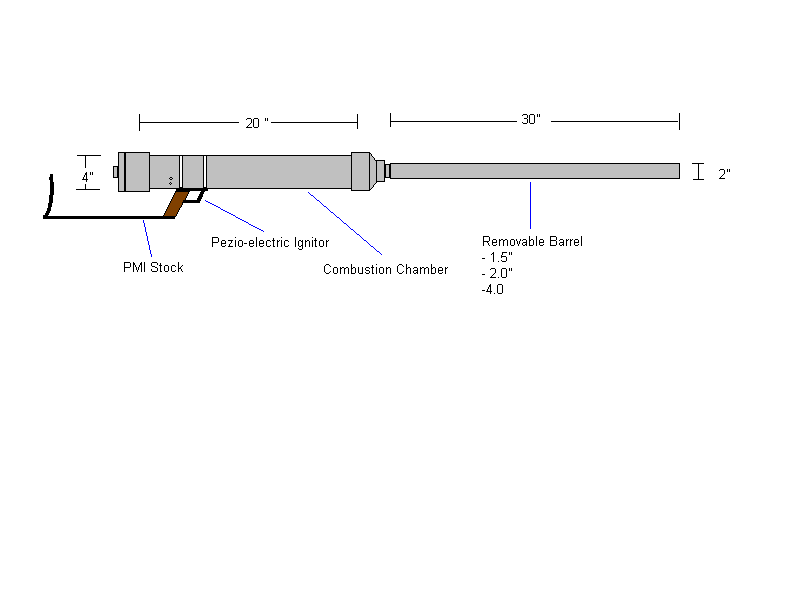
Ken Nelson introduced me to Spud Guns. Spud gun, potato gun, potato cannon, what ever you want to call them, are the coolest combination of engineering, cost effectiveness, entertainment and noise! About 20 bucks can build you a gun like the one shown here.
Here (below) is a bitmap of my gun. So far the longest shot appears to be 400 to 500 yards. This has not been verified yet.
 Update: to find the muzzle velocity of a potato gun, time the rise and fall of the potato. Get a friend to help and man the stopwatch. Point the gun straight up into the air. Start the clock on the launch of the potato. Stop the clock when the potato hits the ground. Apogee occurs at exactly 1/2 the total flight time. This is always true if the launching and landing points are the same elevation.* Ref.: H.D. Young's University Physics 1992.
At that point in time velocity of the projected potato is equal to Zero. 1/2 the flight time multiplied by acceleration due to gravity equals the muzzle velocity.
Velocityp = 0 = (muzzle velocity in Meters) - (9.8 m/s2) t1
Or
Vp = 0 = (Muzzle V m/s) - (9.8 m/s2) (1/2 fight time)
Thus, if flight time =12 sec:
Vp = 0 =(Muzzle V m/s) - (9.8 m/s2) (1/2 of 12 sec)
Or
0 = (Muzzel V m/s) - (9.8 m/s2) ( 6 sec)
Or
(9.8 m/s2) ( 6 sec) = (Muzzle V m/s)
Therefore:
58.8 m/s2 = (Muzzle V m/s)
3.281 ft = 1 meter thus 58.8 m/s2 = 192.923 ft/s2
The longest distance obtained is usually with a 45 Degree launch angle. To find horizontal range, multiply x component velocity by flight time. The X -component velocity equals muzzle velocity multiplied be the cosine of the launch angle. Use 45 deg and the cosine equals 0.707 .
Thus: R (range) = Voxt 2 = {MV (muzzle velocity ft/s) x 0.707} x {flight time}
For our example MV = 192.923, and flight time = 12.0 sec
Thus: R = (192.923 ft/s x 0.707) x (12.0) or (136.397 ft/s x 12.0)
So solving for R = 1636.764 ft, or a range of 545 yards. How's that for a $20 gun?