
The Bing carb that came with my engine had the Economy Tuning Kit installed. It has a dual stage needle that makes the mixture richer at full throttle and leaner at cruise speeds. I'm guessing that the needle wasn't sized correctly for my plane. I could go fly for a few minutes and unless I kept the throttle in nearly all the way in, my engine would reach redline in short order. If I kept the RPM over 2900, it would get hot, but still be less than 350 degrees. If I let the RPM drop below 2900, the CHT and EGT would quickly climb. One would expect the mixture to be too lean, but when I would examine the spark plugs, they would be black. Not quite velvet black, but close. I don't have a long taxi to the hangar. As a matter of fact, my landing roll usually stops in front of my hangar, so I just taxi a few yards and turn off the engine. So I don't think all that black was building up while taxiing.
I suppose my problems could have been fixed with a different size of needle, but since I had an Ellison in my possession, I decided to give it a try.
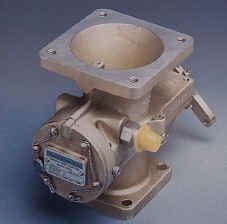
A similar flange needs to be fabricated for the intake side. On my plane, there is not much room between the Ellison and the nose gear leg, so I found an exhaust deflector the correct size with a 45 degree offset in it and cut it to fit. If you are a welder, it wouldn't be very difficult to make your own. This one just happened to catch my eye when I was in Pep Boys, so I bought it.
The throttle body couples to the engine with the same rubber coupling that the Bing used. The intake side uses SCAT tubing to bring air from the airbox. Inside the flange on the engine side, I made my swirl plates to help even out the fuel mixture. I have not run the engine without it, so I don't know if it is really needed. I know my EGTs are usually within 40 degrees of each other as it is, so I don't plan of removing it. See the bottom of my Corvair page for info on how to make the swirl plates.
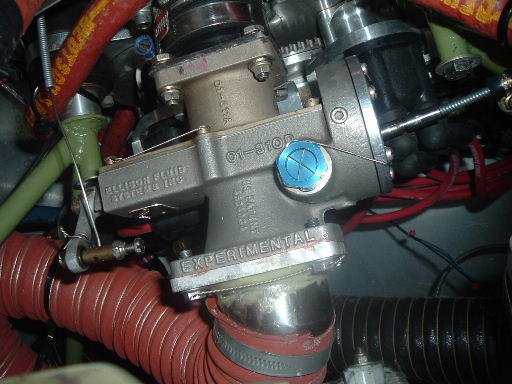
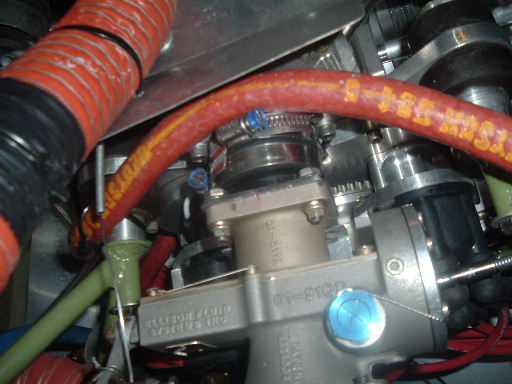
My fix for that was to use a fuel pump and make a return line to the header tank. The return line has brass fitting that was filled with solder and then drilled out with a 3/32" drill to regulate the pressure. This keeps the fuel cooler and hopefully any bubbles that form in the fuel lines will find their way back to the tank. It worked for over 100 hours on my Corvair, so I left it in place for the Jabiru. If you don't want to use a return line, you will need to find some way to keep the throttle body from becoming heat soaked. Maybe a cool air blast tube on the diaphragm cover would help.
Since I have been flying with the Ellison on the Jabiru, I have been burning auto gas with the return line and have had no problems with vapor lock. BTW, Ellison advises against the use of auto fuel.