
|
|
28 april 2007 I�ve often seen it sitting there The cat upon the window sill Now looking in, now looking out Bending perception to its will. A figure that in judgment sits With neat white paws and whiskers brushed Of all the world laid at its feet The sky and wind in awe are hushed. These lessons are we well advised To borrow from the queenly cat That sits upright and pauses now To clean its ear, and values that. 4 april 2007 Word of the day? metempsychosis noun ( pl. -ses) the supposed transmigration at death of the soul of a human being or animal into a new body of the same or a different species. derivatives include: metempsychotic, metempsychotically, metempsychosist Now try to imagine what I was reading when I came across this. I'll give you a hint, in involved technology (and that's not supposed to be some sort of profound statement about the cyborg present). 3 april 2007 I suppose this may be the first volley of the afore-promised exposition. An experimental piece which likely says what many have said and thought before: We begin, like other great thinkers whom we at times attempt to emulate, with those things of which we can be sure: most importantly, each of us has a finite time on earth. From this simple fact, though perhaps objected to by some � the formulation could be made more specific � we can educe already the first layer of meaning in our lives. How we spend that time � how we choose to spend it � is what identifies us. As a proof of our beliefs � abstractly and concretely -- literally it is our history. It is through our choices that we are defined as people. Every choice for something is also a choice against other things. (Choice here must be understood as a complex of action and motives, in other words a choice involves meaning for the chooser.) This statement, perhaps beguilingly simple, could be qualified by way of explanation. For surely, the logistics of daily life � especially in a big city � mean that we spend a great deal of time in ways we don�t choose � i.e. in traffic, in line, doing taxes. One can still understand, however, each of these actions as the result of a choice, albeit at a perhaps very obscured level. The choices may not include your perfect choice � (there are constraints like other people; and how do you know if A is impinging on B�s rights or B on A�s) this is not fantasy, you�re always going to have to deal with what exists and what you have � still, you�re never absolutely forced into something. So, you say, what�s the value in a choice between something and death (a particular binary choice)? The value is in choice. So, you say, such choices are essentially non-choices � biological, egotistical imperatives. Indeed, some would argue that changing the name of the act is not empowering, it�s just rhetorical shenanigans. Fair enough, yet one�s understanding of a situation is hugely important to one�s state of mind and actions (some people do chose death). Still few choices are so black and white. Many play to our natural preferences for minimal discomfort and trouble; the reason to remember that you have a choice is so that you keep your eyes open for other possibilities in every situation. If you shape your choices, you influence the position that you�re in. If someone puts you into a binary situation in order to force your behavior, be aware of the assumptions they have made in predicting your actions. These are likely incorrect, if you are truly opposed to the choice before you. Society is flexible. It is made up of many individuals all with different priorities and characters. It can absorb losses, accept inefficiency and is only a construction. It is not absolutely constrained in any way. Things may have the appearance of being immutable, but this is a higher-level illusion. Now, again, this is not a call for revolting against every aspect of society that irks you. Practicality is key. You have a limited time; it behooves you therefore, to fight the fights that are important. The accretion of choices and constructs of society � so much of which is contingent rather than rational � has a huge inertia, one that grows as the population grows. So choose your battles well � fighting this entails accepting that. Ah, you say, so our limited time (or energy) does in fact pose a constraint on our ability to choose. We cannot choose to change everything. (This is not a moral statement, however.) Again, practicality: if you can find a way. Just remember what�s at stake. The constant refrain must be `at what cost?�. Every choice for something is against something else. Choice, compromise. Thus is each person defined. Choosing to accept someone else�s choice is a choice too. Neglecting to choose is a choice, albeit a weak one. 10 march 2007 This picture is actually from January 31st. What can I say, February was busy. 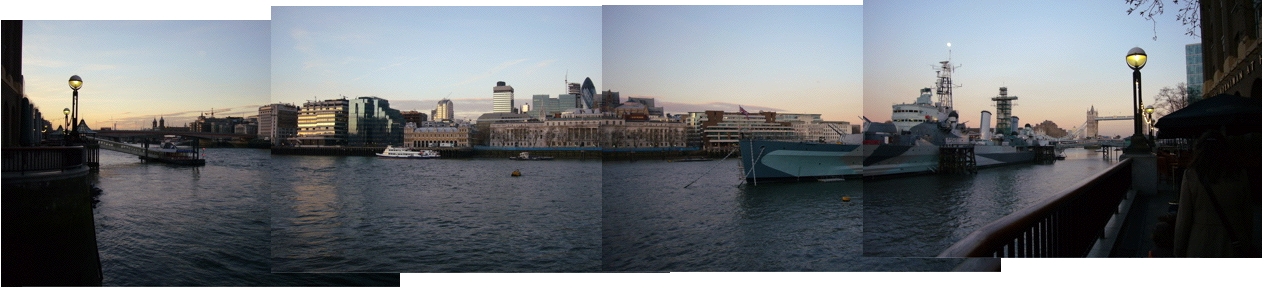 From the south side of the river. (And if you're not sure which river I'm talking about.... look closer.) 6 january 2007 I'm posting these last few entries all at once -- what else could explain their frequency? Today (it is raining unusually persistently) I'm off to the theater for a little inspiration followed by a warm and welcoming family dinner (I say that in the future tense). Perhaps my new camera and its 1 GB card will get some exercise in Islington in the rain. 1 january 2007 Completely missed the apparently world-shattering new year's eve celebrations in London. Apparently gale force winds in the north of the isle kept things minimal. And, just so you don't get suckered by this in the future: United don't serve free champagne on new year's eve flights anymore. Also, new year's eve was announced on board at midnight in London (to a rather week cheer from the economy cabin; everyone else was dozing in spacious comfort), rather than when our plane passed over what might ambiguously be referred to as the new year's line. Logical and yet somehow unfulfilling in a world obsessed with accuracy. 31 Dec 2007 Once again, I'm sitting in the International Terminal at SFO... waiting. It took me less than half an hour to proceed from the curbside drop-off point to my gate (not even using e-check in). I went through security so fast that they had to remind me to take my shoes off. Amazing. The news, for those of you who don't already know it, is that I'm starting a PhD in the History of Technology. I also got a new camera. Well, that about sums it up, I guess, so far as public consumption is concerned. And explains the following picture in several ways. Click on it to revel in full resolution. What normal person honestly needs 6 mega pixels? Technology. (That file used up masses of my free -- in both ways -- geocities disk space.) And those dots are on the window. Which admittedly slightly detracts from the effect. Everyone does, however, need to be able to take photos with a 9:5 aspect ratio. 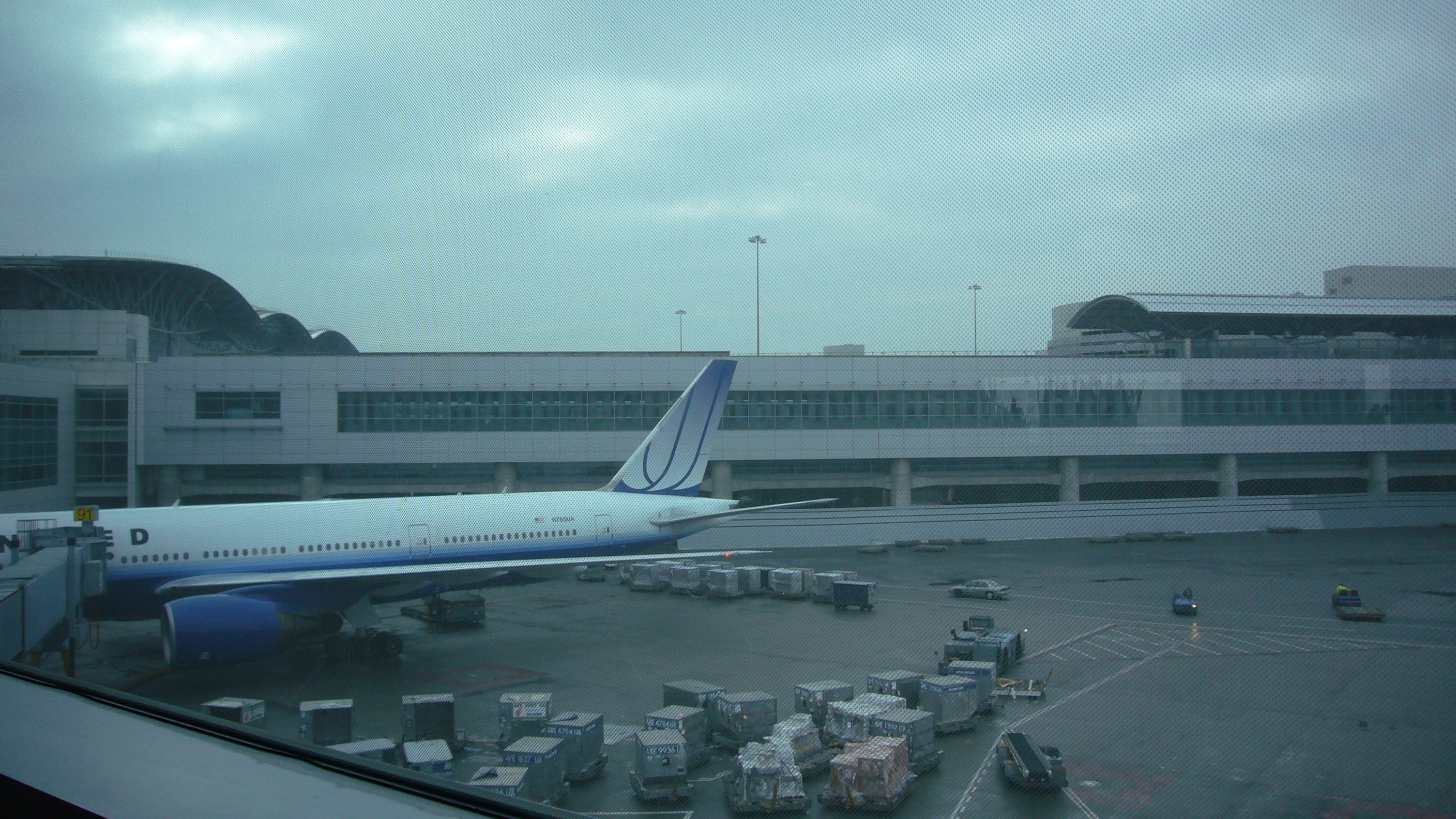 4 October 2006 Has it really been that long since I updated this site at all? I guess time moves more slowly online. The big news (yes, for everyone, dammit) is that I've finished my dissertation (for an MSc). I researched the adoption of tungsten carbide (tools) in Britain 1927-1945. Which is, honestly, most of what has happened between July and now. Now I stand before the ever recurring post college (or university) question of what to do next. How to make myself useful to society without unnecessary boring myself. My mind, flexible as it is, is constantly running over the gamut of possibilities. The more complex society, the larger number of opportunities. And the more I think about it, the more ideas I come up with. Understandable and unsurprising. Am I a fatalist? It's irrelevant. My aspiration to compose a treatise on my `world-view' remains alive and well, if ineffective. The path to hell and blogs... By way of explanation, my research took me to Coventry to consult some business archives. Coventry is an interesting city; I guess it was mostly rebuilt after the second world war and there are a lot of grimy bulidings that look like they date from that era. At the same time, the new catheral which they built next to the bombed out one is really striking. Even though it's completely modern in design and built to a great extent out of concrete (while copying the height and floor layout of a traditional cathedral) it's really amazing. In marked contrast to the outskirts, the city center, which seems to be devoted almost entirely to shopping, seems to be being revamped. There's clearly been some lottery money at work funding restoration of historical sights. A curious city which is really dismal in places (it didn't help that it was overcast all day) and in others truly delightful. These pictures are of their millenial project and the juxtaposed old and new cathedrals; ah, urban renewal. 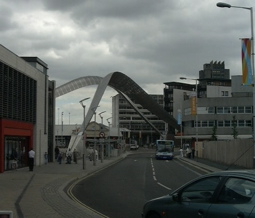 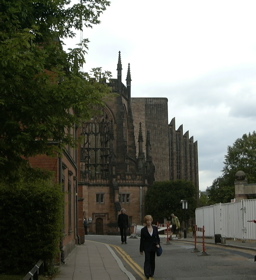
| |
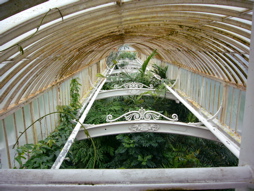 Kew. 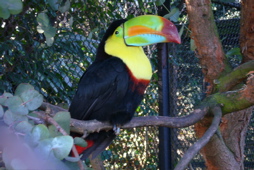 Birthday expedition; yes it's alive. 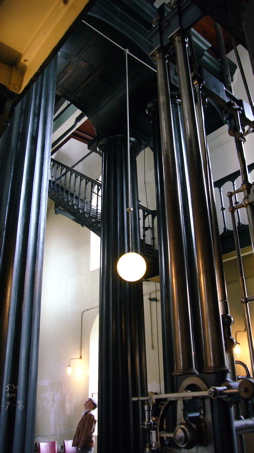 Industrial heritage: part of a steam engine. Industrial heritage: part of a steam engine.
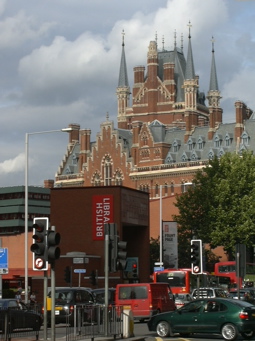 Familiar London. looking for a picture that was here before? | ||
| | ||
To make value judgments is to act, whatever level of abstraction may be the field of judgement. - A.P. Usher ----- Technology is not the problem, nor is it the solution. The problem is political, moral, and cultural, as its the solution: a successful challenge to a system of domination which masquerades as progress... it will also require once and for all a transcendence of the irrational and infantile ideology of technological progress which has confounded Western thinking for a least two centuries -- an ideology which as for too long obscured the realities of power in society, provided legitimation and cultural sanction for those who wield it, and paralyzed any and all opposition. The ideology of technological progress, according to which technological advance is viewed as being inescapable beneficial for society -- indeed, as being identical to social and human progress -- begs all the critical questions. - David Noble ----- We [the public intellectuals] do not influence the course of events by persuading people that we are right when we make what they regard as radical proposals. Rather, we exert influence by keeping options available when something has to be done at a time of crisis. - Milton Friedman ----- Religious suffering is at the same time an expression of real suffering and a protest against real suffering. Religion is the sigh of the oppressed creature, the feeling of a heartless world, and the soul of soulless circumstances. It is the opium of the people... the abolition of religion as the illusory happiness of the people is the demand for their real happiness. - Marx, 1844 (Economic and Philosophical Manuscripts) ----- I have sworn upon the altar of god, eternal hostility against every form of tyranny over the mind of man. -Thomas Jefferson ----- For human life has a double aspect, causality and meaning, and, without both of them, ''destiny'' cannot emerge. Animals follow only causality; gods, only meaning; man alone must live with both. - Kurt Wolff ----- This is the precept by� which I have lived: prepare for the worst; expect the best; and take what comes. - Hannah Arendt ----- In that way the alleged becomes real, and the real alleged, and exactly marks the breakthrough to a new civilizatory type, which writers describe: that the murderer, who also lies, has not murdered, and that the very cowardice of the murder gives him a hero's stature. - Karl Kraus, Die Dritte Walpurgisnacht (1933) ----- Pain is the only force created from nothing, without cost and with out effort. It is enough not to see, not to listen, not to act. - Primo Levi ----- There are two types of fools: those who say: "It has always been this way, therefore it must be good," and those who say: "It's new, therefore it must be better." | ||
| | ||
| | ||
| The brains behind the operation: [email protected] all rights reserved OBC, copyright 2000 | ||