 |
|
|
|
|
|
|
|
|
|
|
|
|
|
|
|
|
Schematics |
|
|
|
 |
|
|
|
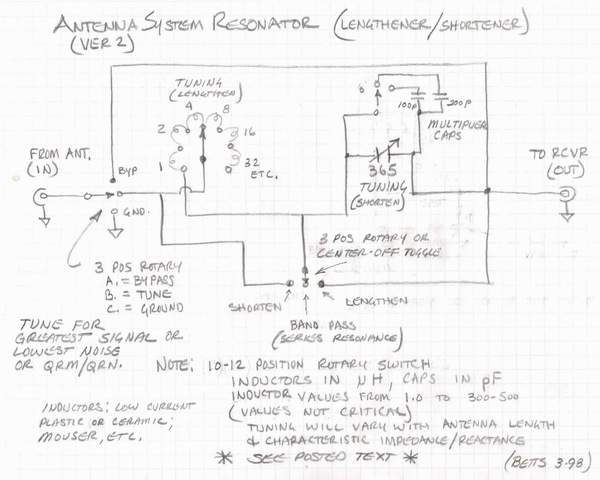
Receivers want high signal levels (voltage). They DO NOT care about impedance matching the antenna's feed point as much as a transmitter does. Don't try to "resonate" an antenna system with a transmitting tuner (more properly called a 'coupler' or 'matcher'). A tuner is an impedance transformer for transmitters, not a resonator for receivers. To a receiver, the difference of 52 Ohms or 73 Ohms don't mean a thing. Receivers are the happiest when the ENTIRE antenna system is resonant ...REGARDLESS OF THE IMPEDANCE.
Many SWLs love end fed, random length antennas. Even some serious ham DXers have seperate receiving and transmitting sky hardware. This circuit will vastly improve the relationship between a ham receiver (or communications receiver) and a wire antenna. An added bonus is the bandpass effect from the series resonances.
For noise avoidance (immunity) and to increase the impedance linearity (usable bandwidth) of the antenna system, it is best to transformer couple end-fed antennas to the feed line ... typically with a 9:1 Unun.
Here's some tips:
1. use a 9:1 Unun for end-fed long wires or random length end-fed antennas.
2. Ground both legs (primary and secondary) of the Unun separetly at the antenna's feed point.
3. Feed the radio with 50 or 75 ohm coax and be sure it is grounded at the radio (chassis) end of the run as well. |
|
|
|
|
 |
|
|
|
|
|
|
 |
|
|
|
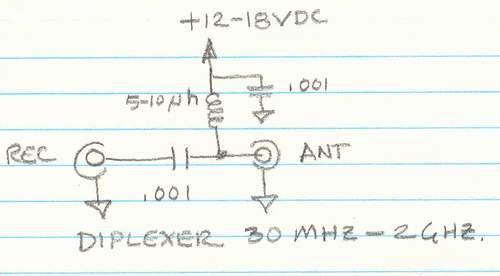
In like-minded thinking, here's the simplest of simple bias-tee's, or, as we say in the trade, "power inserter" or "power diplexer." RF travels one way ... DC goes the other way. |
|
|
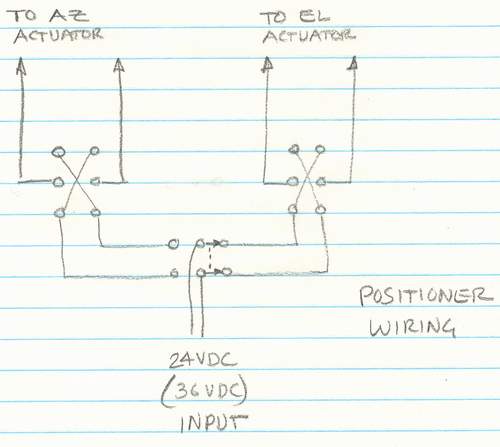
The cheapest way to move a dish's actuators. I put the motor switches, a 24 volt switching power supply, and LED indicators in an old cast aluminum, weather-proof cablevision outdoor box. It looks real cool sitting on the dish's rear mount ... When you're at the controls behind the dish, it kind'a feels like you're swinging a large artillery piece. There's a compass and clinometer attached to the dish so you know when to stop playing and start aiming. |
|
|
|
|
|
|
Home |
|