
E-TRACS
Radio Astronomy, SETI, and EME.
But if the little guy does finally decide to, "...call home" we'll be listening.
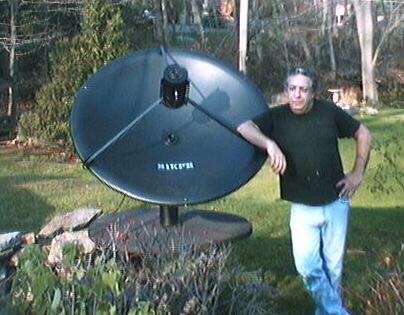
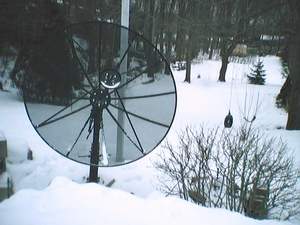
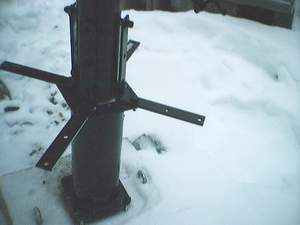
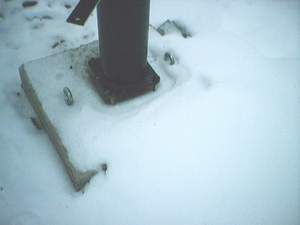
1. The steel pipe is not exposed to "rim rust" which is corrosion at, and just below, the surface of the concrete. It is difficult to maintain the equipment against rim rust and impossible to avoid. (No, you cannot put an aluminum pipe in concrete. Cement is caustic and will corrode the aluminum.).
2. The mount is in the "compression" mode. That is, you are not tightening the nuts against the bolts placing the force in a direction that wants to "pull" the bolts from the cement ... "jack effect." Here, the full weight of the dish and mount are resting on the nuts and bolts. Therefore, there are no added stresses other that the assembly itself.
3. The entire assembly may be finely adjusted to ensure a plumb mount.
Note the heavy duty "L" brackets. They will provide mounts for the future IF amplifiers, an LNB (low noise block converter), and the dish mover motor controls. All will be in weatherproof control boxes. (A necessity in New England)
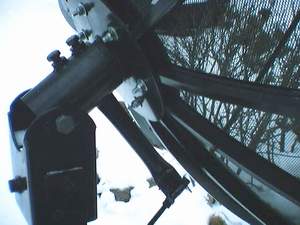
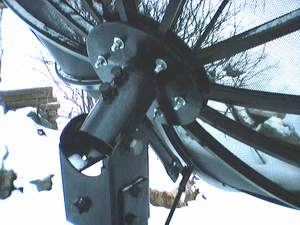
The TVRO mounting brackets (TV Receive Only) when used for ham purposes must be rotated 90 degrees. For "C" band TV the mount provides azimuth scanning. That is where the dish is elevated to a position that coinsides with the Clarke belt where all the TV satellites reside and is adjusted East or West to acquire the various "birds."For our purposes we need elevation scanning. The dish is first alligned South and the modified azimuth pivot now allows for elevation adjustment. Why? Because, in this case, we want the dish to point out into space in a direction that is parallel to the Equator. The rotating Earth becomes our rotator (what a rotator!). If he dish was pointed at its zenith (straight up) we would not be looking straight out into space, relative to our planet. Consequently, we must "declinate" the dish by the difference in degrees that our latitude is with respect to the earth. For example: my latitude is (North) 41.3 degrees. I have to declinate the dish 90 degrees (vertical) minus 41.3, or 48.7 degrees. That will point the dish straight out into space with respect to the Earth's equator and the absolute center of the Earth. Put another way, if you drew a line from the Earth's core, through the equator, the dish would be "looking" in the same direction parallel to that line.