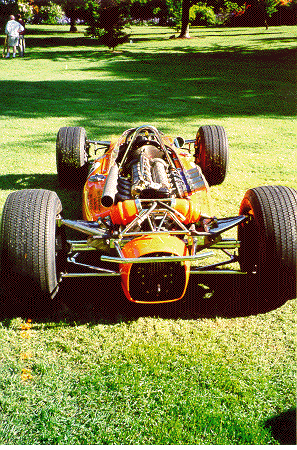
Picture of the car as it looks now, from the rear, without the engine cover. Notice the Hydrolastic "Liquid Suspension" shock absorbers behind the engine. They are orange in colour and have two hoses coming out from between them.
The Indianapolis 500 is the world's most famous auto race. It provides a showcase for corageous drivers, inovative engineering, meticulous preparation, and winning teamwork.
In the early 1960's, leading racecar designers and chief mechanics had begun to achieve some notable successes with rear-engined cars, and it became evident that the traditional front-engined roadster was doomed to extinction on the speedways.
One of the era's most successful racecar engineers was Joe Huffaker, whe was in charge of the competition department of the British Motor Corporation distributorship in San Fransisco, California, owned by Kjell Qvale. Huffaker designed and constructed championship-winning cars at many levels of racing throughout North America.
In order to promote BMC products, primarily MGs - America's Sportcar - Qvale and Huffaker produced the "MG Liquid Suspension Specials" to race at the Indianapolis 500 in 1964.
Superbly crafted with chrome molybdenum space frame carrying the famous Offenhauser racing engine, these machines designed without the advantages of modern computers or sophisticated machine tools, were put to the test by some of the best drivers of the day.
The car was test driven by A.J. Foyt, who set a track record at Phoenix. Champion drivers such as Walt Hansgen, Bob Vieth and Jerry Grant drove these cars during the 1964 and 1965 seasons.
Due to the combination of superb handling, reliability and craftsmanship, these cars were also able to qualify and race from 1966 to 1969 under the "Valvoline" sponsorship banner, when they were in the hands of top drivers Gary Congdon, Sam Sessions, and Wally Dallenbach who is now the Head Crew Chief of the Indy CART series.
Most cars of that era became obsolete and disapeared,as the period of private sportsman ownership and individual design and fabrication was overwhelmed by corporate money, computer-aided designs and advances in composite materials and engineering applications.
This car, when found in a derelict condition, was identified by the unique "Liquid Suspension" system, the hydrolastic shock absorbers as used in the MG sedans. It has now been restored to racing condition and is an important example of the transition from roadster to rear-engined Indy car design.
| Year | Car# | Driver | Sponsor | Qualified | Finished |
|---|---|---|---|---|---|
| 1964 | 53 | Walt Hansgen | BMC | 10th @ 152.58 mph | 13th |
| 1964 | 54 | Bob Vieth | BMC | 23rd @ 153.38 mph | 19th |
| 1965 | 48 | Jerry Grant | Bardhal-BMC | 17th @ 154.60 mph | 27th |
| 1965 | 53 | Walt Hansgen | BMC | 21st @ 155.66 mph | 14th |
| 1965 | 54 | Bob Vieth | BMC | 10th @ 156.42 mph | 24th |
| 1966 | 53 | Gary Congdon | Valvoline | 16th @ 158.68 mph | 23rd |
| 1966 | 54 | Eddie Johnson | Valvoline | 29th @ 158.89 mph | 7th |
| 1967 | 53 | Wally Dallenbach | Valvoline | 15th @ 163.54 mph | 29th |
| 1968 | 54 | Wally Dallenbach | Valvoline | 12th @ 165.54 mph | 17th |
| 1968 | 94 | Sam Sessions | Valvoline | 31st @ 162.44 mph | 9th |
| 1969 | 11 | Sam Sessions | Valvoline | 23rd @ 165.43 mph | 12th |
| FRAME | BODY | TRANSAXLE | ENGINE | FUEL | WHEELS | TIRES |
| Chrome-molydenum triangulated space frame | Fiberglass, 5 sections | Halibrand, 2 speed | 255 cu.in. Offenhauser, normally aspirated (1964-66), 168 cu.in. Offenhauser, Air Research Turbocharged (1967-69) 1000 HP with unrestricted boost | Gasoline(1964) Methanol/Alcohol(1965-69) | 15" American Torque Thrust, magnesium | Firestone (1964) Goodyear (1965-69) |
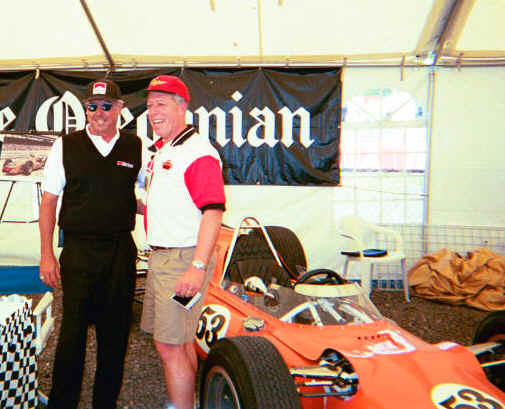
This car has received an immaculate and extensive 5 year restoration by Ralph Zbarsky, the car currently lives in CANADA. It was a centerpiece display at the 1998 Vancouver Indy. Below is a picture of Ralph with famous Indy racer, Rick Mears at an event in Portland, Oregon.
Click here for info on obtaining a piece of this famous car.
