 |
| Supra History |
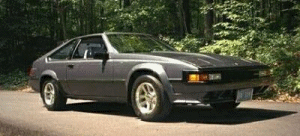
| In 1982 the second generation of the Celica Supra is introduced. This time around they concentrated on the car's performance and handling. It now had a 2.8-liter DOHC (dual-overhead-cam) 6-cylinder that produced 145 horsepower. It also visually separated the Celica with its restyled front and disappearing headlamps, a long power bulge hood and a slit grill with integrated driving lights. Additional styling included wheel flares, roof-mounted spoiler, and exterior paint schemes. The Supra was also equipped with four disc brakes and an independent rear suspension. |
|
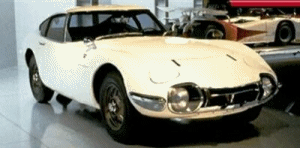
| The 2000GT was first introduced to the public as a prototype in the 1965 Tokyo Motor Show. It was later released to the public in 1967. The 2000GT became the predecessor to the Celica Supra. This car featured a 2.0 Litre inline 6-cylinder, SOHC (single-overhead-cam) engine that produced 150 horsepower. The 2000GT came to be thanks to a collaboration of Toyota and Yamaha. |
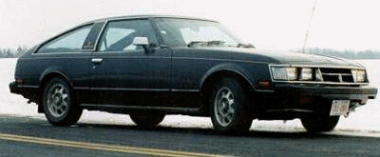
| In 1979, the first Celica Supra was introduced in America. The Celica Supra was basically a Celica whose chassis was lengthened 5.1 inches. The Supra upgrade replaced the Celica's 4-cylinder with a 2.6 Litre SOHC inline 6-cylinder. It also replaced the Celica's solid rear axle with a four-link rear suspension with coil springs, lateral track bar and stabilizer bar. To make it look different from the Celica, the Supra had a longer wheelbase, a wide "B" pillar, a unique grill that was styled after the 2000GT, and the Supra badging was added. |
 |
 |
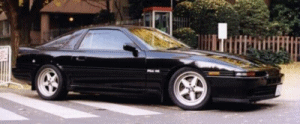
| In 1986.5 the Supra and Celica officially separated. The Celica became a front wheel drive sport economy car, while the Supra evolved into a true, rear-wheel drive, sports car. The Supra was introduced with a 3.0 litre inline 6-cylinder engine producing 200 horsepower. The Supra became the showcase for Toyota technology. 1987 was the first year that the Supra offered a turbo. The car was dubbed or called the Supra Turbo. This high-performance car featured a turbocharger and an intercooled inline 6-cylinder engine that produced and incredible 232 horsepower. This was also the first year that ABS (Anti-lock Brake System) became available. From 1987 to 1992, not much of the Supra changed except for subtle changes to the rear lights and front bumper. |
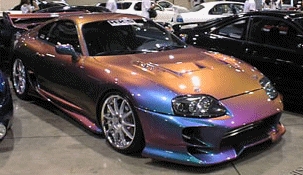
| In 1993, the fourth generation Supra was introduced with the choice of two powerful engines both the turbo and naturally aspirated engines. The new Supra became a true sports car. The new non-turbo engine is a 24-valve inline 6-cylinder developing 220 horsepower. This is incredible considering that it's almost as much as the turbocharged third generation Supra. The new turbo model featured twin sequential turbochargers and an air-to-air intercooler that produces a whopping 280 horsepower. |
 |
 |
| MKIV SUPRA 1993-99 |
| MKIII SUPRA (1986.5-1992) |
| MKII SUPRA (1982) |
 |
| MKI SUPRA (1979) |
| TOYOTA 2000GT GRANDFATHER OF THE SUPRA |