Private End-User
consumer mode
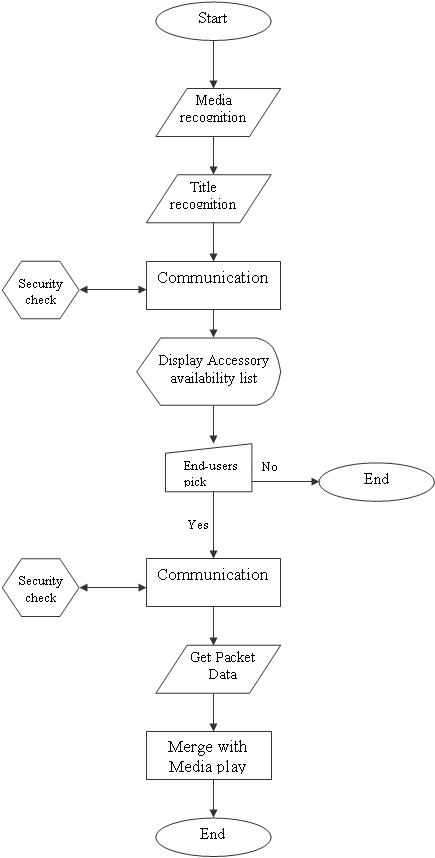
Fig. 6
Field of the invention
The present invention is
in the area of multimedia-networking apparatus and methods, and pertains more
particularly to multi sharing of multimedia information for video end-users,
such as subtitle exchanges and the like.
Background of the
invention
With continuing development
of multimedia systems (TV’s, DVD’s, VCD’s, etc...) and communication channels
(Satellites, Cables, Internet, atc...), more media is coming to the end users
from large variety of sources, where many of them are not useable to common
users, due to communication gaps in, for example, localisation of languages.
There are some efforts done
by local media providers to bridge the gap, by providing some additional
features, such as language selection options, but these efforts are all very
limited and not sufficient to answer all users needs.
The internet network
became in recent years obtainable almost every where - world wide, where many
applications communicate using phone line, cable line or even satellite
channel becoming connected to the network. There are also private networks that
are completely under the control of their owners, such as cable networks, a/v
distribution networks in hotels, educational and other institutions.
Most Internet
applications are based on some kind of computerized platform, which many people
find, complicated to operate, yielding a significant reduction in the network
usability.
So, concluding the above
points, we get that there’s a worldwide growing need for multimedia –
communication system bridging over communication gaps to the common users (such
as language localization gaps). The system can use the IP protocol as a channel
for information flow, providing that the application maintains its simplicity
of use.
SUMMARY OF THE
INVENTION
The current invention
presents apparatus and method, providing worldwide multimedia end users, with
the ability of exchange and share multimedia information (such as movie
subtitles), using an IP network (such as the Internet) as the communication
channel, and an information center (such as a dedicated site or peer to peer
network) - providing an endlessly growing resource.
The invention involves
aspects of hardware, software, multimedia formats, communication formats and
copyrights licensing issues, all should be taken care separately in the final
application’s business model.
The current invention
involves a virtual information center, where multimedia information is
continuously being added to the center database, coming from end users –
worldwide and/or from the network administrator.
All users are connected
to the center via the network, where an end user application (hardware or
software means) is given in order to enable the multimedia end user to connect
the center, with no particularly knowledge (transparency in connectivity). This
end user application may be hosted near by the end-user at an intermediate unit
or be hosted on a remote computer and multiplexed between a number of
subscribers.
The multimedia end user
is capable of uploading his new information to the information center (sharing
it with other users), as well as downloading existing information for its own
use.
The system is divided
mainly into two layers: the network layer, and the end user layer.
As described hereinabove,
the network layer may provide end users with the ability to communicate with
the multimedia information center.
The multimedia
information center is a virtual multimedia database resource(s), giving one
large united library of audio, video, news, advertising and other resources.
The information center is
assembled from a resource memory block, which stores the multimedia
information, a filtering block that filters incoming, an outgoing information, a
security block providing protection to the information and a management program
that organizes the information.
The end user layer
provides a connection between the network layer and the end user multimedia
system.
The end user layer
application can be established by: software means only (for personal computer
platforms), or a combined hardware-software means (for use with multimedia
platforms –TV, DVD, etc..).
The end user layer is
assembled from a data store memory block, communication block, synchronization
block, multimedia interface block and a controlling block.
The system supports two
modes of operation, upload where the end user acts as a provider, and download
where the end user acts as a consumer.
BRIEF DESCRIPTION OF
THE DRAWINGS
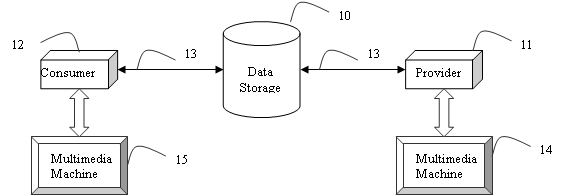
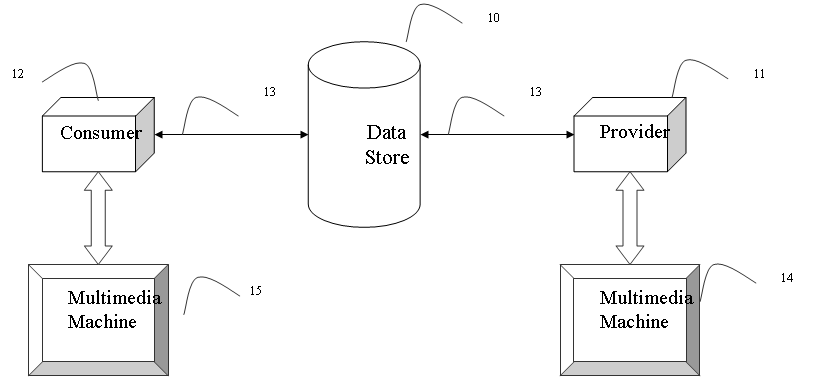
FIG. 1 is a block diagram
of the network layer, showing the main blocks and their interconnections.
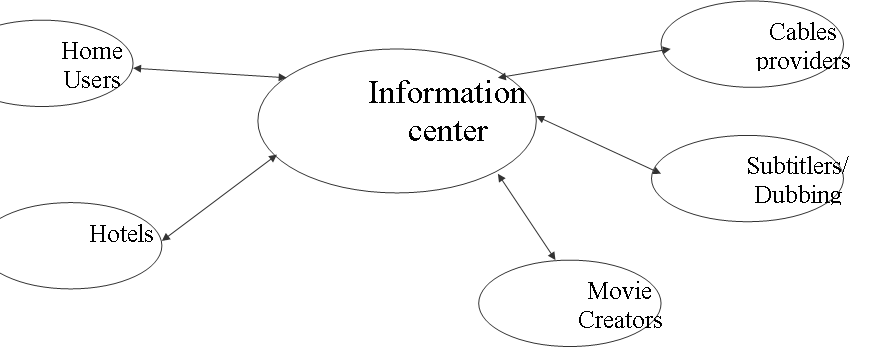
FIG. 2 is a top-level application
demonstration for the system providers / users.
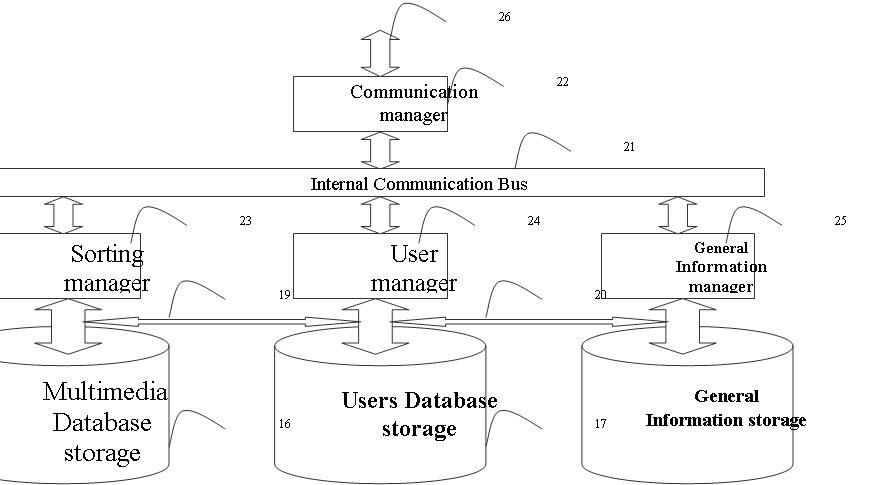
FIG. 3 is a block diagram
of the information center system.
FIG. 4 is a block diagram
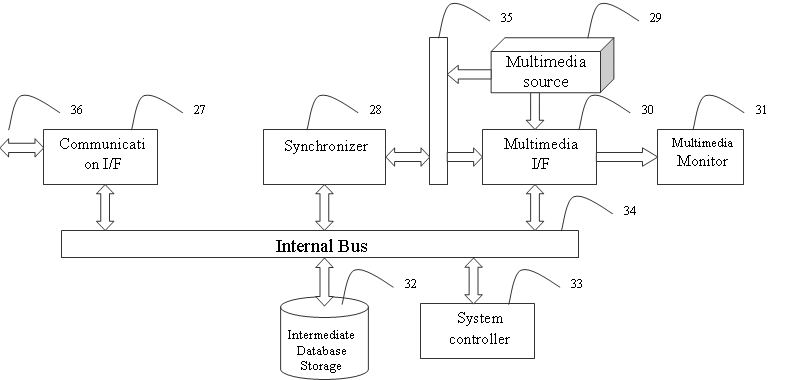
of the end user system.
FIG. 5 is a flow chart
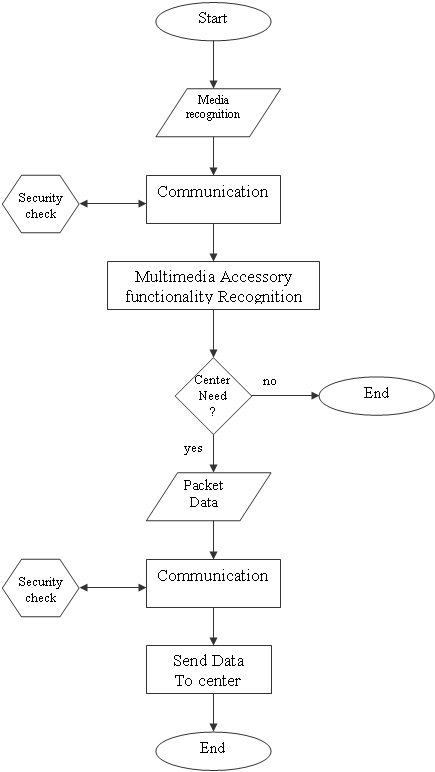
demonstrating end users operational states at provider mode.
FIG. 6 is a flow chart
demonstrating end users operational states at consumer mode.
DESCRIPTION OF THE PREFERRED
IMPLEMENTATION
The network system,
presented in FIG. 1 comprises two channels, demonstrating the network
capabilities, one channel 11 providing multimedia information to the
information database center 10, and another channel 12 consuming multimedia
information from the information database center. Both communication channels
13 are globally spread bi-directional, providing a virtual connection between
multimedia machines 14.
As seen in FIG. 2, the
provider / consumer can be from sources such as private end users, cable
providers, movie makers, hotels, translation companies etc.
The information center
shown in FIG. 3, comprises three levels of hierarchies, the communication,
management and storage levels.
The communication level
is managed by a communication manager, 22, that receives / transmits outside
information through the communication broadband channel, 26, and pass it to /
from local communication BUS 21, it is also responsible for security.
The management levels
sort and control the information into the storage level, where three kinds of
information are managed and stored: Multimedia 16, Users 17 and General information
18.
The sorting manager 23
manages the multimedia storage, the user manager 24 manages the users database
storage 17, and the General information manager 25 manages the General information
storage 18.
Internal buses 19 and 20
provide linkage between the database information.
The end user intermediate
sub-system presented in FIG. 4, comprises a communication interface 27, which
receives / transmit information through communication line 36.
An internal bus 34 pass
the information to / from the Intermediate database storage 32.
The system merges the
multimedia informations with the multimedia source, 29, through the multimedia
interface, 30, which is connected to the users multimedia monitor, 31.
The synchronizer, 28,
synchronizes the multimedia merging process.
The system controller,
33, manages the end user sub-system.
The end user sub system
is capable of working in two modes, the first one is the providing mode
presented in FIG. 5
The providing mode
enables the end user to globally share his multimedia information, by passing
it to the information center.
After Start State
the system goes into media Recognition
State, which identifies
the present media, and prepares the system for the correct operation. Then the
system goes into Communication
State, which checks for
security handshake.
After passing the Integrity State,
the system goes into the multimedia accessory functionality Recognition State,
which identifies the media source characterization.
After the
characterization process, a query is being sent to the information center,
whether the information is required, NO ends the process, YES answer brings the
system into the packet state which packs the information and send it to the
information center.
The second mode is the
consumer mode presented in FIG. 6.
This mode enables the end
user whose using a multimedia source, to enhance his capabilities, by merging
multimedia information, provided by the information center, with his own
multimedia source information.
The first two states are
identical to the providing mode, starting and media recognition passing through
title recognition and into the communication states. After passing those states
the system provide the end user with optional enhanced multimedia capabilities
provided by the information center.
Some kind of MMI is being
used in order to enable the end user choose his preference easily.
After a choice has been
made the packed information is transferred to the end user intermediate memory,
in the communication and the get packet data states.
Then the additional
multimedia information is being merged with the media source play.
Without any addition to
above-described apparatus and method, any combination of the systems parts and
modes can be used for variety of applications.
Claims
1. Apparatus and method for
providing global share of multimedia information (MI), between multimedia
end-users, comprising:
(a)
Multimedia source (MS) used by an end-user (such as Video
source).
(b)
End-users are enabled to operate at provider and/or customer
mode for MI.
(c)
End-user stores/gather the required MI at an End-User sub
system.
(d)
End-users are enabled to send/receive MI to/from a multimedia
information center.
(e)
End-users communicate with multimedia information center via
communication network.
(f)
The multimedia information center gathers and accumulates MI,
providing it to be globally shared.
(g)
End-User sub system unit provides a merge of multimedia
information center’s MI with the end-users MS information.
2. Apparatus and method as
in claim 1, comprising two layers, Network Information (NI) layer, and End-User
(EU) layer.
Where NI layer provides global share of multimedia information and the EU layer
provides the end-user to merge the required multimedia information downloaded
from the NI layer, with his private multimedia source. The EU layer also
provides a mode for Uploading multimedia information to the NI layer to be
stored for global share.
3. Apparatus and method as
in claims 1 and 2, includes multimedia NI layer, comprising:
(a)
Multimedia database.
(b)
Communication network for MI transportation.
(c)
Dedicated protocols, providing internal and external layer
communication.
4. Apparatus and method as
in claims 1 and 2, includes end-users layer, comprising:
(a)
Communication interface unit, connected to NI layer and
transporting information between layers.
(b)
Intermediate storage unit, provides storage capabilities for
the supplemented MI.
(c)
Multimedia interface unit, provide merge process between the
supplemented MI and the end-user MS information.
(d)
Synchronization unit, which synchronizes the multimedia
interface unit according to the end-user MS.
5. Dedicated system as in
claims 1-3, that functions as a multimedia information center, comprising:
(a)
Communication manager unit, provide send/receive information
to/from a communication network.
(b)
Storage unit provides for MI, EU information and
general-purpose information storage.
(c)
Internal managing units that organize, sort and order the MI
for quick fetch.
6. Apparatus and method as
in claims 1-5, that provide the End-User sub system working at two modes of
operation: provider mode and consumer mode for MI.
Where provider mode enables the end-user to send multimedia information
(gathered by the End-User sub system), to the multimedia information center.
Consumer mode enables the end-user to receive MI from the multimedia
information center and merge it with his private MS.
7. Protocol as in claims
1-6, enables the MI transportation between NI and EU layers and internally in
each layer.
8. Application as in claim
1, with the use of systems as claims 2-7, for providing distribution of movies
subtitles (multi-language capability) to/from multimedia information center and
End-User sub system and merging it with the end-user video source.
9. Application as in claim
1, with the use of system as in claims 2-7, for separation classification and
transportation of subtitle file, from end-user video source to multimedia
information center.
10. Application as in claim
1, with the use of system as in claims 2-7, comprising:
(a)
Sampling subtitle information from video source.
(b)
Storage of the subtitle information at an intermediate
storage.
(c)
Merge of the stored subtitle information with another
end-user’s video source.
11. Application as in claim
1, with the use of systems as claims 2-7, for providing distribution of movies
dubbing (multi-language capability) to/from multimedia information center and End-User
sub system and merging it with the end-user video source.
12. Application as in claim
1, with the use of system as in claims 2-7, for separation classification and
transportation of dubbing file, from end-user video source to multimedia
information center.
13. Application as in claim
1, with the use of system as in claims 2-7, comprising:
(i)
Sampling dubbing information from video source.
(ii)
Storage of the dubbing information at an intermediate storage.
(iii)
Merging of the stored dubbing information with another
end-user’s video source.
14. Application as in claim
1, with the use of systems as claims 2-7, for providing distribution of movies digital
audio features to/from multimedia information center and End-User sub system and
merging it with the end-user video source.
15. Application as in claim
1, with the use of system as in claims 2-7, for separation classification and
transportation of digital audio features file, from end-user video source to multimedia
information center.
16. Application as in claim
1, with the use of system as in claims 2-7, comprising:
(i)
Decoding digital audio features information from video source.
(ii)
Storage of the digital audio features information at an
intermediate storage.
(iii)
Merging of the stored digital audio features information with
another end-user’s video source.
17. Server based application
for A/V cable networks capable of joining 2 or more sources of input to be sent
to requesting Multimedia Clients. Operating in a similarly manner to 1, but
client functionality is held centrally and remotely.