MEETING THE WORLD CHALLENGE
Toyota in Australia has come a long way in the past decade. From a loose-knit
group of manufacturing, importing, distribution and sales operations in the
1980s, today's Toyota Australia is a united and powerful force in the nations'
automotive industry.
With over three decades of local car production behind us, we are now developing
a new role - competing in the global market. Following the commissioning of
our $420 million, state-of-the-art car plant at Altona, Melbourne, in 1995,
we are emerging as one of Toyota Japan's global manufacturing and export centres.
Our overseas markets are expanding significantly with regular shipments of Altona-built
cars and components to countries in the Middle East, South-East Asia and Oceania.
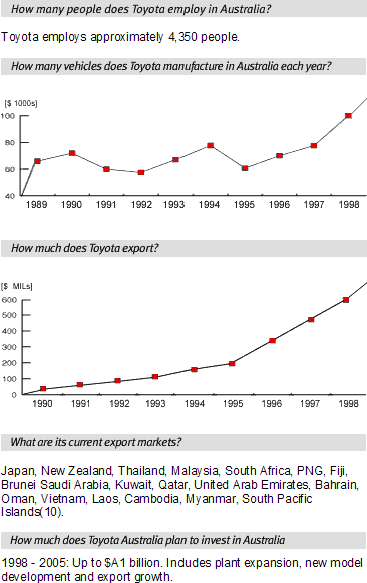
At the turn of the century, Toyota Australia's export revenues totalled over
$600 million a year and accounted for one-third of the Altona plant's production.
The success of Toyota Australia in both the domestic and export markets reflects
our pursuit of world best practice and our commitment to satisfying our customers
in every market in which our products are sold. We call it "Meeting the
World Challenge".
ABOUT TOYOTA AUSTRALIA
Toyota Australia represents the successful marriage of Australian and Japanese
expertise in high quality motor vehicle manufacture and marketing.
The company's Head Office and manufacturing operations are located in Melbourne
while its Sales and Marketing activities are Sydney-based.
Toyota Australia's world-class Altona plant in Melbourne produces the Vienta,
Camry and Corolla car ranges. These vehicles make extensive use of locally-produced
components and enjoy a fine reputation for reliability, durability and economy.
In addition to its locally-built models, Toyota imports a variety of cars from
Toyota Motor Corporation of Japan.
These include Celica, MR2, and the luxury Lexus LS430 and ES300. The Lexus models,
designed and built to compete with the best the world automotive industry can
offer, are marketed under their own brand name.
Toyota also imports Australia's best-selling range of commercial and four-wheel-drive
vehicles including LandCruiser, Prado, HiLux, RAV4, HiAce, TownAce, Tarago,
Dyna and Coaster models.
In addition, Toyota imports and distributes the Toyota Industrial Equipment
range of products, including forklifts, skid-steer loaders and towing tractors.
The Altona plant began production in July 1994 and was commissioned officially
in March 1995. The investment demonstrates Toyota's long term commitment to
car manufacture in Australia and is part of the company's strategy to be internationally
competitive and develop substantial export markets.
TOYOTA PRODUCTION SYSTEM
Quality and productivity are themes central to the advancement of the internationally
recognised Toyota Production System (TPS).
TPS is the means by which Toyota achieves Total Quality Control (TQC) together
with the Toyota Management System (TMS) which permeates the entire organisation.
TPS engenders job satisfaction by providing all employees with the opportunity
to exercise judgement and creativity. Working in teams, employees have responsibility
and authority to design their own jobs to smooth production flow, raise quality
or to improve working conditions.
Key aspect of the TPS are:
JIDOKA
The principle used at Toyota to build in quality. Jidoka is giving machinery
or equipment human-like intelligence so that if a defect occurs, the equipment
will stop automatically. The principle of Jidoka allows team members to stop
the production line for quality problems. Defects must not be passed on, ensuring
quality is built in at every stage of production.
JUST-IN-TIME
Our primary goal for Just-In-Time production is to translate each order to a
finished quality vehicle quickly and efficiently. To do this, model types and
variations are spread evenly over the day. Only small quantities of material
are kept on production lines with the replacement of only those items used in
the right amount, at the right time controlled by kanban.
STANDARDISED WORK AND KAIZEN
Standardised work is best defined as procedures and standards of work established
by supervision at the worksite. Kaizen is the quest for continuous improvement.
All employees are encouraged to contribute ideas for improvement, recognising
that the people who perform the job are best equipped to find ways to improve
it.
Quality Circles and the Suggestions Scheme are ways in which team members can
be involved in the kaizen process. Quality Circles support development of individuals
with training in problem solving, team building and leadership skills. The Suggestion
Scheme encourages creativity and implementation of ideas (no matter how small)
with cash and other rewards as benefits of participation.
Toyota Australia encourages, promotes and provides training on the Toyota Production
System throughout the organisation and to component suppliers.
BUILDING A CAR AT TOYOTA
Production of a new vehicle at the Toyota Altona plant is a complex series of
interactive processes involving people (team members) and robots.
The production line begins with the manufacture of major components in the engine
and body stamping shops, and ends at the assembly shop where finished products
roll off the line. From the body shop to the assembly shop, the production line
is more than four kilometers long, passing between each facility via enclosed
conveyor bridges. The stamping shop produces the sheet metal panels and parts
that make up the basic structure of the vehicle. The next step is the Body Shop
where the metal components are welded together to form the body shell. The sub-assembly
process and fully automated jig line involve around 80 robots as well as manual
input.
Then comes the paint shop, where the bodies pass through a process for corrosion
protection before entering booths where a combination of manual and robot spraying
techniques is used to apply the many layers of polyester finish. The painted
shells then transfer to the assembly shop where engines and transmissions, suspension
and braking systems and interior trim and components are fitted.
After final checks including water-sealing and driveline function, the finished
vehicle is then ready for delivery.
ENGINE PLANT, PRESS PLANT & FOUNDRY
Toyota Australia produced its first locally assembled engine on the
Altona site in October, 1978. The engine shop produces the high-technology,
overhead camshaft multi-valve four cylinder engines used in Camry and Corolla
models. The engines range from 1.6 litres to 2.2 litres and offer state-of-the-art
levels of performance, economy and exhaust emissions. Almost 1,000,000 engines
have been produced at the plant since 1978.
The engine plant preceded the stamping (press) shop set up in 1981. The facility
was expanded during the 1980s to maintain its position as a world-class manufacturing
facility and keep pace with Toyota's growth in domestic and export markets.
Together with the existing alloy foundry that forms part of the original complex,
the engine and stamping shops now are fully integrated with the new Altona body,
paint and assembly shops.
Engines produced at the Altona plant are exported to South Africa and New Zealand,
while locally manufactured alloy castings are shipped to Japan.
Inventory Management Helps Auto Supplier Withstand Pricing Pressures
Toyota Australia Licenses BEA For Supply Chain application
Toyota Australia Licenses BEA For Supply Chain application
By InternetWeek.com
Toyota Australia has licensed BEA Systems's integration platform to connect
Toyota and its trading partners electronically to improve supply chain performance.
Toyota chose BEA WebLogic Integration 8.1 for the project because of the software's
support for open standards and its strong implementation of the Java 2 Enterprise
Edition, a platform for running and building applications, officials with both
companies said this week.
Toyota's eBusiness Transformation Program calls for all integration to be carried
out via web services interfaces built with WebLogic Integration 8.1. The carmaker
is looking to use web services in place of proprietary technologies.
Inventory Management Helps Auto Supplier Withstand Pricing Pressures
By Antone Gonsalves
Costly incentives are the sales engines keeping U.S. carmakers from making a
pit stop.
Rebates and 0 percent financing bring buyers to showroom floors, but they also
tap the brakes on profits. Despite these efforts, industry experts expect U.S.
sales of new cars and light trucks this year to total about 16.3 million units,
a decline of 2 percent from last year.
While that sales level isn't bad historically, it represents the third year
of decline since the record 17.35 million units sold in 2000. Squeezing profits
further is the loss in market share to foreign competitors. In 2002, Detroit's
portion of U.S. auto sales shrank to 62.8 percent, from 64.5 percent in 2001
and 66.8 percent in 2000, according to Global Insight Inc.
Under these conditions, raising prices is not an option. So when carmakers cut
costs to increase profit margins, so do their suppliers.
Metaldyne Inc., a Plymouth, Mich., manufacturer of engine and chassis components,
is looking to inventory-management technology and a Japanese manufacturing method
called Kanban to meet carmakers' demands for lower prices.
Kanban, a Japanese term for "visual record," was developed at Toyota
Motor Corp. in the 1950s to manage the flow of material to the assembly line
in such a way as to reduce inventory. Storing and maintaining supplies is a
huge expense for manufacturers. As a process, Kanban is part of a just-in-time
production system in which the movement of goods during manufacturing and deliveries
from suppliers are carefully timed, so that parts arrive as close to when they're
needed as possible.
Metaldyne is working with manufacturing software vendor QAD Inc. to give a high-tech
spin to the Japanese process. Eagle Consulting and Development is providing
bar-code readers.
The auto supplier, which has annual sales of more than $1.5 billion, uses QAD
software now to publish its inventory levels on the Internet. Called Supply
Visualization, the QAD-hosted software regularly polls Metaldyne's inventory-management
system and extracts data. Software from QAD and J.D. Edwards powers Metaldyne's
enterprise-resource planning system.
With Supply Visualization, suppliers can fill purchase orders and record when
the parts will arrive at Metaldyne. The software also shows inventory amounts
so suppliers can avoid falling below a minimum level.
"If the quantity falls into the red, it's the supplier's responsibility
to send us parts or call our production planner if there's a problem,"
said Ed Witkow, supply-chain director at Metaldyne.
At its Royal Oak, Mich., facility, Metaldyne is getting ready to test whether
it can take Supply Visualization closer to a customer's assembly line, combining
Kanban with the software's ability to post data on the Internet quickly.
Under the Kanban system, parts are taken to the assembly line in boxes as they
are needed, eliminating the need to store parts in the production area. Starting
in March, or possibly April, boxes of Metaldyne parts sent to customers will
be scanned as they leave the customer's "supermarket," which is a
kind of mini-warehouse that directly feeds the production line.
Metaldyne will use the QAD software and the Kanban bar code reader to monitor
the amount of parts in the supermarket, replenishing when the number reaches
a specified level. "With this system, the customer isn't overstocked,"
Witkow said. "However, I need to account for the time it takes to ship
parts to the assembly plant. It takes a supply chain that's communicating properly."
The communication link is the QAD software. When Metaldyne logs on to the site,
the QAD server will query a PC at the customer site that has the latest inventory
figures. The data is encrypted and sent over the Internet via extensible markup
language, or XML, using HTTPS. QAD software supports certificate-based SSL security.
Besides reducing the amount of inventory needed in the production area, the
e-Kanban system also has the potential of reducing the number of purchase orders
moving between supplier and manufacturer. Purchase orders are oftentimes created
when parts are replenished. Under the system in development, a manufacturer
can pay only for the parts used.
Metaldyne expects the test to take between 30 and 60 days. QAD plans to offer
the same capability to other manufacturers by April. From using Supply Visualization,
alone, Metaldyne has been able to convert 6,000 square feet of inventory storage
in its Hamburg, Mich., plant into additional production lines.
It's too early to tell whether Metaldyne will be able to use the e-Kanban system
in the 50 facilities it has in a dozen countries. But whether it's e-Kanban,
or some other process, Metaldyne will have to continue to cut costs to satisfy
carmakers and other customers. "We have to make sure we're running a smooth
production line on our end, rather than working at an emergency level,"
Witkow said. "The whole concept is to try and smooth out your manufacturing
operation."