Adult
VCE
VCE, Arts and Preparatory Department
Nicholson Campus
VCE Year 12
Accounting
Introduction
Course Outline
Assessment
Feedback/Consultation
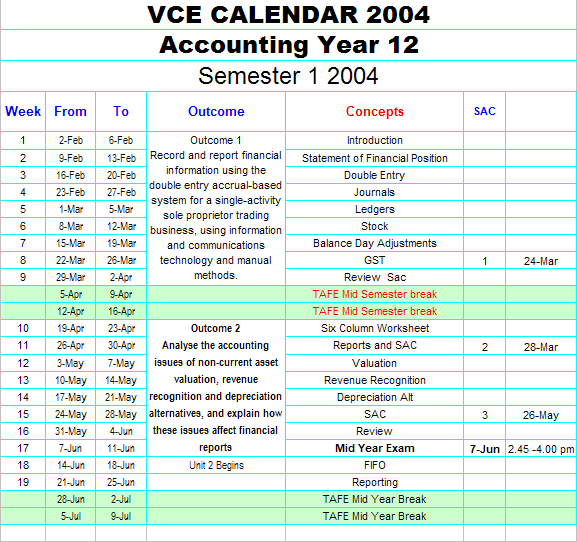
Timeline
This information may be accessed online:
http://au.geocities.com/mytutor9
Teacher
Susheel Chand (Bachelor of Business, Master of Professional Accounting, Grad Cert TT)
VCE Accounting
Objective:
Completion of this study will enable students to participate effectively and responsibly in a changing business environment and provide information and skills useful to the management of personal finances.
Structure:
The study is made up of four units
|
Level |
Units |
Area of Study |
No. Learning Outcomes |
Semester |
|
Year 12 |
Unit 3 |
Double Entry for a Trading Business |
2 |
1 |
|
Unit 4 |
Planning, Control and Decision Making |
2 |
2 |

Year 12 –
Units 3 and 4
Unit 3: Double Entry for Trading
Business
Outcome 1
On completion of this unit you
should be able to record, report and explain the financial information using
double entry accrual-based system for a trading business of a sole proprietor,
using manual and information and communications technology methods.
Outcome 2
On completion of this unit you
should be able to analyse the accounting issues of non-current asset valuation,
revenue recognition and depreciation alternatives, and explain how the issue
affects financial reports.
Unit
2: Planning, Control and Decision Making
Outcome 1
On completion of this unit you should be able to record, report using double entry accrual-based system of accounting; and prepare budgets and analyse budget variances to faciliatate planning and control using manual and ICT methods. a
Outcome 2
On completion of this unit you should be able to select and use financial and key performance indicators to evaluate business profitability, liquidity, stability and efficiency to assist in making business decisions to improve the business’s profitability and liquidity.
Assessment
The award of satisfactory completion for a unit is based on a decision that the student has demonstrated achievement of the set of outcomes specified for the unit. This decision will be based on the teacher’s assessment of the student’s overall performance on assessment tasks designated for the unit.
At the Completion of a unit student’s result will be reported as:
“S’ - Satisfactory. You have demonstrated the achievement of the learning outcomes
Or
‘N’ - Not Satisfactory. You have NOT demonstrated the achievement of the Outcomes
Assessment of
Levels of Achievement
Levels of achievement would be determined by:
School-Assessed Coursework (SAC),
Mid Year Exam and End-of -Year Exam.
Contribution
to Final Assessment
|
Assessment |
Marks |
|
SAC Unit 3 |
17% |
|
Mid Year Exam |
34% |
|
SAC Unit 4 |
17% |
|
End of Year Exam |
34% |
|
Total |
100% |
The VCAA will report your achievement for each set of assessment as a grade from A+ to E or UG (ungraded). Finally VCAA will report your overall achievement as a Study Score. Your study Score shows your level of achievement relative to the achievement of all students who took the study.
|
Study Score |
Percentage of Students above this position (approximate) |
|
45 |
2 |
|
40 |
8 |
|
35 |
24 |
|
30 |
50 |
|
25 |
76 |
|
20 |
92 |
Exams: Exams are prepared and conducted by the VCAA.
School Assessed Coursework
The following will be assessed by your teacher at school. All SAC are done during class time.
Unit 3
|
Outcomes |
Assessment task |
Marks |
|
Outcome
1 Record
and report financial information using the double entry accrual-based system
for a single-activity sole proprietor trading business, using information and
communications technology and manual methods. |
A
task involving the recording and reporting of 20 transactions, including
appropriate adjustments, using double entry computer software. |
30 |
|
Structured
exercises requiring the recording and reporting of financial information. |
30 |
|
|
Outcome
2 Analyse
the accounting issues of non-current asset valuation, revenue recognition and
depreciation alternatives, and explain how these issues affect financial reports. |
A
case study involving analysis and evaluation of accounting issues and their
affect on the financial performance and financial position of the business. |
40 |
|
|
|
100 |
Unit 4
|
Outcomes |
Assessment task |
Marks |
|
Outcome
1 Record
and report using the double entry accrual-based system of accounting; and
prepare budgets and analyse budget variances to facilitate planning and
control using manual and information and communications technology methods. |
Structured
exercises involving the manual recording of transactions, including
subsidiary records for debtors or creditors and stock. |
30 |
|
Structured
questions on budget preparation from the established data of a trading
business, using ICT methods. A written response which analyses the financial
decision making of the business and which explains the variances after the
actual figures are established. |
30 |
|
|
Outcome
2 Select
and use financial and key performance indicators to evaluate business
profitability, liquidity, stability and efficiency to assist in making
business decisions to improve the business’s profitability and liquidity. |
A
written response to a problem relating to the evaluation of business
performance using financial reports and key performance indicators. The evaluation
should provide advice on ways to improve the profitability and liquidity of
the business. |
40 |
|
|
|
100 |
Text Book (Prescribed)
Box., Neville, VCE Accounting
Units 3&4, Third edition,
MacMillan 2002
Other Materials: HB pencil, eraser, Calculator, Lecture Pad and Folder, Access to a Computer with MS Word and Excel.
Consultation/Feedback/Ongoing
Contact
Outside class time, the teacher may be contacted by the following means:
|
|
|
Response Time |
|
Phone: |
92848726 (Staff
Room) |
When Available (Check T/table) |
|
Email: |
Less than 24 Hours |
|
|
Online: |
Query Form on website |
Less than 24 Hours |
|
In Person: |
Time as agreed |
As Agreed |
Marked Assignments/SAC Returned in class – Second class after Due date.