Jimi Hendrix
Born James Marshall Hendrix in Seattle, Washington, November 27, 1942,
Hendrix listened regularly to the work of blues guitarists like Robert Johnson and
Muddy Waters during his adolescence. In 1961 he enlisted in the U.S. paratroopers,
where he met bass player Billy Cox, whose friendship he was to call on in later years.
He was discharged for medical reasons in 1963, and immediately started to earn a living
as a musician. He played in various tours of the South, and at one time backed his
idol, B.B. King. Other temporary gigs included backing Little Richard, Jackie Wilson,
and Wilson Pickett, and for a time he played behind the Isley Brothers. At this time he
used a pseudonym, Jimmy James, and it was while playing under this name, backing
Curtis Knight, that Chas Chandler saw him playing at the Cafe Wha in Greenwich Village.
Chandler was more than impressed, and immediately recognized Hendrix's potential.
He took him back to London, and they auditioned for a rhythm section, which resulted
in the employment of Noel Redding (bs) (who had actually been auditioning for the job of lead
guitar in the rapidly disintegrating Animals) and Mitch Mitchell (drms); the
Jimi Hendrix Experience was formed. They played their first public gig at Paris Olympia.

A one-off single, "Hey Joe", was issued (on the Polydor label) just to test the water.
The Experience appeared on Britain's "Ready Steady Go", and with this boost, the single
reached No. 6 in U.K. charts at the beginning of 1967. Hendrix's impact was an
immediate and a barn-storming one. His amazingly powerful psychedelic blues was the
heaviest rock heard at that time; but Hendrix had everything going for him--he had
supremely cool vocal drawl, dope-and-Dylan-oriented lyrics, the acid dandyism of his
clothes, and the stirring element of black sexual fantasy. (It was significant that
his audience at the beginning was virtually entirely white.)He also played guitar with
his teeth on "Top Of The Pops". By the early summer of 1967, Hendrix's success was
already enormous, through two British hit singles, "Hey Joe" and "Purple Haze", and a
successful debut album, "Are You Experienced?", which was almost an embarrassment of
riches, a blueprint of everything that had suddenly become possible with Hendrix's
scintillating technique, and his indefatigable use of the wah-wah pedal.
Pete Townshend and Eric Clapton were reputedly converts to the cause, and it was at
Paul McCartney's insistence that Hendrix was put on the bill at the Monterey Festival;
though in doing this, McCartney had baulked his own plans for Hendrix to appear in the
"Magical Mystery Tour" film. Hendrix, so sensational in the U.K., was a prophet without
honour in his own country until the Monterey Festival. His performance there made him
a star, as the sheer magnetic force of his presence, and the pyrotechnics of his stage
act (literally)became common knowledge throughout the U.S. rock audience. The Hendrix
charisma was growing so fast, publicity soaring to the point of being thrown off the
Monkees tour (as opening act) because his act was too outrageous, thus opening the
door to his most successful year, 1968. That year featured sell-out tours everywhere he went,
and two gold albums--"Axis: Bold As Love" and "Electric Ladyland". The former had
cut down on the instrumental extravagances, and emphasized Hendrix the songwriter;
the latter was an extravagant double album featuring star guests like Al Kooper,
Steve Winwood, Buddy Miles, and Jack Casady.
The album also spawned
"Voodoo Chile" that became a posthumous No. 1 hit single in Britain.
While his stature as a performer and a unique guitar stylist was growing daily,
and he was already the complete superstar, problems were building up around him.
Mounting tensions within the Experience led to their break-up and the Toronto
drug bust in 1969. In July of '69 he had played at Newport, using Mitch Mitchell
on drums, and his old army buddy Billy Cox on bass. In August he appeared at
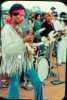
Woodstock, playing what was probably his last definitive set, with a version of
the "Star Spangled Banner" that has passed into the folklore of rock music.
In August, 1970 he played a strange, messy set at the Isle of Wight, and on
September 18th he died in the apartment of Monika Danneman in London.
The official cause of death was inhalation of vomit following barbiturate intoxication,
and an open verdict was returned by the coroner.
Hendrix had been a little under four years in the public spotlight, but in that time
he had extended the boundaries of rock music and revealed himself as the most important
instrumentalist in its history. There seemed no limit to what he could achieve (though
some maintain that his creativity was in decline when he died); he seemed to be moving
into the areas of jazz and avant-garde music. To quote "Rolling Stone": "Hendrix
was the first black performer to take on
white rock 'n' roll head on and win."
|