
The age of the Buddha saw another prince walking away from his palace to become a hermit. After years of meditation and contemplation, the hermit attained perfect enlightenment - the mysteries of the cosmos unfolded before him. He shared his wisdom with the rest of humanity before ascending to his heavenly abode.
The hermit's name was Vardhamana. He lived in the land known today as Bihar. He became renowned as Mahavira, the bravest of the braves who confronted the material world and triumphed over it. He had done something that even the gods could not do. He was therefore greater than the gods, worthy of worship. He was recognized as Tirthankara, the seer who finds the spiritual bridge that takes everyone from the eternal cycle of rebirth.
His words form the foundation of Jainism - the non-violent path of true conquerors. It advocates truth, simplicity, purity and continence.
Jainism, however, is older than Mahavira and the Buddha. It has always existed in the cosmos, revealing itself from time to time to the many Tirthankaras who have walked this earth since the dawn of time.
| Digambara | Svetambara | Chakravarti | Vasudeva | Salakapurushas | Tirthankara |
Two hundred years after the death of Vardhamana Mahavira, North India was struck by a great famine. Many Jains emigrated to the south led by the chief pontiff Bhadrabahu. Bhadrabahu died by ritual starvation in the hills of Shravana Belgola. After the famine, which lasted twelve years, the surviving emigrants returned to the North, only to discover that that those who had stayed back in Magadha had changed their ways: the monks had ceased to observe the vow of nudity. As a result Jainism split into two groups – the more austere Digambaras or the sky-clad-ones and the less austere Svetambara or the white-robed-ones.
The Digambaras, who are mainly found in South India, believe amongst other things that:
1.The words of Mahavira were lost forever during the famine as Bhadrabahu
did not teach all the scriptures to his survivor
2. Mahavira never married and had no children.
3. The vow of nudity is mandatory for all monks.
4.Women can never attain sainthood unless they are reborn as men and that
the nineteenth Tirthankara Malli was a man, not a woman as claimed by Svetambaras.
Unlike the Digambaras or the sky-clad-ones, the Svetambaras believe that all Tirthankaras did not take up the vow of nudity. Parsva, the Tirthankara before Mahavira, wore white robes. Mahavira also wore white robes until one day the robe got caught in a thorny bush and was pulled off. Mahavira, who never held on to worldly things, let go and walked on naked. Thus Mahavira's nudity was not consciously adopted.
The Svetambaras who are mainly from North India believe among other things that:
1. The words of Mahavira were not lost during the great twelve-year-famine
of Magadha
2. Mahavira lived a householder's life with wife and daughter until his
parents died
3. The vow of nudity is not mandatory for monks
4. Women can attain sainthood and that the nineteenth Tirthankara Malli
was a woman.
 A
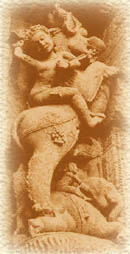
Chakravarti is the emperor of the world, lord of the material realm. Though
he possesses worldly power, he often finds his ambitions dwarfed by the enormity
of the cosmos.
A
Chakravarti is the emperor of the world, lord of the material realm. Though
he possesses worldly power, he often finds his ambitions dwarfed by the enormity
of the cosmos.
One of the greatest Chakravartis mentioned in Jain scriptures is Bharata in whose memory India came to be known as "Bharata-varsha".
After conquering the whole world, King Bharata, brimming with pride, sought to inscribe his great feat on the slopes of Mount Meru. To his great dismay, he found names of many other kings carved on Meru. Like him, they too had conquered the world. He was not the first man to do so. He was not the last. There were many before him, there were many after him. Bharata, humbled by the experience, returned to his kingdom to do his duty, aware that his actions were not unique and that his existence was not special.
 A
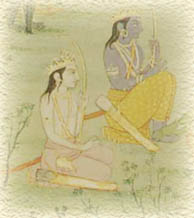
Vasudeva is a hero who appears on earth from time to time to save the world
from the villain Prativasudeva. He is always accompanied by a wiser, older
and gentler elder brother known as Baladeva. The Baladeva upholds the Jain
principle of non-violence. The Vasudeva however forsakes this principle for
the good of humanity as he kills the Prativasudeva.
A
Vasudeva is a hero who appears on earth from time to time to save the world
from the villain Prativasudeva. He is always accompanied by a wiser, older
and gentler elder brother known as Baladeva. The Baladeva upholds the Jain
principle of non-violence. The Vasudeva however forsakes this principle for
the good of humanity as he kills the Prativasudeva.
Two very famous Vasudevas mentioned in the Jain scriptures are Lakshmana and Krishna.
In the Jain Ramayana, the Rakshasa-king Ravana who abducts Sita, wife of Prince Rama of Ayodhya, is killed by Lakshmana. Rama refrains from doing so. By adhering to non-violence, he earns the exalted rank of a Baladeva.
In the Jain Mahabharata, Krishna participates in the great Kurukshetra war supporting the Pandavas against the Kauravas to rid the world of unrighteous kings. He thus becomes a Vasudeva. His elder brother Sankharshana is the Baladeva because he refuses to fight the war, renounces the world and finds release.
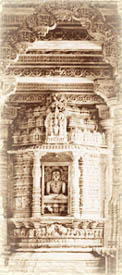 The
cosmos has no beginning or end; it is forever going through alternate cycles
of degeneration and regeneration known as Avasarpini and Utasarpini. In Avasarpini
life on earth worsens while in Utasarpini things improve. So say the Jain
scriptures.
The
cosmos has no beginning or end; it is forever going through alternate cycles
of degeneration and regeneration known as Avasarpini and Utasarpini. In Avasarpini
life on earth worsens while in Utasarpini things improve. So say the Jain
scriptures.
In each cycle there appear 63 worthy beings known as Salakapurushas. These include:
1. 24 Tirthankaras or spiritual leaders who enlighten all beings
2. 12 Chakravartis or temporal kings who rule over the earth
3. 9 triads of heroes (27 in all), each triad comprising of a gentle hero
called Baladeva, a violent hero called Vasudeva and a villain called Prativasudeva
A study of these worthy beings enables one to understand, absorb and assimilate Jain teachings in one's life.
A Tirthankara or bridge-finder is a wise seer who rediscovers the Jaina way. To the Jains, he is greater than the gods because he transcends the laws of Space and Time.
Actions or karma are responsible for ensnaring the soul in the flesh and for entrapping all beings in the material world. The Tirthankara provides all creatures with the means to liberate the soul from the confines of the body and to rise towards bliss, enlightenment and release from the eternal cycle of rebirth.
He advocates continence, truth, non-violence, simplicity and purity for those who seek liberation.
In every cycle of existence there have been 24 Tirthankaras, each one a prince, each one represented by a symbol, served by a Yaksha and a Yakshi.
The following were the Tirthankaras of the present cycle of existence:
|
Tirthankara
|
Symbol
|
|
Vimala
|
Boar
|
|
Ananta
|
Hawk
|
|
Dharma
|
Thunderbolt
|
|
Santi
|
Antelope
|
|
Kunthu
|
Goat
|
|
Ara
|
Fish
|
|
Malli
|
Jar
|
|
Suvrata
|
Tortoise
|
|
Nami
|
Blue lotus
|
|
Nemi
|
Conch-shell
|
|
Parsva
|
Serpent
|
|
Mahavira
|
Lion
|
|
Rishabha
|
Bull
|
|
Ajita
|
Elephant
|
|
Sambhava
|
Horse
|
|
Abhinandana
|
Ape
|
|
Sumati
|
Partridge
|
|
Padmaprabha
|
Lotus
|
|
Suparsva
|
Swastika
|
|
Chandraprabha
|
Moon
|
|
Suvidhi / Pushpadanta
|
Capricorn
|
|
Sitala
|
Srivatsa
|
|
Sreyamsa
|
Rhinoceros
|
|
Vasupujya
|
Buffalo
|