
Hinduism is a complex mixture of sublime Vedic philosophies, dogmatic Brahmanical rituals, Yogic mysticism, Tantrik occultism, fertility cults, monastic orders, pagan customs and the belief in one God who manifests as innumerable divine beings.
The oldest text known to Hinduism is the Rig Veda that reached its final form around 1500 BC. For at least 2000 years before that, a great urban civilization existed in North-West India on the banks of the Indus and its tributaries. The sacred motifs of this mysterious civilization – like the bull, the serpent and the swastika – are still part of Hindu worship.
There are many contradictions within Hinduism because Hinduism has tried to assimilate every belief it has come in contact with. Hinduism acknowledges that the Ultimate Truth manifests itself in infinite ways, and the human mind cannot fathom it.
| Way-of-Life | Theism | Philosophy | Ritualism | Mysticism | Paganism | Occultism | Brahmanism | Varna-Ashrama Code | Casteism |
Hinduism is a socio-cultural phenomenon that evolved in the Indian sub-continent and spread to South-East Asia. It does not have a clearly defined God or one dominating philosophy or one holy book or one prophet or one church or one religious hierarchy. The secular and the sacred are not separated. Hence, Hinduism is referred to more as a way-of-life than as a religion.
Some common features of Hinduism are:
1. Reverence for the Vedas
2. Belief in God (Bhagawan, Ishvar) whose is part of the universe, not distinct
from it and who incarnates as innumerable divine beings
3. Adoration of the mother-goddess (Devi)
4. Absence of the concept of evil and the Devil; all negative things in life
are seen as the products of ignorance and lack of awareness
5. Ritualism (yagnas, pujas, vratas, samskaras), including idol, plant, animal,
ancestor and Nature worship
6. Belief in reincarnation and the fatalistic acceptance of present situation
as a consequence of actions performed in the past life (karma)
7. Search for liberation from the cycle of existence through guidance of gurus
or wise teachers
8. Balancing righteous conduct (dharma) with material aspirations (artha),
sensual pleasures (kama) and spiritual pursuits (moksha)
9. Acceptance that there are many means (marga) to reach the divine
10. Caste system (varna, jati)
11. Belief that Hindus are born and are not products of conversion
12. Perceiving the environment, the body and the mind as illusion (maya) and
only the soul (atma) as the True Self that can be identified with the Supreme
Divine Being (brahman)
All Hindus believe in God. However, the definition of God varies. To some, God is an impersonal set of absolute principles. To others, God is a personal entity who has form (saguna) or no form (nirguna). The form can be masculine or feminine, human or animal, animate or inanimate.
Hindus worship many gods but believe all of them to be manifestations of a single godhead. It is said that the impersonal Godhead (brahman) becomes accessible to all by manifesting as a personal god (ishta devata), a household god (graha devata), a family god (kula devata), a village god (grama devata), a cosmic god (param ishwara) and as the soul (atma).
Some gods are enshrined as idols in temples, adored through elaborate rituals and petitioned by devotees. Others are invoked through occult rituals and forced to do man's bidding.
Hindu theism resulted in the "bhakti" revolution that propagated passionate devotion to a personal god as the means to live a materially and spiritually fulfilled life. Depending on the personal god chosen, Hindu theism can be broadly divided into three schools:
Shaivism, based on the worship of Shiva, the ascetic
who transcends Nature.
Vaishnavism, based on the worship of Vishnu, the lord who dispassionately
preserves Natural order.
Shaktism, based on the worship of the mother-goddess, who personifies
the wisdom, bounty and mystery of Nature.
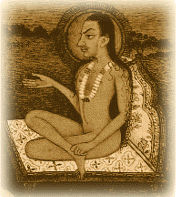 Hinduism
is both world-affirming as well as world-rejecting. Worldly life is appreciated
while liberation from material existence sought.
Hinduism
is both world-affirming as well as world-rejecting. Worldly life is appreciated
while liberation from material existence sought.
According to Hindu beliefs, the cosmos is a manifestation of the Divine. However, life is not merely the product of God's will. It is a series of reactions. Past actions generate the present, just as present actions will generate the future.
One is obliged to experience the rewards and punishments for one's actions (karma), in this lifetime or the next. Thus, the soul is dragged through unending cycles of birth and death (samsara).
There is free will though – the freedom to react to any circumstance.
One who reacts to circumstance builds up his karma and remains trapped in the cycle of life; one who chooses not to react, burns up his karma and is liberated.
For those who choose worldly life, Hinduism prescribes rituals to help live a comfortable life and beliefs to cope with worldly problems.
For those who seek liberation, Hinduism offers philosophies and prescribes practices to break the fetters of material existence.
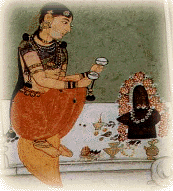 Rituals
are practices through which man attempts to communicate with the universe.
These practices play an important cultural role, as they are common to people
sharing a religious heritage. Through taboos and decrees, rituals unite people.
Rituals
are practices through which man attempts to communicate with the universe.
These practices play an important cultural role, as they are common to people
sharing a religious heritage. Through taboos and decrees, rituals unite people.
Major Hindu rituals require the intervention of priests or Brahmins who are trained to perform it. Minor ones are carried out in private and tend to be more personal and less dogmatic.
1. Pujas
Rituals for adoring, saluting and petitioning the divine. The god is perceived in human terms, housed as an idol in a temple, bathed and bedecked with jewels, offered food, flowers, incense and gifts and entertained with songs and dance.
2. Havan
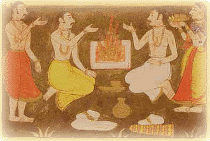
Offerings made to celestial beings of the cosmos through a fire altar to ward off malevolent spirits and usher in benevolent forces. It is a modern derivate of ancient Vedic yagnas.
3. Vrata
Vows and observances taken up mostly by women for the good of the household. Some common practices include fasting, food restrictions, painting of ritual diagrams, all night vigils, bathing in sacred ponds, pilgrimages and charity.
4. Samskara
Sacraments that mark a major event in human life – like birth, tonsure, puberty, marriage and death.
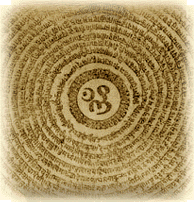 Mysticism
is the belief that there is more to life than just empirical reality. Mystics
look for a 'Higher Reality' that lies beyond the senses. Realization of this
'Higher Reality' (brahman) is said to liberate man from 'Mundane Reality'
(samsara).
Mysticism
is the belief that there is more to life than just empirical reality. Mystics
look for a 'Higher Reality' that lies beyond the senses. Realization of this
'Higher Reality' (brahman) is said to liberate man from 'Mundane Reality'
(samsara).
Samkhya and Vedanta are the theory while Yoga is the practice of Hindu mysticism.
Samkhya states that the world has two realties – the material (prakriti)and the spiritual (purusha). The mind, the intellect, the ego, the body and the world around are products of the material reality, hence impermanent. Beyond these impermanent realities pervades the spirit – permanent, unchanging, serene and sublime.
Vedanta calls the spirit atma. Every individual has a soul called jivatama. This jivatma is in essence a product of paramatma, the soul of the universe, the soul of God. The material world, according to Vedanta is essentially an illusion (maya) that enchants the mind.
Yoga yokes the human mind so that it can realize the spirit without being bewitched by material transformations. Submission to divine will (bhakti yoga), physical mortification (hatha yoga), detachment from results (karma yoga) and intellectual rationalization (gyan yoga) are some of the ways by which the mind can be disciplined.
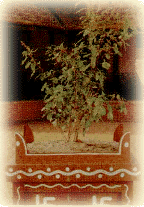 Paganism
is the worship of Nature based on ancient animistic, fetishist and totemic
beliefs. Hinduism has not rejected these practices. These have been adapted,
adopted and assimilated to supplement mainstream religion.
Paganism
is the worship of Nature based on ancient animistic, fetishist and totemic
beliefs. Hinduism has not rejected these practices. These have been adapted,
adopted and assimilated to supplement mainstream religion.
Hindus thus worship plants (Banyan, Tulsi), animals (cows, serpents), mountains (Govardhan, Kailasa), rivers (Ganga, Yamuna, Godavari), stones (shalagrama, pinda, linga) and ancestors (pitrs).
Through these practices, the Hindu acknowledges the sacredness of the universe and the divinity of all animate and inanimate beings.
Occultism is the exploration and exploitation of the mysteries of the cosmos.
Tantra represents the occult side of Hinduism. It originated from primitive fertility cults and exerts great influence on popular rituals and practices.
While Vedanta considers the universe to be maya or illusory, Tantra considers it to be shakti, energy, that can be harnessed and used for material and spiritual benefit.
The occult tools to harness the powers of Nature and unlock the mysteries of the universe include:
Yantras, ritual diagrams that capture universal energies
Mantras, ritual chants that evoke divine spirits
Maithuna, ritual sex that excite dormant powers
Mada, ritual consumption of liquor that destroys inhibitions
Mamsa, ritual consumption of meat that breaks conventional taboos
Mudra, ritual postures that arouse neural networks
 Brahmanism
represents the orthodox side of Hinduism based on the caste hierarchy, patriarchy,
ritualism, vegetarianism and belief in the Vedas.
Brahmanism
represents the orthodox side of Hinduism based on the caste hierarchy, patriarchy,
ritualism, vegetarianism and belief in the Vedas.
Brahmins or keepers of Vedic lore have dominated Hindu society since time immemorial. They performed Vedic yagnas in ancient times and became temple priests in medieval times. They were also interpreters of ritual codes who defined social structure. So powerful were the Brahmins that to kill or tax a Brahmin became the worst sin conceivable in Hindu society.
Brahminism was opposed by Buddhists and Jains, challenged by the egalitarian and non-ritualistic 'Bhakti' revolution, rejected by other-worldly yogis and subverted by Tantrikas
Being highly adaptable, Brahmins managed to make peace with all by assimilating within the framework of Hinduism tribal practices, folk beliefs, yogic mysticism, occult rituals, revolutionary theism, Jain views on non-violence and Buddhist concept of monasticism.
 The
'Varna-Ashrama' code forms the basis of traditional Hindu society that was
laid down by Manu, legendary father of humankind.
The
'Varna-Ashrama' code forms the basis of traditional Hindu society that was
laid down by Manu, legendary father of humankind.
'Varna' involved dividing society into four inter-dependent
groups that contributed to the welfare of society. Society, according to Manu,
was a living organism, the Purusha:
1. The head was made of 'brahmin' or keepers of knowledge
2. The hands were made of 'kshatriya' or keepers of power
3. The trunk was made of 'vaishys' or keepers of wealth
4. The feet were made of 'shudra' or providers of service
'Ashrama' involved dividing the human lifespan into four parts so that man could meet both his material obligations as well as his spiritual needs in one lifetime without burdening society.
1. Bramhacharya, when man prepared himself to be a
member of society.
2. Grihasta, when man fulfilled his social and biological obligations.
3. Vanaprastha, when man retired from society preparing the way for
next generation.
4. Sanyasa, when he worked towards realization of the divine.
 When
the Portuguese came to India, they found every village community divided into
discrete groups. Each group pursued its own unique craft, activity or trade.
Members of one group would not eat with or marry members of another group.
Social contact between groups was limited and hence each group had a culture
of its own. The Portuguese called these groups 'casta' meaning 'clan' or 'race'.
The word 'caste' is derived from this term.
When
the Portuguese came to India, they found every village community divided into
discrete groups. Each group pursued its own unique craft, activity or trade.
Members of one group would not eat with or marry members of another group.
Social contact between groups was limited and hence each group had a culture
of its own. The Portuguese called these groups 'casta' meaning 'clan' or 'race'.
The word 'caste' is derived from this term.
The caste system, endemic to the Indian population, has its origin in the 'varna-ashrama' code of social organization propagated by Manu. Manu divided the society into four groups, each responsible for a specific social chore. In time, the four groups were divided and subdivided into several hundred jatis.
The division led to the creation of a hierarchy, with one group dominating the other. Those who were at the top of the caste-pyramid (priests, noblemen and landowners) enjoyed all the benefits of society while those who were at the bottom (sweepers, tanners and undertakers) were declared 'untouchables' and subjected to inhuman treatment.