
Vili and Ve pretty much disappear. But Odin never disappears. He becomes the king of the gods, a just war god. Only in German and Roman myth do war gods actively urge their people into war and delight in it. Odin is too wise to urge people into war. People are terrified of him. He is looked on with superstitious awe. The battle cry is almost always to Odin.
There is a set of races among deified entities. There were once two different races of gods, but they then merged and lived in peace. (For example, Hera and Zeus both are storm gods and sky gods -- marriage of the matriarchy and the patriarchy.) The Aesir (who live in Asgard) are war gods. The Vanir (who live in Vanaheim) are fertility and agricultural gods -- more peaceful. The two races go to war. Eventually, they decide to call a truce. Usually, some strong symbolism of the truce is needed. Each set of gods lined up and spat into a cauldron, creating Kvassir, the potion of poetic inspiration. (Also, when personified Kvassir is the God of Ultimate Wisdom.) The dwarves steal it at one point. They decide to exchange live-in hostages (emissaries) to guarantee a peaceful existence. The Aesir send Honir, who is tall, handsome, and strong, and Mimir, who is short, unattractive, and smart, to Vanaheim. The Vanir are pleased with Honir who is sensible and gives good solutions to problems. The Vanir go to him for advice. Mimir is called away at one point, and Honir is unable to help them. They are outraged when they realize that Mimir is the brain behind the mouth. When Mimir returns, they decapitate him in anger and send his head back to Odin in Asgard. Odin liked Mimir and by magic brings the head back to life. He places the head next to the well of future knowledge and wisdom. Mimir thus becomes the guardian of the well.
Odin is wild, furious, angry, almost mad with a wild kind of unleashed fury. The All Father, the Val Father (God or Father of the Valiant Dead). He knew he was king of the gods and must rule wisely and with foreknowledge. He first went to Mimir to ask for a drink from the well so he would have foreknowledge. Mimir refused at first. He finally relented but for a heavy price: one of Odin's eyes. So Odin took out a dagger and pried an eye out and threw it into the well. Thus, Odin knows the long-range future. His right eye is missing and he doesn't wear a patch over the socket. Odin also knew that he needed ultimate wisdom. So he took a spear and stabbed himself and hung himself on a tree for nine days as a corpse. At the end of that time, he turned himself back into a god again and had attained the wisdom which he sought. (A possible manifestation of the crucifixion of Christ? The enlightenment also parallels Buddha.) The tree is called the Hanging Tree or the Gallows Tree. From this event comes the phrase "riding the Gallows Tree" which refers to hanging -- sometimes as a sacrifice to Odin. These are the two forms of self-sacrifice Odin had to go through in order to rule well. Annually, toward mid-winter (December), Odin goes out on a hunt with friends (other gods) and dogs. He makes a tremendous amount of noise as he rides across the sky. This is called the Wild Hunt or the Wild Ride. If you see it, you will die. It is good luck to hear it, but a human is never to look upon it. Odin is a vigorous man with a long, grey beard (50-60 years old). He is powerful, with armor and a long cloak. When on Earth, he wears a floppy hat which covers his missing eye. He is a sky god, so the cloak is blue or black. He carries a spear, called the Invincible Spear. He has, as does each god, his own hall with a throne only for him. From there, he can see almost everything, yet he has information brought back to him constantly by the eagle and hawk who sit high in the branches of the World Tree and by two ravens who perch either on his shoulder or on the back of his throne. The ravens are Hugin (Thought) and Munin (Memory). At his feet sit two wolves or dogs. They do not have names. Both wolves and ravens are associated with warfare and death. No mild beings are associated with Odin. He is a fearsome battle god.
Asgard
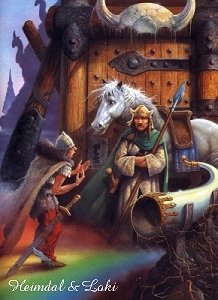 Heimdall
is a god chosen for his talents to be the guard at the gate on Bifrost bridge.
He stands at the gate and is brilliant in white armor (steel armor highly
polished like a mirror). His teeth are gold. He has a great sword. He is a
fierce warrior and very handsome. His talents are that he can see 200 miles
in complete darkness and that he can hear the grass growing. Three gods vied
for the position, but Heimdall's talents secured it for him. Once a giant
made a deal with an air spirit who was to sneak into Asgard to listen to the
Gods' plans and tell the giant. Air spirits are invisible. The air spirit
succeeded and was listening in to Odin and the Gods. Heimdall came in and
said, "I have to resign because I have somehow sensed that something got past
me and I di not stop it." So Odin magically freezes the air spirit, who is
thus nabbed. They force an oath from the air spirit never to come again. And
Heimdall is persuaded to stay at his post. Heimdall carries a sword and the
Gjallar horn.
When a god comes to the gate, he blows the horm softly. If anyone tries to
overwhelm him, he will blast it and get help immediately.
Heimdall
is a god chosen for his talents to be the guard at the gate on Bifrost bridge.
He stands at the gate and is brilliant in white armor (steel armor highly
polished like a mirror). His teeth are gold. He has a great sword. He is a
fierce warrior and very handsome. His talents are that he can see 200 miles
in complete darkness and that he can hear the grass growing. Three gods vied
for the position, but Heimdall's talents secured it for him. Once a giant
made a deal with an air spirit who was to sneak into Asgard to listen to the
Gods' plans and tell the giant. Air spirits are invisible. The air spirit
succeeded and was listening in to Odin and the Gods. Heimdall came in and
said, "I have to resign because I have somehow sensed that something got past
me and I di not stop it." So Odin magically freezes the air spirit, who is
thus nabbed. They force an oath from the air spirit never to come again. And
Heimdall is persuaded to stay at his post. Heimdall carries a sword and the
Gjallar horn.
When a god comes to the gate, he blows the horm softly. If anyone tries to
overwhelm him, he will blast it and get help immediately.
Tyr is the bravest of all the Gods. He is the God of Battle. Once he was King of the Gods, but he was later relegated to a secondary position. He is a very powerful warrior. Anytime something REALLY dangerous has to be done and all the Gods are afraid, Tyr does it.
Loki is the Trickster of the Gods. He doesn't get along with Heimdall. Originally, he was the God of Fire. He has fiery red hair and is extremely funny and witty. He would do anything to make people laugh. He is half giant but has been approved by Odin. Eventually, his pranks devolved into practical jokes with a streak of viciousness. He devolved further into a trickster, a figure found in many cultures . The trickster amuses himself at the expense of others. His jokes often backfire. He is arrogant, funny, but not usually popular. For example, the American Indian Trickster is the coyote (as in Wile E. Coyote). He steals and is always caught and has to make restitution. Odin or Thor can always make Loki tell the truth. He has several wives and children. Loki is always aiming at the destruction of the Gods. Heimdall aims to protect the Gods.
Donder (also Donar) is the God of Thunder, who becomes Thor, the Storm God. He is the most colorful of the Gods. He almost always travels with Loki. Loki is a shape-shifter, as is Odin. Thor is a size-shifter. He is terribly heavy and hot, and he cannot cross the Bifrost bridge. He must wade through the North Sea and come around the long way. He is a storm god, so he has fiery red hair and a bright red bristling beard (lightning). He has a red nose -- he is an enormous drinker (lightning). His eyes are always bloodshot (same reason). His voice is low, gruff and loud (thunder). he rides in a chariot pulled by two goats (rams), one of which travels with a limp. Hung on his chariot are pots and pans which, make the noise of thunder. The serious limp suggests the jagged path of lightning. Thor always has (1) a belt, which is heavy, powerful, and wide -- the tighter he pulls it the stronger he gets, and (2) a steel gauntlet (battle glove -- leather with steel plates sewn on) which is used with his (3) hammer called Mjollnir, "The Destroyer." The hammer is a lightning bolt -- Thor's Hammer. Thos ir not a mental wizard. He is not a deep thinker, not a contemplator. His philosophy is blast with the hammer and then ask what's going on. He has a terrible temper (flash storms). He is a man of action, the strongest of the Gods. But he is also gentle at times (like a rainstorm). Loki is unpredictable as fire would be. Thor is married to Sif, a beautiful goddess with LONG, gold-blond hair. She is not very active, but gorgeous. Another feature of Thor's Hammer is that when he turns it around and taps with the other end, it can bring the dead to life. Whatever he hits is killed. He is the Gods' chief protection against the Giants. Everyone is afraid of Thor's wrath. He is unstoppable.
Frey, God of the Sun (solar deity). Frey and Freya are twins, brother and sister. They are Vanir. Frey is also the god of warm spring and summer showers. He is put in charge of Alfheim (home of the light elves) because of his characteristics. The elves obey him. Frey has a sword. He shines brilliant gold. So does his sword, which will fight by itself and magically defeat any enemy when he draws it. Not only does his gold color represent the sun, it also represents the golden grain which grows because of the sun's rays. Since he is the God of the Sun, at a certain time of the year he is called Jul. The sun is though of as a wheel in the sky. "Jul" means wheel. The wheel would roll away and return beginning on Midwinter's Day. This is called Yuletide -- the season of the wheel. It is a month of rejoicing. The Scandinavians would take wheels of dry wood to hill tops, set them alight with fire, and then roll them down into ponds. This took place at Winter's Solstice.
Frey was Vanir and therefore a foreigner in Asgard. One day, he even went to sit on Odin's throne because he didn't know any better. Frey looked far north and saw the most beautiful woman he had ever seen. She was the daughter of a giant. Her name was Gerda. Frey wanted to marry her but was too shy to ask, so he sat around and moped instead. Finally, his assistant Skyrnir came to him to find out what was bothering him. Skyrnir said, "I'll go in your place and woo her, but it will cost you your magic sword." Frey consented, blinded by love. Skyrnir took Frey's image (i.e., he looked like him) to court Gerda who wasn't interested. Finally he said, "If you don't consent, your body will have no more heat. Your body will wither and dry up and you will be an ugly old woman at whom no one will look." So she agreed. She said she'd be there in nine days. The two were married. The sword was lost. Gerda = Erda which means "earth." The metaphor represents the sun wooing the earth with warmth followed by nine months of winter.
Freya, the twin sister of Frey. She is considered the Goddess of Love. She is strikingly gorgeous. Ans she is made even more beautiful when she wears her Brising necklace which was made by dwarves out of the twinkling of the stars. This is how she got it: The dwarves made it and went to her and showed it to her. She is very egocentric (archetypal trait of love goddesses) and wants it very badly. The three ugly dwarves demand that she has to have sex with all three of these ugly dwarves. She says, "What?! -- All right." And she does it. (Having seduced every male god in Asgard and Vanaheim, Loki accuses her of leaping like a nannygoat from bed to bed.) Freya is also the Goddess of War, because love and hate were seen as basically the same emotion just redirected. After a battle, she comes down and leads the Valkyries (beautiful women flying through the air on horses), and they take the spirits back to Valhalla and splits them with Odin. Freya and come and go from the Underworld without any problem. For a while she was married to Odur (a traveler), but he left her and never returned. She was devastated and wept copiously. Some say she still weeps and the tears fall to Earth where they land they sometimes turn stones soft or turn them to gold. If her tears land in the sea, they turn stones to amber. She has the falcon cloak (or "cape" or "garb"). It is made of falcon feathers. The cloak enables the wearer to fly. She rides in a chariot drawn by cats (an interesting symbol). ALL the Frost Giants lust after her.
Frigga is a goddess closely associated with Frey and Freya. No one is sure after which of the three "Friday" is named. Frigga and Freya may be alteregos. Frigga is the Goddess of Cloudy Skies (not of Vanir but Aesir). She is always wearing either a black robe or a white robe. Sometimes Odin is displayed in a black robe. Sometimes the robe has stars on it. This could be associated with the current concept of a wizard's robe. The robe is the night sky because Odin is a storm god. Frigga is Odin's wife. She is Queen of the Gods. She has knowledge of the future but WILL NOT tell. She is very beautiful, but she is not thought of the same way as Freya. She has a maternal and wifely kind of beauty. Freya is the Goddess of War and Love. Frigga does love beautiful jewelry and clothing. She wears in her tiara plumes of heron, symbolizing silence (this suggests her refusal to reveal the future). She wears a ring of keys at her belt (like a jailer) symbolizing her role as housewife (a standard Scandinavian symbol). Females ran the household in complete dominance -- Frigga is the patron goddess of housewives and mothers. Because of this, she is almost always alone, as wives tended to be. She sits at a spinning wheel, spinning alone for long hours in the Hall of Mists. (In the night sky, what we know as the Belt of Orion, is known to the Sacndinavians as "Frigga's Spinning Wheel.") It is not a terribly joyful life. And yet she has her own large hall to which the spirits of certain people go when they die. It is the hall which houses the spirits of true lovers, and they are never parted. Frigga has other names: Jörd /yerd/ = Earth; Bertha or Ertha. She does control some aspects of fertility. Another of her names is Eastra /ay ahs' tra/ = spring (origin of our word "Easter").
Three gods came from Vanir: Frey, Freya, and their father Njord. He bore his children on his sister, and the Aesir did not like that very much. It makes the Vanir look more primitive, thus making the Aesir superior. Njord is associated with the ocean and shores. He is the God of Offshore Waters and the Winds. His palace is on the seashore. (Most temples to him are also on the seashore.) Njord is the patron god of fishermen and commerce/merchants. Under Njord's control are ALL ships entering and leaving port, thus all trade belongs to him. In addition, he is the God of Summer because climates are most temperate near the seashore. He is portrayed as a handsome young man wearing a short green tunic and a crown of seashells and seaweed. The Scandinavians prayed to Njord to stop storms and for a good harvest. Njord eventually marries Skadi. She is the Goddess of Scandinavian Weather.
Idun, Goddess of Eternal Youth. She has a large basket of apples known as Idun's Apples or the Apples of Immortality. Annually, the Gods eat from her basket to stay young. Her basket is eternally full.
Bragi, the poet and musician of the Gods (the Aesir)
Aegir is considered a proto-god, but he is also the God of the Sea -- an ancient god who is God of the Sea. He dwells in the sea and is old. He makes great storms and tempests and hurricanes in the ocean as he pleases. He takes great pleasure in sinking shiips. He sees sailors as intruders. His major epithet is "The Concealer." He hides ships forever. The ocean is called "Aegir's Brewing Vat." Like the sea gods of other cultures, he has sway over whatever goes on in the ocean.
Ran is Aegir's wife and sister. Her names means "robber." She is not quite as "nice" as Aegir. She likes to entice mariners and then snares them with her net. She then slowly draws them down to the bottom of the sea and drowns them, robbing their families. When someone dies at sea, Ran is considered a Goddess of Death (at sea). She has a weakness: she LOVES gold. Many mariners in a storm would throw gold overboard to appease her. She is called "Mother of the Nine Waves" (which are thought of as daughters). It was popular to believe that waves came in groups of nine. Nine is thought to be a magic number in many cultures.
Nicors (or Nixies) lived in the sea also. They were mermen. Some people believe "Nicor" is the source of "Old Nick," who is Satan. Mermaids are called Undines. They sit on the rocks and sing when sailors steer closer to rocks, causing them to crash (similar to the Sirens of the Greek), and everyone would drown. They are not really evil. But they are not benevolent. They were just irresistible when they sang. Lorelei is a German derivative, but there is only one and she is only on the Rhine. Sailors were notoriously non-swimmers, so crashes meant doom for them.
Vali - He is sort of a personification of the returning sun, an archer god (representative of the sun's long rays)
Vidar the Silent - the God of Resurrection and Renewal (like spring)
Balder and Hoder are twin brother gods, the sons of Odin and Frigga