
The ultimate divine principal is unfathomable. But it makes itself known through many manifestations. The foremost manifestation is that of the gods.
The gods of the Hindu universe are guardians of the natural order. They help humans enjoy a worldly life. They also provide the means to break free from the wheel of eixstence. The three supreme manifestations of the surpreme divine principle are:
1. Brahma, the creator, who introduces the soul into the cycle of
life;
2. Vishnu, the sustainer, who helps the soul participate in the cycle
of life;
3. Shiva, the destroyer, who liberates the soul from the cycle of life
| Shiva | Vishnu | Kama | Brahma | Ayyappa | Devas | Hanuman | Ganesha | Kartikeya |
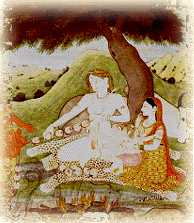 Shiva
is the destroyer - destroyer of ignorance, desire, ego, and death.
Shiva
is the destroyer - destroyer of ignorance, desire, ego, and death.
Worldly matters do not interest Shiva. Unaffected by the whims of the world, he is innocent and guileless, pure of mind and heart. He does not adorn his body with jewels or flowers; he mats his hair; wraps his body in animal hide and lets the serpent slither around his neck. He rejects social norms and does not mind the company of ghosts, gnomes , goblins, bhutas, pisachas and yakshas. He even rejects his body; hence he is worshipped as a linga.
Sometimes he wanders into crematoriums, smears his body with ash and dances in the light of the funeral pyres, reminding all about the transitory nature of material things.
Shiva prefers to isolate himself atop Mount Kailas, shutting his eye, restraining his senses, meditating and transcending samsara. In fact so intense is the power of his tapas that it transforms him into a pillar of fire that has neither an origin nor an end.
But the gods seek his wisdom. They wanted him to participate in the worldly affairs. They wanted him to marry and produce mighty sons who would protect the world. So they enlisted the help of the mother-goddess Shakti. Manifesting as Parvati, the goddess succeeded, after great difficulty, in becoming Shiva's consort. Together they created two sons: the wise Ganesha and the mighty Kartikeya. Parvati inspired Shiva to compose music, choreograph dances and unravel the mysteries of the Tantra and the secrets of Yoga for the benefit of the universe. He even enlightened her on the art of lovemaking, delighting man and god alike.
Occasionally, Shiva does tire of family life and goes back into the forest to meditate or dance in serene isolation. As he alternates between being an austere hermit and an amorous householder, the cosmos either withdraws into itself or blooms like a lotus.
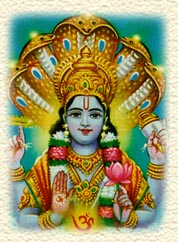 Vishnu
is the preserver of the cosmos, the keeper of universal laws, the sustainer
of life, who resides in Vaikuntha, the highest heaven. He constantly participates
in worldly affairs making sure all is well.
Vishnu
is the preserver of the cosmos, the keeper of universal laws, the sustainer
of life, who resides in Vaikuntha, the highest heaven. He constantly participates
in worldly affairs making sure all is well.
When order prevails in the cosmos, he rests on the coils of Adi-Sesha, the serpent of time.
When there is disorder, he mounts his eagle Garuda and battles with the forces of chaos.
Vishnu descends from heaven incarnating as man or beast to set things right. The ten incarnations of Vishnu are:
1. The fish Matsya
2. The turtle Kurma
3. The boar Varaha
4. The man-lion Narasimha
5. The dwarf Vamana
6. The warrior-priest Parashurama
7. The prince Rama
8. The cowherd Krishna
9. The sage Buddha-Mayamoha
10. The horseman Kalki
Vishnu uses both force and guile to ensure the stability of the universe. His consort Laxmi, goddess of wealth and power, offers him the wherewithal to maintain the integrity of the world.
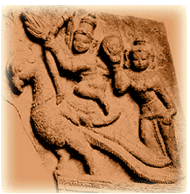 Kama
is the god of love. Priti and Rati, the goddesses of longing and lust, are
his consorts. The god of spring Vasanta, the apsaras and the gandharvas are
his companions. They carry his banner bearing his symbol - the makara.
Kama
is the god of love. Priti and Rati, the goddesses of longing and lust, are
his consorts. The god of spring Vasanta, the apsaras and the gandharvas are
his companions. They carry his banner bearing his symbol - the makara.
Kama uses the cane of sugarcane as the shaft of his bow and a line of buzzing bees as his bowstring. He rides a parrot across the three worlds shooting his five flower-tipped arrows that arouse the five senses and enchants the mind with visions of beauty.
But Kama is not worshipped. He has been identified with the principle of desire that entraps the soul in samsara. In fact, in Buddhism, he is called Mara, the demon, and enemy of all enlightened beings.
When Kama shot his love-dart into Brahma's heart, Brahma was so aroused by desire, that he stirred the still cosmic waters and set in motion the cycle of life.
But when he shot his love-dart at Shiva, Shiva opened his third eye, let loose a fiery missile and reduced his dart to ashes. Shiva seeks to transcend all worldly matters and his rejection of Kama is therefore understandable.
Wounded by Kama's darts, man craves for the wonders of existence, the beauty of life, Kama excites artists, inspires poets. He is a patron of arts. Kama enchants lovers. He brings the bee to the blossom, the man to the woman, thus catalyzing the creation of new life. Little wonder then, he is considered the son of Laxmi and Vishnu. As the son of the goddess of affluence, he follows wealth and bestows the gift of luxury and pleasure. As the son of the preserver, he makes sure people crave for life and participate in worldly affairs.
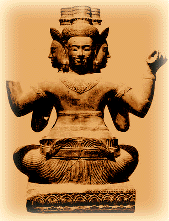 Brahma
is the creator. But he is not worshipped because he is responsible for distracting
the mind away from the soul and towards the cravings of the flesh.
Brahma
is the creator. But he is not worshipped because he is responsible for distracting
the mind away from the soul and towards the cravings of the flesh.
Before the cosmos existed, Brahma was all alone, self contained and self-content. Wounded by the love-god Kama's darts, however, he felt inadequate and longed for company. He split himself and created Shatarupa, the goddess of samsara. She was ephemeral yet enchanting. Her many forms captivated Brahma. He desired to posses her, hoping that the union would restore his peace of mind.
But that was not to be. Like all material things, Shatarupa would turn into something else every time Brahma got to her. She turned into a cow, a mare, a goose and a doe. Brahma kept pursuing her, taking the form of the corresponding male - a bull, a horse, a gander, a buck. Thus all creatures of the cosmos, from the smallest insect to the largest mammal, came into being. Brahma became Prajapati, lord of progeny.
Brahma, in his obsession, sprouted five heads, so that he could look upon Shatarupa at all times. To restrain his lust, Shiva as the ferocious Bhairava wrenched off one of his heads.
Sobered by the experience, Brahma took Saraswati, the goddess of knowledge, as his consort. With her help, he regained control of his mind, drawing it away from the senses towards the bliss of the soul.
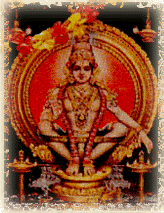 The
eternal boy-god sits atop the hill of Sabarimalai, Kerala, protecting the
forests from demons and wild malevolent spirits.
The
eternal boy-god sits atop the hill of Sabarimalai, Kerala, protecting the
forests from demons and wild malevolent spirits.
He was born when Vishnu, in the form of the enchantress Mohini, united with Shiva.
This divine child was raised by a childless king. Soon after his arrival into the royal household, the queen gave birth to a son. As the years passed, the queen feared that the foundling - who had grown up to be a wise, strong and handsome youth - would usurp her own son's claim to the throne. Feigning illness, she claimed that only the milk of a tigress fetched by a virgin warrior would cure her. Ayyappa immediately set out for the forest.
The queen's plot to kill Ayyappa backfired. In the forest, he fulfilled his destiny and returned a god. After he had milked the leopards, he was attacked by a ferocious demoness called Mahishi. Ayyappa killed Mahishi and rode into his father's kingdom on a tiger covered with the battle scars. The people cheered his return and begged him to be King. But Ayyappa renounced his claim to the throne and retired to the peak of Sabarimalai.
Every year, thousands of devotees make a perilous journey across forests and over hills to take refuge in the grace of this brave and magnanimous vira.
The Devas are the guardians of light and life. They are the sons of the primal sage Kashyapa, a manifestation of Brahma, and his wife Aditi. Aditi's first-born was the Indra; he became the leader of the Devas and the god of rain. Her last-born was Vishnu; he became the champion of the gods.
The other Devas are:
1. Agni, the god of fire
2. Vayu, the god of wind
3. Varuna, the god of the sea
4. Yama, the god of death
The Devas live in Amravati, the eternal city, where they drink Soma or Amrita, the sap of life and enjoy music and dance. They are energized by the Yagna ceremony.
The Devas constantly fight the Asuras, their half brothers. When the Devas are victorious, the day dawns, the moon waxes, the tides rise, the rains fall, the plants grow, the animals breed. When they lose, the sun sets, the moon wanes, the tides ebb, the rains stop, the plants wither, the animals die.
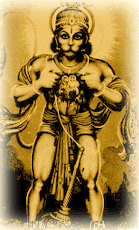 Hanuman,
the monkey-god, has a body of steel and the mind of a yogi. His physical prowess,
mental discipline and spiritual purity have won him many admirers.
Hanuman,
the monkey-god, has a body of steel and the mind of a yogi. His physical prowess,
mental discipline and spiritual purity have won him many admirers.
As a child, he mistook the rising sun for a fruit and tried to eat it, in the process disrupting the movements of the nine astrological bodies, the grahas. When Indra, lord of the skies, hurled his thunderbolt to stop Hanuman, Vayu was so angry that he sucked away the air from the three worlds causing all creatures to choke. Vayu was only pacified when the gods granted him eternal life and absolute wisdom. This event also gave Hanuman the power to overcome the baneful influence of all celestial bodies. Because of this, humans who seek to avert the malevolent influence of Mars and Saturn worship Hanuman.
In the Ramayana, we are told how Hanuman helped Rama rescue Sita who had been abducted by Ravana, the rakshasa-king of Lanka – how he flew across the sea and located Sita in the island-kingdom of Lanka; how he was caught by rakshasas who set his tail on fire; how he managed to break free and set alight the city of Lanka with his burning tail; how he built a stone bridge across the sea to Lanka; how he helped Rama launch an attack on rakshasa-kingdom by raising an army of monkeys and bears; how Rama rode into battle on his shoulder and shot Ravana dead, thus liberating his beloved Sita from the pleasure-gardens of Lanka. The epic extols Hanuman's humility and devotion that has made him worthy of reverence.
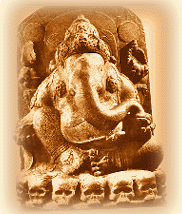 The
Goddess Parvati wanted a child but her consort Shiva was not interested in
a family. Determined to be a mother, the goddess decided to create a child
on her own. She scrubbed her skin, collected the dirt, mixed it with clay
and moulded out of it an idol into which she breathed life. She called this
being, created without the help of her husband, Ganesha and declared him her
son.
The
Goddess Parvati wanted a child but her consort Shiva was not interested in
a family. Determined to be a mother, the goddess decided to create a child
on her own. She scrubbed her skin, collected the dirt, mixed it with clay
and moulded out of it an idol into which she breathed life. She called this
being, created without the help of her husband, Ganesha and declared him her
son.
Parvati ordered Ganesha not to let any strangers enter her cave. Ganesha, who had never seen Shiva in his life, stopped his mother's consort from entering her abode. Enraged, Shiva beheaded Ganesha with his trident. When Parvati learnt of her son's death, she threatened to destroy the whole world unless he was brought back to life. To appease his consort, Shiva cut the head of a cow-elephant, placed it on Ganesha's severed neck and brought him back to life. From that day, Ganesha came to be known as "Vighneshwara" - the lord of hurdles. He blocks the movements of the undesirable.
Hindus salute the elephant-headed god Ganesha before beginning any activity or journey in the hope that there are no obstacles in their endeavour. His image is placed near gateways and above thresholds as he blocks all malevolent forces and lets only benevolent ones enter the house.
Ganesha rides a mouse and prevents it from destroying crops. He ties a serpent round his stomach to prevent the food in his stomach from falling out. Thus Ganesha ensures the prosperity of man and is often shown seated beside Lakshmi, goddess of wealth and fortune.
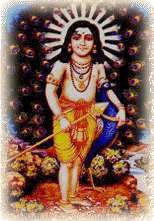 The
gods wanted Shiva to father a child because only his son could destroy the
demon Taraka who threatened the celestial realms. But Shiva was not interested
in family; he preferred to meditate. So the gods begged his consort Parvati
to help. The goddess managed to soften her stern husband's heart and obtain
his divine essence in the form of a seed which she gave to the gods. So fiery
was this seed that it burnt the fire-god Agni, singed the wind-god Vayu, boiled
the river-goddess Ganges and set alight the forest of reeds. When the fire
died down, the six forest nymphs known as Kritikas found a six-headed child
under the embers within a lotus. They nursed the child after naming him Kartikeya.
On the sixth day of his life, the child let out a piercing war-cry, picked
up his lance, attacked and killed Taraka. Then taking command over celestial
armies, he led the gods to many victories.
The
gods wanted Shiva to father a child because only his son could destroy the
demon Taraka who threatened the celestial realms. But Shiva was not interested
in family; he preferred to meditate. So the gods begged his consort Parvati
to help. The goddess managed to soften her stern husband's heart and obtain
his divine essence in the form of a seed which she gave to the gods. So fiery
was this seed that it burnt the fire-god Agni, singed the wind-god Vayu, boiled
the river-goddess Ganges and set alight the forest of reeds. When the fire
died down, the six forest nymphs known as Kritikas found a six-headed child
under the embers within a lotus. They nursed the child after naming him Kartikeya.
On the sixth day of his life, the child let out a piercing war-cry, picked
up his lance, attacked and killed Taraka. Then taking command over celestial
armies, he led the gods to many victories.
This virile commander of the gods rides a peacock and wields a lance.
In North India he is considered to be a bachelor. But in South India, he has two consorts – Devasena, daughter of Indra, king of the gods, who was given to him in recognition of his valour and Valli, a tribal maiden who won his heart as she stood in the middle of her father's millet field.