
MAIN GODS OF CELTIC MYTHOLOGY
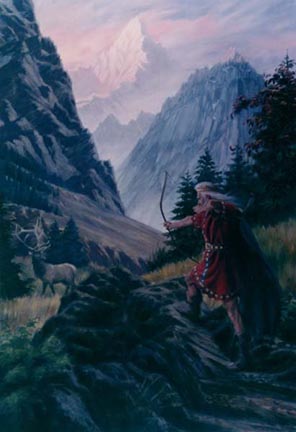 Celtic
Myths. Heroes or Kings could over time turn into Gods, and later on into faeries
or elves.
Celtic
Myths. Heroes or Kings could over time turn into Gods, and later on into faeries
or elves.
Amongst the major Gods of the Celts were:
| De Dagda | Lugh | Oghma | Gwydion |
De Dagda was the High King of the Tuatha de Dannan (folk of the Goddess Dana) His name meant: `The Good God`. De Dagda was the Gaelic God of the earth, heavens, and magic amongst others. He had a harp made of oak which -when he played it- put the seasons in their order, so that spring came after winter, summer after spring and autumn followed summer. This harp would magically float through the air to him when he called it. He was very fond of porridge, and was a good fighter. De Dagda`s Wife was called Boand. He had several children, the most important being Angus, Brigid, Oghma, Midir and Bodb the Red. WHen De Dagda resigned as King, his eldest son Bodb the Red succeeded him. After the battle of Telltown, the Tuatha de Dannan withdrew into the spirit world. They cast a veil of invisibility on themselves, which they can lift at will. Thus Ireland is diveded into two worlds, the physical and the spiritual world. The spiritual world is divided by De Dagda amongst the Tuatha de Dannnan. Later on when Christianity starts to influence the Celtic Mythology, the Tuatha de Dannan become faeries, the people of the Sidhe (pronounced Shee), also called elves. The Sidhe were a magical people living in Fairy Mounds and beautiful palaces, hidden by their magic so that the humans could not see them
Lugh is the Irish sun god, and a god of war. Lugh was the grandson of Balor, a Formorian King. There was a druidic prophecy that Balor would be slain by his own grandson. Therefore he had his only child Ethnia locked up in a high tower, Tor Mor, with twelve matrons to keep her away from all men. One day, a man named Kian wanted revenge on Balor for stealing his magic cow, so with the help of a druidess he disguised himself as a woman and sought shelter at the tower. The druidess put an enchantment on the matrons, and when they had left again, Ethnia was pregnant and gave birth to three sons nine months later. When Balor heard of this, he ordered that the children were drowned. A servant wrapped the babies in a cloths and took them with to drown. But one of the babies fell out of the wrapping and the servant only drowned the other two. This child was Lugh. Lugh grew up and learned many trades. He was a carpenter, warrior, druid, mason, smith, harper, poet, physician and goldsmith. In the second battle of Moy Tura he threw a stone into Balors eye and killed him, thus fulfilling the prophecy. Lugh was the father of the famous Celtic hero Cu Chulainn.
Oghma was the Irish God of literature and eloquence. He was the son of De Dagda and the champion of the Tuatha de Dannan. He carried a huge club. He invented the Ogham script which is named after him. It was originally intended to be carved upon the edges of standig stones. He was also called Cermait, which means `honey-mouthed` or Grainainech, meaning `sunny-faced`. He married Etain, daughter of Diancecht, the God of Medicine, and got several children. His son Cairpre became the professional bard of the Tuatha de Dannan.
Gwydion was a Welsch God. He was the son of Don (Dana) and brother of Arianrhod. Gwydion was taught the magical arts by his uncle Math. He is the druid of the gods and the master of illusion and phantasy, the teacher of all that is useful and good. As is common in mythology, he was married to his sister Arianrhod. They had two children, Dylan and Llew. Dylan, son of the Wave, represented darkness, his element was the sea. After he was born he jumped directly into the sea, and no wave would break beneath him. He was killed by his uncle Govannon, and the whole country wept for him. Llew on the other hand, personified light, he is the counterpart of the Irish god Lugh. When his mother refused to name him, Gwydion used his illusions to change his son and himself into cobblers. Arianrhod ordered shoes, but Llew made the first pair too big and the second pair too small, so that she would come to their boat for fitting. When she sat there, Lleu shot a wren that was sitting on the edge of the boat. And Arianrhod said: `the lion aimed at it with a steady hand`. From that moment on Lleu had his name, Llew Llaw Gyffes, which means `lion with a steady hand`.
MAIN GODDESSES OF CELTIC MYTHOLOGY
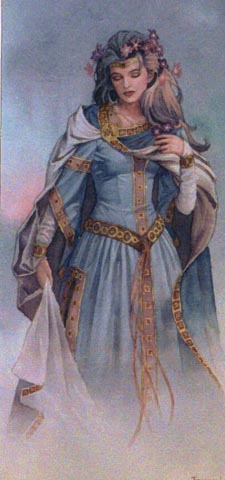 In
Celtic Myth the Goddess has three major aspects: the maiden, the mother and
the crone. These three represent the three stages in life of a woman. Blodeuwedd
is the flower maiden, Arianrhod represents the mother and The Morrigu at last
is the crone. These three aspects of the Celtic goddess may have different
names in different regions and regional legends. For example, Morrigan also
takes the mother role at times.
In
Celtic Myth the Goddess has three major aspects: the maiden, the mother and
the crone. These three represent the three stages in life of a woman. Blodeuwedd
is the flower maiden, Arianrhod represents the mother and The Morrigu at last
is the crone. These three aspects of the Celtic goddess may have different
names in different regions and regional legends. For example, Morrigan also
takes the mother role at times.
| Blodeuwedd | Arianrhod | Morrigan |
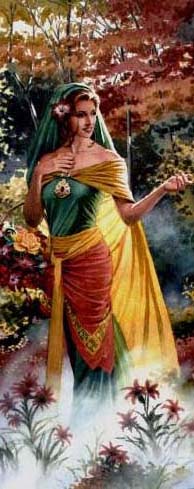 Blodeuwedd
is the flower maiden, the aspect of the Goddess that represents the maiden.
Blodeuwedd means `Flower Face'. According to the myths she was made by Gwydion
and his uncle Math to be Lleu's wife. They took the blossoms of the oak, then
the blossoms of the broom and of the meadow-sweet, and produced from them
a maiden, the fairest and most graceful that man ever saw. Blodeuwedd fell
in love with another man than Lleu however and managed to change him into
an eagle. Gwydion and Math took revenge however and after healing Lleu, chased
down Blodeuwedd and changed her into an owl. In old tales this chase took
place across the night sky, and the Milky Way is the trace that's left of
it.
Blodeuwedd
is the flower maiden, the aspect of the Goddess that represents the maiden.
Blodeuwedd means `Flower Face'. According to the myths she was made by Gwydion
and his uncle Math to be Lleu's wife. They took the blossoms of the oak, then
the blossoms of the broom and of the meadow-sweet, and produced from them
a maiden, the fairest and most graceful that man ever saw. Blodeuwedd fell
in love with another man than Lleu however and managed to change him into
an eagle. Gwydion and Math took revenge however and after healing Lleu, chased
down Blodeuwedd and changed her into an owl. In old tales this chase took
place across the night sky, and the Milky Way is the trace that's left of
it.
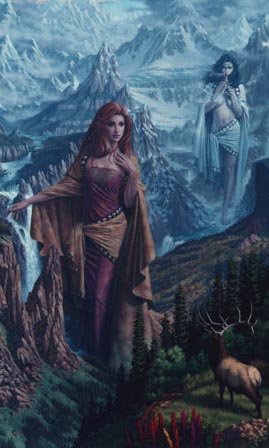 Arianrhod
is the mother aspect of the triple Goddess. The names of the aspects change
per myth however. Arianrhod means Silver Circle (Arian meaning `silver', and
Rhod meaning `wheel' or `disc'). She was Gwydions wife, and mother to both
a sun god and a god of darkness. In the later Arthurian Legends her place
is taken by Morgause, Arthurs sister.
Arianrhod
is the mother aspect of the triple Goddess. The names of the aspects change
per myth however. Arianrhod means Silver Circle (Arian meaning `silver', and
Rhod meaning `wheel' or `disc'). She was Gwydions wife, and mother to both
a sun god and a god of darkness. In the later Arthurian Legends her place
is taken by Morgause, Arthurs sister.
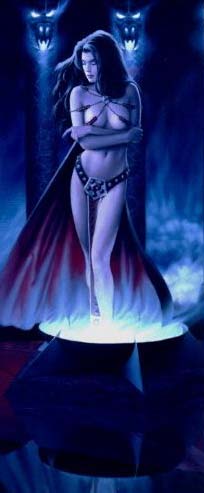 The
Morrigu (or Morrigan) represents the Crone aspect of the Goddess. She was
a Celtic War Goddess who delighted in setting men at war. She fought in battles
herself, and at times hovered like a crow over the warring men. She was represented
as fully armed, carrying two spears in her hand, and wherever there was war,
she was there. Her battle cry is said to be louder than that of a thousand
men. She had a sort of Love-Hate relationship with Cuchulain, who refused
her. Afterwards she fought with him and attacked him in three different forms.
Cuchulain wounded her, and later she came back to him in the guise of an old
woman to have him heal her wounds, for only he could do so. After that she
became his friend and helped him.
The
Morrigu (or Morrigan) represents the Crone aspect of the Goddess. She was
a Celtic War Goddess who delighted in setting men at war. She fought in battles
herself, and at times hovered like a crow over the warring men. She was represented
as fully armed, carrying two spears in her hand, and wherever there was war,
she was there. Her battle cry is said to be louder than that of a thousand
men. She had a sort of Love-Hate relationship with Cuchulain, who refused
her. Afterwards she fought with him and attacked him in three different forms.
Cuchulain wounded her, and later she came back to him in the guise of an old
woman to have him heal her wounds, for only he could do so. After that she
became his friend and helped him.
