
The sacred Hindu universe is inhabited not just by humans...
There are gods in the celestial realms and demons in the nether regions,
Besides these, there are enigmatic spirits who guard the bounty of Nature and celebrate its beauty.
These are the demigods.
| Yaksha | Apsara | Gandharva | Naga |
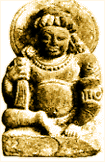 Yakshas
are pot-bellied squat creatures associated with wealth and fertility. They
are guardians of treasures and keepers of water holes. They are often depicted
holding a bag of gems and gold coins. Yakshas are very fond of riddles – those
who answer their riddles are richly rewarded; those who don't risk death.
Yakshas
are pot-bellied squat creatures associated with wealth and fertility. They
are guardians of treasures and keepers of water holes. They are often depicted
holding a bag of gems and gold coins. Yakshas are very fond of riddles – those
who answer their riddles are richly rewarded; those who don't risk death.
In the Mahabharata, the Pandava brothers came upon a lake that was guarded by a Yaksha. He demanded that they answer his riddle before drinking the water. None the brothers, except the eldest Yudhistira, paid heed to the Yaksha's demand. Enraged, the Yaksha killed all the Pandavas except Yudhistira. He asked Yudhistira, "What is the greatest wonder of life?" and the Yudhishtira replied, "That everyday men die and the rest live as if they were immortal." Pleased with the reply, the Yaksha blessed Yudhishtira, revived his brothers and gave him rich gifts.
Yakshas have been worshipped in India long before the Vedic tradition took root. Such was their popularity that even Buddhists and Jains were forced to include these mysterious spirits in their pantheon. The images of Buddha and the Jinas are often shown flanked by images of Yaksha and his consort, the Yakshi. Hindu temple walls are adorned by images of Yakshas.
The Yakshas who built and ruled the golden city of Lanka in the middle of the sea before the Rakshasas drove them out. Their leader Kubera then built the city of Alaka in the North.
Yakshas and Rakshasas are descendents of the primal sage Pulatsya-Vaishravana. Both Yakshas and Rakshasas consider Shiva to be their spiritual leader. But while Yakshas are adored, Rakshasas are despised.
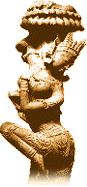 Apsaras
are nymphs, usually associated with lakes and rivers. They were churned out
of the ocean of milk by the gods and ever since then they have captured the
hearts of all creatures.
Apsaras
are nymphs, usually associated with lakes and rivers. They were churned out
of the ocean of milk by the gods and ever since then they have captured the
hearts of all creatures.
Apsaras represent the principle of pleasure. They know 64 ways to rouse the senses and delight the mind. The god-king Indra loves their company. Some of his favorite nymphs are Menaka, Urvashi, Rambha and Ghritachi.
Whenever a sage becomes too powerful by performing austerities, the god-king Indra sends his nymphs to bewitch them with their beauty. As soon as the sage embraces these voluptuous beauties, he loses his spiritual prowess acquired after years of restraint and self-mortification.
When lovesick humans wish to marry Apsaras, they often have to make a promise. If the promise is broken, the Apsara returns to her heavenly abode. King Pururava married the nymph Urvashi only after he promised never to be seen naked by anyone but her. One day, thieves stole the royal cows and the king, who was in Urvashi's bedchamber, rushed to their rescue without bothering to cover himself. The whole city saw him naked and that was the end of his marriage to the nymph.
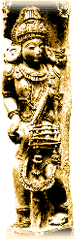 Gandharvas
are so called because they have fragrant bodies. Anyone who smells them falls
in love with them. Whenever Gandharvas love the women of earth, they forget
them as soon as they return to their heavenly abodes.
Gandharvas
are so called because they have fragrant bodies. Anyone who smells them falls
in love with them. Whenever Gandharvas love the women of earth, they forget
them as soon as they return to their heavenly abodes.
Gandharvas are celestial musicians who, along with Apsaras, follow the love-god Kama wherever he goes.
At one time they stole the sacred essence, Soma. To get it back, the goddess Saraswati enchanted them by playing tunes on her lute. The Gandharvas were so pleased with the music that they not only returned Soma to the gods, they also took on the role of celestial musicians.
Gandharva-Vidya, the lore of the Gandharvas, is a treatise on the performing arts given to man by these ethereal beings.
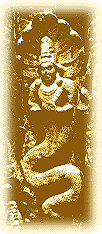 Nagas
are serpent-beings who live in the netherworld in a city called Bhogavati.
Ant-hills mark the entrance to this radiant city. The Nagas acknowledge Vasuki
as their king. On his head shines Nagamani, a gem capable of curing all diseases
and bestowing good fortune.
Nagas
are serpent-beings who live in the netherworld in a city called Bhogavati.
Ant-hills mark the entrance to this radiant city. The Nagas acknowledge Vasuki
as their king. On his head shines Nagamani, a gem capable of curing all diseases
and bestowing good fortune.
Manasa Devi is Vasuki's sister. She is the goddess who cures snakebites. The serpent Karkotaka slithers around Shiva's neck. Vishnu sleeps on the coils of the serpent Sesha on whose roods rests the earth. Nagas are even seen raising their hoods to shelter Buddhas and Jinas.
Nagas are descendents of the sage Kashyapa. Their mother Kadru once enslaved Vinata, mother of birds. To secure her freedom, the great eagle Garuda stole Amrita, elixir of immortality, from the city of the gods. Before the serpents could drink Amrita, Indra stole it back. A few drops of the celestial drink fell on the grass. The serpents slithered on it and hence the skin of serpents has the capacity to renew itself. The old worn-out scales can be easily shed and replaced by new ones.
Images of Nagas adorn houses, temple-walls and village-shrines as they are considered keepers of fertility. They are worshipped by farmers seeking a rich harvest and women who wish to bear children. When a king banned the worship of serpents, his kingdom was struck with drought. The rains resumed as soon as the king placated Vasuki.