
Five hundred years before the birth of Jesus Christ, a spiritual revolution took place in India. Kings and princes, tired of worldly power, invited sages and seers to explain to them the meaning of life. Monks and hermits took refuge in forests to fathom the nature of reality. Wise men rejected blind rituals in favour of meditation and contemplation.
Everyone was trying to solve the mystery of human existence.
It was in this age that a prince asked the question, "Why does man suffer?" The prince was Siddhartha Gautama of the Sakya clan. His answer evolved into a way of life known as Buddhism - the path of the enlightened.
| Buddha | Hinayana | Mahayana | Vajrayana | Bodhisattva |
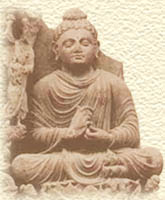 Buddha
means 'the enlightened one'. There have been many Buddhas in the world. The
most famous one was born 500 years before Jesus Christ in the land now known
as Nepal. He was a prince belonging to the Gautama clan of the Sakya tribe.
He was called Siddhartha.
Buddha
means 'the enlightened one'. There have been many Buddhas in the world. The
most famous one was born 500 years before Jesus Christ in the land now known
as Nepal. He was a prince belonging to the Gautama clan of the Sakya tribe.
He was called Siddhartha.
His father brought him up surrounded by all the pleasures of the world. He married a beautiful woman called Yashodhara who bore him a son called Rahul. But one day, as the prince rode through the city he saw an old man, a diseased man, a corpse and a hermit. The first three sights filled him with dread and despair; the last sight filled him with peace. For the first time he experienced unhappiness and he wondered why.
Siddhartha slipped out of his palace in the middle of the night, leaving behind his wife and son, and became a hermit determined to find the cause of suffering. He met wise men, meditated and contemplated and finally concluded that 'unhappiness is the result of desire'.
Everything changes in the world. Yet desire makes us crave for material pleasures. When the pleasures wither away, we are unhappy. True happiness arrives when one accepts that change is the ultimate reality of the material world. Nothing lasts forever. This realization makes a being a Buddha, an enlightened being. An enlightened being can break free from the fetters of 'samsara' or material existence - this breaking free is called 'nirvana'.
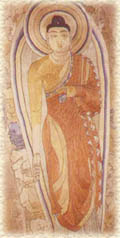 The
Hinayana system represents the conservative branch of Buddhism that is practiced
in Burma, Sri Lanka, Thailand and other parts of South East Asia.
The
Hinayana system represents the conservative branch of Buddhism that is practiced
in Burma, Sri Lanka, Thailand and other parts of South East Asia.
Also known as the Thervada or the path of the elders, this system remains true to the original teachings of Sakyamuni Gautama Buddha that are found in the Pali scriptures. They believe that Buddha was man who liberated himself through meditation and contemplation. They look upon him as a teacher and so image of Buddha in these lands are revered, not worshipped. In this system, every man must strive to liberate himself through enlightened actions - neither gods nor
magic spells can assist the process.
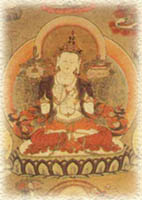 The
Mahayana system represents the progressive branch of Buddhism that is today
practiced in East Asia, especially China and Japan. It reached these lands
via Central Asia.
The
Mahayana system represents the progressive branch of Buddhism that is today
practiced in East Asia, especially China and Japan. It reached these lands
via Central Asia.
This system introduced new metaphysical concepts such as the notion of 'nothingness' or ' sunya' through Sanskrit scriptures written by scholars such as Nagarjuna, Asanga, Vasubandhu and Asvaghosha. Hsuan-tsang of China visited India in search of these texts which were then translated into Chinese and Japanese.
This system also introduced the concept of Bodhisattva and the goddess called Tara. People no longer had to take up difficult vows to attain 'nirvana'; they could simply earn merits and liberate themselves by worshipping Bodhisattvas who, in their infinite compassion, worked for human welfare.
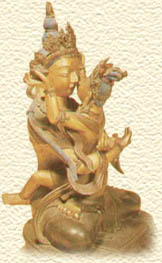 The
Vajrayana system represents the occult branch of Buddhism that is today practiced
mainly in Tibet and some parts of Bhutan and Nepal.
The
Vajrayana system represents the occult branch of Buddhism that is today practiced
mainly in Tibet and some parts of Bhutan and Nepal.
Also known as Tantric Buddhism, it owes its origin to the scholar Padmasambhava who went to Tibet from Bengal. He assimilated Hinayana and Mahayana doctrines of Buddhism with the pagan Bon religion of Tibet and the occult practices of Tantric Hinduism.
Thus beside meditation and contemplation, Vajrayana also prescribes the visualization of Buddhas passionately embracing their shaktis and the use of ritual diagrams (mandalas), special chants (mantras), specific postures (mudras) and sexual practices (maithuna) to attain enlightenment and liberation. The idea of these practices is not to indulge the senses. The aim is to experience and understand the fleeting nature of the material world. A true adept or siddha thus becomes fully aware that material existence or 'samsara' is no different from spiritual release or 'nirvana'. One does not have to run away from the world to be free - one can embrace the material world and still be spiritually free.
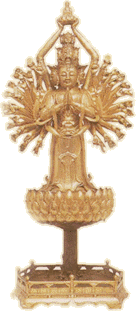 Some
enlightened beings, on the verge of liberation (nirvana) from the material
world, chose to stay back in to help all other creatures liberate themselves
from the eternal cycle of rebirth and suffering. They refuse to leave the
material realm until all creatures are free. These compassionate Buddhas are
known as Bodhisattvas.
Some
enlightened beings, on the verge of liberation (nirvana) from the material
world, chose to stay back in to help all other creatures liberate themselves
from the eternal cycle of rebirth and suffering. They refuse to leave the
material realm until all creatures are free. These compassionate Buddhas are
known as Bodhisattvas.
Bodhisattvas have many hands so that they can help many beings. From their tear, shed after hearing the lamentations of suffering souls, rises Tara, the goddess of wisdom. The compassionate Bodhisattva with the aid of the wise Tara seeks to alleviate all suffering.
The concept of Bodhisattvas comes from Mahayana Buddhism and is especially popular in East Asia. In Tibet, the most famous Bodhisattva is known as Avatilokeshvara. In China and Japan, the most famous Bodhisattva worshipped by Buddhists has a female form. She is known as Kwan-yin or Guannin.