The
Ultimate Greek Hero
Introduction:
We analyzed the Labors
and Death of Heracles. We
looked at what makes Heracles a hero, how his journey followed Joseph
Campbell’s Cycle of the Hero, the qualifications that made Heracles a
hero, how the values in the Labors and Death of Heracles related to both values
of that time and also modern day values, and finally, we compared Heracles to
other heroes we have studied.
Background:
Apollodorus’s
Heracles was the most famous of the Greek heroes. He was often called the “defender of the earth.”
He did not seek glory or fame; rather these achievements came to him
through his incredible strength and willingness to help others.
Heracles probably existed in the matriarchal culture.
In the female-dominated society, a youth who wished to become king and
companion of the reining priestess had to compete against many other contenders
through various contests similar to the ones Heracles completes (Rosenberg).
Summary:
 Alcmene,
wife of Amphitryon, made love to both Zeus and her husband on the same night and
bore two sons, Heracles (son of Zeus) and Iphicles (son of Amphitryon). Heracles
suffered the everlasting wrath of Hera because he was the child of her
unfaithful husband. A few months after his birth Hera set two serpents in
Heracles’ cradle, but the infant promptly strangled and killed them.
Alcmene,
wife of Amphitryon, made love to both Zeus and her husband on the same night and
bore two sons, Heracles (son of Zeus) and Iphicles (son of Amphitryon). Heracles
suffered the everlasting wrath of Hera because he was the child of her
unfaithful husband. A few months after his birth Hera set two serpents in
Heracles’ cradle, but the infant promptly strangled and killed them.
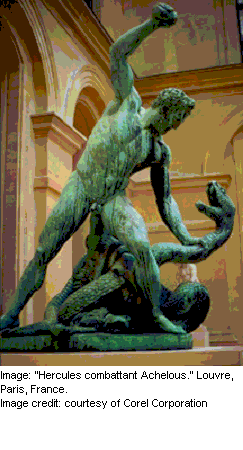
After his labors were completed, Heracles was involved in many other adventures and combats, including the Calydonian hunt and the Argonaut expedition. He killed Iphitus, son of the king of Oichalia, because the king would not give him his daughter Iole. When Neleus, king of Pylos, refused him absolution for that crime, Heracles sacked his kingdom and killed all his sons except Nestor. For that outrage the Delphic oracle fated him serve Omphale, queen of Lydia, who, in some legends, dressed him in women’s clothes and had him work with her maids spinning wool. He later was her lover, but after he finished his servitude he returned to Oichalia and carried off Iole.
When his second wife, Deianira, daughter of King Oeneus, was seized by the centaur Nessus, Heracles killed Nessus with arrows dipped in the poisonous blood of the Hydra. As he died, Nessus told Deianira that blood from his wound would restore Heracles’ love for her if ever it were to wane. Later, when Deianira sought to win back her husband’s love, she contrived to have him don a robe smeared with the blood. The robe stuck fast to Heracles’ skin, burning him unbearably. In agony, he built a huge pyre atop Mt. Oite and had it set afire. His mortal body parts burned away, but the rest rose to heaven, where he was finally reconciled with Hera and became immortal (Columbia Encyclopedia).
Heracles vs. His Contemporaries
In many ways, the story of Heracles is very different from the stories of other heroes of the time, yet in other ways, many parallels exist.
First, Heracles fits the traditional hero archetype by his background and his appearance. As a hero, he (of course) represents the epitome of mankind. He is of noble blood, being the son of the chief god. He is somewhat crafty, maybe not so much as other heroes of the time, but whatever he lacks in mental ability, he more than makes up for in physical prowess. He is VERY VERY strong and apparently isn't half bad with a bow either.
Events from Heracles' past life (before his labors) resemble the hero patterns. An failed attempt on his life is made in his infancy when Hera sends two ill fated snakes after him. Details of his childhood are scarce, but he grows up to be a man of potential, even marrying a princess. Like many heroes of the time such as Jason and Perseus, Heracles is feared by the powers that be in the mortal world. King Eurystheus is convinced that he will be overthrown by Heracles although he recieves no prophecy to that effect. He calls in an agreement with Zeus that would require Heracles to perform the labors.
This is the point where the story of Heracles begins to stray from conventional hero myths.
Most heroes set out in search of glory. Jason, for instance, sought to become king, and Odysseus and Achilles sought the glory that comes with war. Oedipus killed the sphinx to become the "defender of Thebes" Heracles on the other hand, is satisfied with what he has and is not interested in glory, not even accepting the tasks that would bring him glory until he is directly commanded by the gods.
The labors of Heracles is a rather unusual adventure for a hero because he takes it all in stride and completes each task with relatively little difficulty (although it takes him eight years to do). The only reason he faces failure is because of technicalities set by Eurystheus. Many other heroes face dismal failures and come to a point when they question whether or not they will ever succeed in their quest.
Heracles vs. Modern Hero's
When comparing Greek heroes in mythology, to those in modern times, a lot of
discrepancies are found. For example, in the case of Heracles the noble Greek
hero, the people of those times found his greatest virtues to be his strength,
his stamina, and his intelligence. To be a hero back then, one had to be
fearless in the face of danger and sometimes forget his or her weaknesses. If a
task was difficult, a hero did not give up, he or she would
 persist,
but instead of being narrow minded when it came to figuring out how to complete
a task, the hero would consider options, and wait patiently for
persist,
but instead of being narrow minded when it came to figuring out how to complete
a task, the hero would consider options, and wait patiently for
the opportunity to arise for the problem to be defeated. However, a hero was not
always expected to perform all tasks alone. Friends played an important part. If
you had friends, you were better off, for sometimes, they were more equipped at
handling certain obstacles or they had tools you didn't have which would make
the task simpler. When a hero was given a task to perform, he or she had to
consider the consequences of completing said task a certain way. They knew
better than to anger a god or goddess, instead they thought of ways that a task
could be performed without angering the gods. While one had to be courageous in
the face of danger, it was not wise to jump in without thinking ahead, which is
where the intelligence of the hero plays a key role. Finally, the hero had to be
just. If the hero faced a task that he or she knew was not virtuous to complete,
the task was not completed in the way specified and sometimes, not at all.
The big difference between modern heroes and Greek heroes is that modern heroes can be anyone from a child, to a pet, to a scientist or artist. While nowadays a hero might not be asked to kill an immortal enemy, he or she has to face many other difficult obstacles. While intelligence, courage, and determination are definitely virtues, even the weakest human being can be a hero. Kindness and charity are noble virtues that many times cause people to be called heroes. Parents and teachers are seen as heroes because they help shape the future of the world in the children. Athletes are not heroes because they can carry a team to victory, they are heroes because they give children someone to look up to. People who give of themselves to better others are heroes. Those who give money, volunteer, or work as doctors and nurses are some of the greatest heroes of modern times. A hero is someone who sets an example of the way people want to be. He or she is a role model to everyone and is not a hero because of an amazing feat performed, but because of his or her character.
Not only are the traits of heroes different, but also the rewards they receive
are different. Heracles, was given immortality as a gift to his
heroism. Now, sometimes all a hero gets is a smile and the satisfaction that he
or she did something that benefited someone else.
Is Heracles truly a hero?
Heracles,
the Greek son of Zeus and an immortal woman, can be examined as a hero by the
standards of Joseph Campbell. He
fulfills many, but not all of Campbell’s requirements.
Campbell’s model starts with the departure, Heracles first answers the
call portion of the departure early in his childhood when he kills the serpents
sent by Hera to kill him. 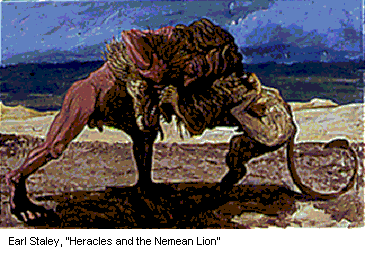 This
was the beginning of his fame and it only grew from there.
Heracles’ supernatural aid was Zeus, his father who wanted him to
become immortal. Heracles was in the belly of the whale when he withdrew from
society after he killed his children. By
asking the advice of the oracle, and deciding to perform the feats required,
Heracles crossed the threshold from mere ordinary humanity, to something much
greater and more dangerous than he even realized that he could go.
This
was the beginning of his fame and it only grew from there.
Heracles’ supernatural aid was Zeus, his father who wanted him to
become immortal. Heracles was in the belly of the whale when he withdrew from
society after he killed his children. By
asking the advice of the oracle, and deciding to perform the feats required,
Heracles crossed the threshold from mere ordinary humanity, to something much
greater and more dangerous than he even realized that he could go.
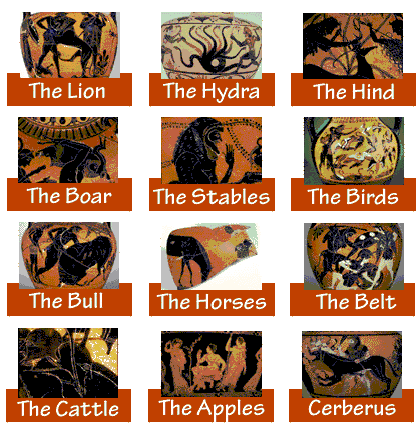
Heracles is initiated as a hero through the trials he encountered, the atonement with his father and society and his realization that his purpose was to complete countless other tasks. The twelve tasks that are required of Heracles are definitely a fulfillment of the “Road of Trials” element in Campbell’s model. Heracles twelve labors are as follows: killing the Nemean lion, killing the Hydra of Lerna, bringing Artemis’s deer to Tiryns, capturing Erymanthian boar, cleaning King Augeas’s stables, chasing away the Stymphalian birds (Athena helped him with this), capturing the bull of Poseidon from King Minos, capturing the mares of Kind Diomedes, stealing the belt from the Amazon queen, Hippolyte, capturing Geron’s red cattle, collecting Hesperides golden apples, and finally, entering the underworld the bring Cerberus to King Eurystheus.
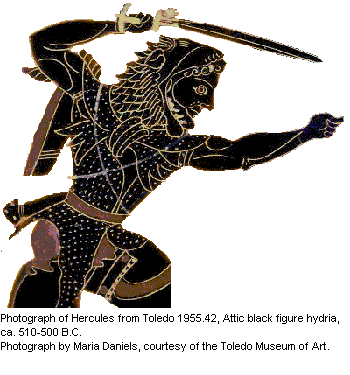 These
tasks were not all Heracles did during the many years it took him to complete
them. He had help from Athena and
was guided by Hermes when he went to the underworld in the course of fulfilling
his obligations, two other requirements of a hero stated by Campbell.
These
tasks were not all Heracles did during the many years it took him to complete
them. He had help from Athena and
was guided by Hermes when he went to the underworld in the course of fulfilling
his obligations, two other requirements of a hero stated by Campbell.
Although Heracles did not marry a goddess, the woman he did marry kills him in the end, proving to be very dangerous. Heracles does find atonement with his father when he completes his tasks. His pseudo father could be seen as Eurystheus since his is Heracles’ way of atonement for his fit of wildness. This atonement is also Heracles’ boon, his new awareness and successful completion of his goal.
It may be said that Heracles’ apotheosis was his
realization that he must continue to perform great deeds even though his
requirements for atonement were complete
So far, Heracles’ departure and initiation as a hero have closely followed
Campbell’s model.
Heracles's return does not fit the Campbell very well. Heracles passes back to the land from which he came, not by majestic feat nor does he cross a threshold to an alternate world to complete his tasks. Heracles also never does "master both worlds". in the end Heracles cannot cope with the pain of his wounds so he cowers into the flames to be killed. Only in his time of weakness is Heracles brought back from his "natural" adventrues by that of a "supernatural" force.
Hero Qualifications of Heracles
1) The hero's mother is a royal virgin : NO
2) His father is a real king. : YES
3) His father is a relative to his mother : NO
4) unusual conception : YES
5) son of a god: YES
6) Attempt to be killed early in life: YES
7) spirited away from homeland: YES
8) Reared by foster-parents: YES
9) told nothing of his childhood: YES
10) returns to home when he is a man : YES
11) Victory over king/beast : YES
12) Marries a princess: NO
13) Becomes king: NO
14) reigns uneventfully: NO
15) Prescribes laws: NO
16) Loses favor with gods/ subjects: No
17) driven from throne: NO
18) meets Mysterious death: NO
19) dies at the top of a hill: YES
20) Not succeeded by children: YES
21) Holy sepulchres: YES
Interesting
Heracles sites:
http://www.csun.edu/~hcfll004/hercking.html
http://www.mythweb.com/hercules/
http://www.perseus.tufts.edu/Hercules/
David Just
Jody Oltman
Christine Dahlan
Evan Dooley
Rebecca bailey
Heracles and the Rulers of Greece. http://www.csun.edu/~hcfll004/hercking.html [accessed April 19,2001].
Hercules, Greece’s Greatest Hero. http://www.perseus.tufts.edu/Hercules/ [accessed April 20, 2001].
Hercules. http://www.mythweb.com/Hercules/ [accessed April 19, 2001].
Rosenberg, Donna. World Mythology: An Anthology of the Great Myths and Epics. Lincolnwood, IL, 1999.
The Columbia Encyclopedia. Sixth Edition. 2001.
http://myhero.com/New_Directory/directory_table.asp
World Mythology
http://www.perseus.tufts.edu/Hercules/