What
is Fate?
 Chance,
destiny, divine will, doom, fortune, future, outcome, Moira, predestination
(Webster’s New Thesaurus, 1990)—these are all words that are synonymous with
Fate. But
they do not tell us exactly what fate is; why people believe in fate; or how
fate works. Fate
is a very significant theme found throughout mythology.
This theme is very evident throughout Oedipus the King, The
Illiad, and The Odyssey, among other myths.
But exactly what is Fate?
Chance,
destiny, divine will, doom, fortune, future, outcome, Moira, predestination
(Webster’s New Thesaurus, 1990)—these are all words that are synonymous with
Fate. But
they do not tell us exactly what fate is; why people believe in fate; or how
fate works. Fate
is a very significant theme found throughout mythology.
This theme is very evident throughout Oedipus the King, The
Illiad, and The Odyssey, among other myths.
But exactly what is Fate?
According to Encyclopedia Britannica Online, Fate
is the span of a person’s life and his allotment of misery and suffering.
Homer speaks of Fate or moira in the singular, as an impersonal power and
often makes its functions interchangeable with those of the Olympian gods.
Fate is a power that supposedly predetermines what
is to happen. It
is one’s destiny and ultimate outcome (The New American Webster Handy College
Dictionary). It
is the principle or determining cause or will by which things in general are
believed to come to be as they are or events to happen as they do.
Fate is an inevitable and often adverse outcome, condition, or end (WWWebster
Dictionary).
Fate is a predetermined course of events considered
to be beyond human control that is determined by a combination of human
intelligence and divine will (Microsoft Encarta Encyclopedia 99).
Free
will or fate
Fate plays an important role in the lives of
Greeks. It was the cause of the fall of Oedipus and many other tragic Greek
heroes. The question lies however in whether fate really exists, and if it does,
how could one escape his or her fate. If fate really does exist, then how can
one be condemned or praised for his or her actions?
To begin with, one has to understand who the fates were and how they
affected both Greek gods and mortals.
The
three Fates, Clotho, Lachesis, and Atropis were in charge of weaving the
destinies of both gods and mortals. Their powers were supposedly so great that
even a god could not escape his or her fate. Once the thread was woven, neither
mortal nor god could change it. This idea can be seen in the “wheel of
fortune” card of the tarot.
In
“The Spindle,” Boria Sax explains the metaphor for the wheel of fortune
card, “the goddess Fortuna turns a wheel, while figures representing different
estates clung desperately to its rim. Though Fortuna held a cornucopia, a symbol
of plenty, there was often a blindfold on her eyes. The topmost figure on the
wheel wore a crown, while the one at the bottom fell into oblivion. The image
expressed the aspiration and terror that men and women felt on the threshold of
the modern world.”
The
idea behind fate was that it could not be changed and that a person’s entire
life was predetermined and nothing they did could change that. Victor Estevez,
from www.travel-italy.com, says, “There's no avoiding your fate. You may from
time to time put it off by a little, but there's no escaping it, and the foolish
attempt to do so is the subject of more than one Greek myth.” 
Those
who tried to deny their destiny were called hubris, which means arrogance in the
face of the gods. Many mortals and gods including Cronos, Zeus’s father, had
tried and failed at overcoming their destinies. One such hubris was Oedipus who,
in order to defy his destiny of slaughtering his father and marrying his mother,
fled his homeland. He did not realize that his known parents were not his actual
biological parents and while fleeing, he killed a man who he later learned was
his real father and fulfilled his destiny of marrying his mother.
The
question of whether destiny is real or not has baffled man for centuries.
Philosophers ask the question of whether man has free will or if all his acts
are predetermined. To believe in free will is to deny the existence of fate. If
there is no free will, then no acts can be either punished or praised because
all acts were predetermined. This would mean that those who believed in the
Fates could not properly condemn those who lived their destinies, such as
Oedipus.
Others
do not believe in fate in the way the Greeks did. In “The Three Threads of the
Cord,” Annie Besant says, “These three Fates are not the women of the Greek
legend; they are the three Powers of the human Consciousness: the Power to Will,
the Power to Think, the Power to Act. These are the Fates which spin the threads
of human destiny, and they are within the man, not outside him. Man's destiny is
self-made, not imposed upon him arbitrarily from without; his own powers,
blinded by ignorance, spin and twist the cord that fetters him, as his own
powers, directed by knowledge, liberate his limbs from the self-imposed
shackles, and set him free from bondage.”
Were
Oedipus to follow the fates of free will, his condemnation by the town would be
at least somewhat justified. Instead, by trying to outrun his destiny, he
stumbled upon his fate. By believing in his destiny, he put himself into the
situation that destroyed him. Had he gone with the flow, and just lived his life
with his adoptive parents without fearing his destiny, his destiny may have
never been fulfilled. In “Oedipus and his Human Destiny,” Eva Maria
Migliavacca says, “And at the end of his journey, against everything and
everyone, Oedipus realizes that, playing the game from beginning to end, he was
the marionette, from beginning to end.”
One
could say that the Fates knew that, upon learning his destiny, Oedipus would
have run, thereby fulfilling that which he was trying to escape. It is hard to
say whether his destiny would have been fulfilled if he had acknowledged his
destiny but had chosen to stay with his adoptive parents. This however could not
be possible because his decision to run must have already been woven into his
thread of destiny. This takes away the possibility of Oedipus having free will.
If
one cannot avoid his or her destiny and all actions are predetermined, then no
one has free will. If this were to hold true in modern times, then jails could
not exist because the act of murder was already determined and not of free will
thereby it cannot be punished. If the people of Greek mythology believed so
strongly in the Fates, then they wouldn’t have tried to escape those destinies
and no mortal or god could either be condemned or praised for his or her
actions.
This
might lead one to believe that the people of Greek mythology believed strongly
in the Fates, but also believed that they had free will and could escape their
destinies. For both free will and determinism to hold true is a contradiction.
It is impossible to answer which truly exists. As far as modern times show, the
people believe in free will and to believe in fate is to deny one’s human
nature. One would only be a pawn, never living his or her life but rather a
marionette to be used for the entertainment of the fates.
If
fate really does exist, the only way to have apparent free will is to deny it
and to live one’s life to the fullest, even if one’s life is predetermined,
he or she can just enjoy it in blind ignorance. To quote the movie, “Only
You” when asked if he believed in destiny, the old Italian man simply said,
“It is written on the stars.”
Fate
in Practice
Fate
has been a common theme in literature from of ancient Greece to modern times.
In most cases in mythology, a fate
is revealed to a hero in a prophecy. The
wise heroes carry on with daily life as though nothing had changed (knowing that
they cannot control fate). More often than not though, hubris causes the hero to
try to escape his own destiny and in the process, he walks right into it making
the prophecy self fulfilling.
There seems to be a very common
(almost universal) theme of sons deposing fathers.
The
Story of Odysseus
Before
departing for Troy, Odysseus was warned that if he went to war, he would return
alone twenty years later. Not
looking foreward to this prospect, Odysseus pretended to be insane but his
friends suspect and trick him into going. This
doesn't really show the intricate twists of fate that other myths show, but it
does help show the unavoidability of fate.
The
Story of Zeus
The
ruler of the gods Cronos learns that the Fates have proclaimed that he would be
overpowered by his own son just as he himself overpowered his own father.
In an attempt to cheat fate, he swallows each of his children whole as
they are born except for Zeus whom his wife hides from him.
When Zeus learns of the terrible crimes of his father, he leads a
rebellion and defeats him. This
myth shows displays a self fulfilling prophecy and shows how even the gods
themselves are subject to fate.
The
Story of Perseus
King
Acrinius was told by the oracle of Apollo that his grandson would kill him so he
locked up his daughter Danae in an attempt to prevent her from having children.
While imprisoned, Danae gets knocked up by Zeus and gives birth to
Perseus. When his Perseus was born,
Acrinius cast his wife and child into the sea.
By no small miracle, the two survived, and Perseus would go on to have
great adventures, slay Medusa, and marry the princess Andromeda.
In his travels, he by chance crosses paths with Acrinius at some games
and Perseus kills Acrinius (accidentally in a freak discus mishap).
As it turns out, the act of sending his grandson away began a chain of
events that would come to destroy Acrinius.
The
Story of Oedipus
King
Laius learns from the Oracle that his son would kill him so when Oedipus is
born, Laius has his infant son abandoned in the mountains where he could not
survive. Oedipus is found, rescued,
and raised as a prince in Corinth. He
learns from the oracle that he is destined to kill his father and marry his
mother. Thinking that those who
raised him are his parents, he runs away in an attempt to cheat fate.
On the way to Thebes, he is insulted by a traveler and kills him and his
men, unaware that he has just killed his biological father and the king of
Thebes. At Thebes, Oedipus becomes
a great hero by saving the city from the Sphinx and marries the late King's
widow who is actually his biological mother.
In this case, two men thought that they could not be touched by fate and
in doing so brought about their fates and even angered the gods in the process.
Fate
today VS. Fate in the time of the odyssey
In ancient times believing in fate was not a personal question, but
rather an aspect of the culture. T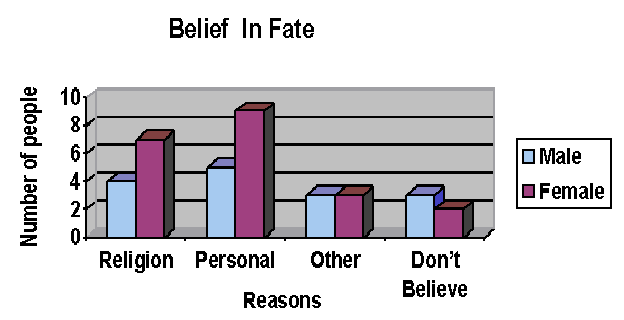 he
Fates dictated the gods and the gods dictated the people’s fate.
he
Fates dictated the gods and the gods dictated the people’s fate.
Fate is not a dominant force in today’s society and it is not pressed upon the
people by the culture. But fate is
still a popular idea. In a survey taken, Over 90% of the sample believes in
fate. Of that 90% about 50% believe
in fate because there religion tells them so, and the other 50% believe in fate
for personal reasons. In
today’s culture belief in fate is a decision made by the individual and the
definition of fate changes from person to person. These definitions are
constructed and influence by events or concepts such as traumatic experience and
the belief that they were put on this planet for a specific purpose.
The Fates
The
Fates were three sisters who determined the length and quality of one’s life. The Fates had power over all mortals; the gods of Olympus
couldn’t even manipulate them to change the thread of a mortal’s life most
of the time (ibc). Their names were
Klotho, Atropus, and Lachesis. Each
of these sisters played a different role in determining one’s fate (ibc).
Klotho combed to wool of one’s life and started the thread (one’s
birth), Lachesis determines the length of the thread (one’s life), and Atropus
cuts the thread (one’s death) (messagenet).
Some say that they all shared one eye (Hamilton).
They were “regarded as
prophetic deities”, whose minister’s were “soothsayers and oracles” (ibc).
In the Odyssey they were “mentioned as the heavy spinners” (messagenet).
Well respected, The Fates “had sanctuaries in many parts of Greece” (ibc).
The Fates were mentioned in many myths and many mythological figures
tried to convince them to change their decisions on one’s fate.
Not many were successful. Psyche
is pictured, one whose fate was complicated and sad. (For more on Psyche, go to http://www.scils.rutgers.edu/special/mjoseph.)
In the story of Meleager, the Fates play a visible role as exemplified in
the following excerpt:
“When
Meleager had been but a few days old, the Fates had appeared at his mother’s
bedside. Your son will become a
brave hero,” the first foretold. “Your son will be a great man,” prophesied the second,
“Your son,” concluded the third, “will live until that brand on the hearth
is consumed by fire” (Schwab 145).
As
one can see, having your fate determined for you can be a very unchanging and
disappointing thing. Most have some
joy in their fates, but also much sadness.
These Fates were powerful and not to be convinced to change their minds.
One’s fate really can’t be altered where these women were concerned.
Interesting
Fate Sites To Check Out:
http://www.evilfate.50megs.com/index.html
http://www.ibtcenter.com
By
Gilgamesh
David
Just
Christine
Dahlen
Jody
Oltman
Evan
Dooley
Rebecca
Bailey
Bibliography
Encyclopedia Britannica Online
[Accessed March 17, 2001].
Evil
Fate.
Website. http://www.evilfate.50megs.com/index.html
[Accessed
March 15, 2001].
IBT.
Website.
http://www.ibtcenter.com
[Accessed March 15, 2001].
Microsoft
Encarta Encyclopedia. Microsoft, 1999.
The
New American Webster Handy College Dictionary. Signet.
New York, 1994.
Webster’s
New Thesaurus.
Russell, Geddes, & Grosset, Windsor Court, New York, 1990.
WWWebster
Dictionary. [Accessed March 17, 2001].
http://www.travel-italy.com/ct/episodes/fate.html
http://www.human-nature.com/free-associations/emm.html
“The
Spindle” by Boria Sax, Parabola winter 2000, vol. 25
“The
Three Threads of the Cord” by Annie Besant, Parabola winter 2000, vol.
25
Hamilton,
Edith. Mythology. New York: New American Library. 1953.
http://ibc.wustl.edu/moiria/ling-yellow/fates.html
http://www.messagenet.com/myths/bios/fates.html
http://www.scils.rutgers.edu/special/mjoseph
Schwab,
Gustav Benjamin. Gods and
Heroes. New York: Pantheon. 1946.
Survey,
Done By David Just over the week of 9-17th of march.
WWW.GreekMythology.com