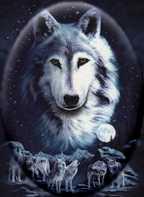
Wolves belong to the family called "Canidae". Wolves are wild animals that look much like a large German Sheperd dog, but have longer legs and larger feet. They also have more powerful jaws, a wider head, and short ears that always stand up straight. Wolves also have long, bushy tails. Most male wolves weigh considerably more than 100 pounds, but females weigh less. Wolves can travel for hours at about 20 miles per hour.Wolves may be white, gray, brown, or black. In general, wolves of the northern and arctic regions are lighter in color than those of the southern forests. The artic wolf may be pure white. The timber wolf is often called the gray wolf, because it's long, thick coat is medium to light gray. The red wolf, a much smaller animal, gets its name from its reddish coat.
Wolves have strong family ties. They often mate for life. The female usually bears from four to six pups about two months after mating. The pups are usually born in April or May in a den dug in the earth. They do not begin to see until they are about a week old. Both parents supply the pups with food and train them. Wolf families remain together for long periods, and most wolf packs are just family groups.The highest-ranking male is referred to as the "alpha male," and the top female is the "alpha female." When traveling in a pack, the howls or calls of individual wolves help keep the group together.
Wolves live in North America, Greenland, Europe, and Asia. They may be found in northern Canada and Alaska, and a few wilderness areas in the United States, such as in northern Minnesota. The wolves' howls once sounded in almost every part of the United States and Canada, but civilization pushed these animals back until today they are in danger of complete extinction. Bounties (rewards) have been offered for wolf pelts because wolves sometimes kill livestock. In the far north or in wild regions, however, wolves form a vital part of the natural community. Wolves are master hunters and they kill sick or injured caribou, moose, or deer that would be a burden to the herd.
Spirit of the Wolf
As the wolf is pushed to the brink of extinction
She looks back on those who have pushed her there
There is no malice in her eyes
Just a kind of grim understanding
For she knows that, it is not her that is lost
But the tame humans
Who have lost their true spirit
The wild calls to her, and she follows, knowing where her path will lead her
But she follows none the less
For she can no more ignore her spirits
Than she could not be a wolf
And she knows that when she is gone from this world
Her legacy will forever live on
For even if her species is forever gone
The true spirit of a wolf can never die
by:Cheyne Highwind, 1999
Please support the North American Wolf Association
and ensure the survival of these beautiful creatures.....