 |
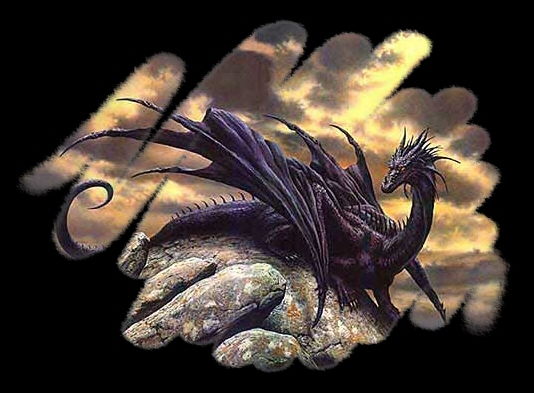
Few
creatures of folklore and mythology conjure up the mental images
of the dragon. Also known as wurm, wyrm and firedrake, these
mercurial creatures pervade almost every pantheon of classical
mythology and have become an integral inclusion of an entire
genre of fantasy literature. |
|
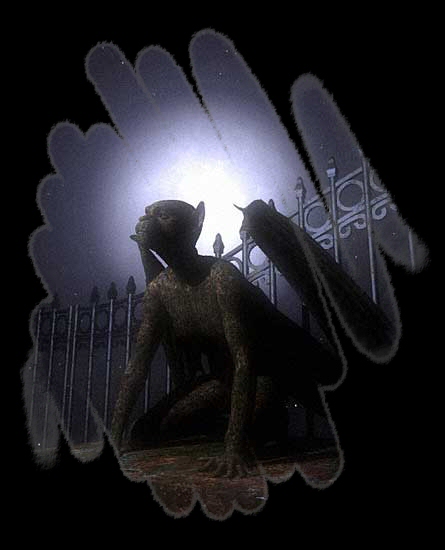
Gargoyles are the grotesque carvings of faces and bodies of
humans and animals. Serving originally as water spouts to direct
the water clear of a wall, they can often be found on (Gothic)
buildings and churches. In medieval times, the function of
Gargoyles changed. They became representations of religious
events, created for the illiterate population to "read". |
 |
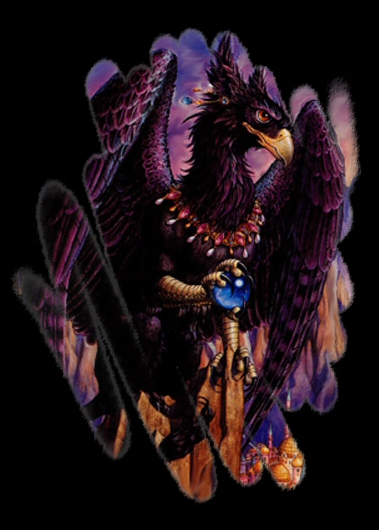 |
The
Griffin is a legendary creature with the head, beak and
wings of an eagle, the body of a lion and occasionally the tail
of a serpent or scorpion. Its origin lies somewhere in the
Middle East where it is found in the paintings and sculptures of
the ancient Babylonians, Assyrians and Persians. In Greek
mythology, they took gold from the stream Arimaspias and,
neighbors of the Hyperboreans, they belonged to Zeus. The later
Romans used them for decoration and even in Christian times the
Griffin motif often appears. Griffins were frequently used as
gargoyles on medieval churches and buildings. |
|
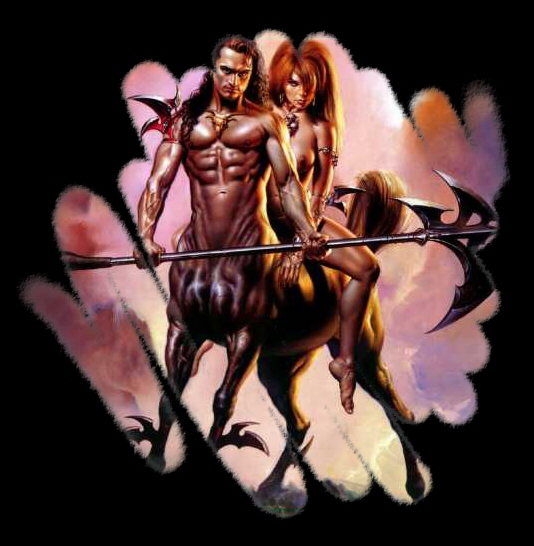
The centaurs of Greek mythology are creatures that are part human and part horse. They are usually portrayed with the torso and head of a human, and the body of a horse. Centaurs are the followers of the wine god Dionysus and are well known for drunkenness and carrying off helpless young maidens. They inhabited Mount Pelion in Thessaly, northern Greece. According to one myth, they are the offspring of Ixion, the king of Lapithae (Thessaly), and a cloud. He had arranged a tryst with Hera, but Zeus got wind of it and fashioned a cloud into Hera's shape. Therefore, the Centaurs are sometimes called Ixionidae. Notorious is their bestial behavior on the wedding of Pirithous, king of the Lapiths. They violated the female guests and attempted to abduct the bride. What followed was a bloody battle, after which they were driven from Thessaly. An exception was the kind and wise centaur Chiron, the teacher of the Greek heroes Jason and Achilles |
 |
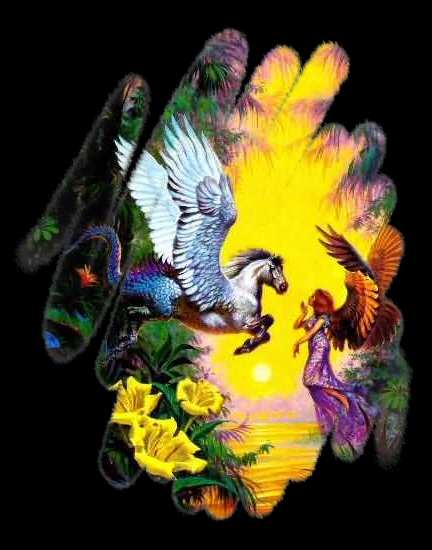 |
In Greek mythology, Pegasus is the winged horse that was fathered by Poseidon with Medusa. When her head was cut of by the Greek hero Perseus, the horse sprang forth from her pregnant body. His galloping created the well Hippocrene on the Helicon (a mountain in Boeotia). When the
horse was drinking from the well Pirene on the Acrocotinth,
Bellerophon's fortress, the Corinthian hero was able to capture
the horse by using a golden bridle, a gift from Athena. The gods
then gave him Pegasus for killing the monster Chimera but when
he attempted to mount the horse it threw him off and rose to the
heavens, where it became a constellation (north of the
ecliptic). |