
The men who translated the Bible under the authority of King James were, I'm sure, under the supposition the world was created in six days. That is probably something they and their ancestors had always been taught. When it came time for them to substitute English words for the original Hebrew, they did what they thought was right. It should be noted that these Hebrew words often have a variety of meanings. In order to keep with
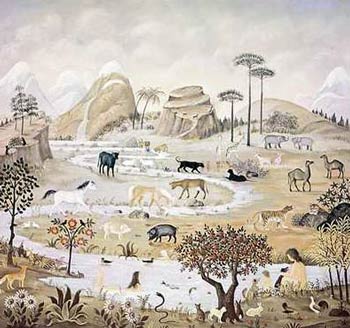
"In the beginning God created the heaven and the earth."
Genesis 1:1
The next verse states:
"And the earth was without form, and void..."
Genesis 1:2
According to Scofield, Thomas Chalmers, and other biblical scholars, it was during this expanse of time that something horrible happened. As in many languages, Hebrew words can actually say more than one thing. With that in hand, lets attempt to see if these translators did indeed translate the words correctly, or if they tried to "fit in" the translation to what they always thought was creation.
The use of the word "was," in the above, really stood out as a convincer for something strange going on in this verse. The word "was" comes from the Hebrew hayah. According to Strong's Concordance, a great guide to Hebrew words, this word primarily means to be, to come to pass, to come about, or fall out. Did the earth begin the way it was stated in Genesis 1:2, or did it become that way? The words "without form," in the English, is the translation of the Hebrew tohuw, which means to lie waste, that which is wasted, or a place of chaos and confusion. The Hebrew for "void" is bohuw: a state of waste or emptiness. Put them all together, and we have another possible translation for this verse:
"And the earth came to be a place of chaos, and waste."
-or-
"And the earth had fallen from its original form, and became a place of chaos and waste."
The question remains: was the earth created that way, or did it become that way? If we look at these other meanings, it seems very possible there was something terrible that occured in between the two verses. You'll also note, in Genesis 1:1, God created the "heaven" and the earth: the word heaven in the singular. However, at the end of the six-day creation, the heavens and earth were finished, and all the host of them (Genesis 2:1). Now, we have heaven as a plural? Whats going on? Why the first one, then the other? Could the first "heaven" have been destroyed, and another brought up to take it's place?
Why would God create a world to be formless and void in the first place? I thought when you create something, it becomes a finished product.
"For thus saith the LORD that created the heavens; God himself that formed the earth and made it; he hath established it, he created it not
in vain, he formed it to be inhabited; I am the LORD; and there is none else."
Isaiah 45:18
Since I truly believe the Bible doesn't contradict itself, this verse seems to clear up everything. It seems God made the earth, and established the foundation to a world, not in vain, but to be inhabited. There was an established world before our own, which was destroyed, for whatever reason. Then, God decided to do something different. As the first chapter of Genesis tells us, He created new "lights" (i.e. the sun and moon) in the sky, thus creating a brand new "heaven" above. At the end of our current "creation," we are given a summary of God's work:
"Thus the heavens and the earth were finished, and all the host of them."
Genesis 2:1
There, according to Genesis, were at least two "heavens" fashioned, by God, at the end of our six-day creation. We, as well, have a very interesting clue to what may have happened before our present foundation of earth, in II Peter 3:3-8:
II Peter 3:3: "Whereby the world that then was, being overflowed with water, perished:
4: But the heavens and the earth, which are now, by the same word are kept in store, reserved unto fire against the day of
judgment and perdition of ungodly men."
Many have asserted this verse refers to Noah and his flood. But if we look at Genesis 1:2, we see this foundation for our current world as covered by a dark expanse of water, and no one survived. There is so much more evidence for this, in my upcoming book, The Rise of Mystery Babylon. What it all boils down to simply: why would a creator create something already demolished? According to Genesis 1:28, God tells mankind to "be fruitful, and multiply, and replenish the earth..." What would there need to be replenish if everything was created brand new? I truly believe that, somewhere in our dateless past, our original heaven and earth were created. The established world, just before our own, was destroyed, for whatever reason. God, in this world, decided to try something new, and set up the foundation for a whole new world: our current planet, and everything now placed in it.
What is the purpose of this ancient speculation, anyway, and why does it matter? As you see, this now sets the stage for so much more of the early parts of Genesis to be "re-interpreted." Is everything else the same as what we were always taught, as well? Was Adam created only, as the first man? What about the rest of the different people we have on our earth today? If everything was created so perfectly, then why did it topple so easily? Perhaps this refashioned world we live in now wasn't created so perfectly. There was a new order and new foundation for our current world; it still may have worked if things remained constant to what Adam was told. God said that our current world was "good" and "very good" (Genesis 1:21, 31), but not more. There could have still been a lot of evil, from the last world, retained to our current world; just held at bay, balancing on the one commandment given to Adam. All it took was for the head of this new order to allow it all to fall apart.
Could there have been more interpretations, which, for whatever traditional or political reason, people have deliberately covered up, or tossed aside? What really was the world like back then, and what really happened to change it to the world it is today?