| Fitness Home & Health Club Exercise & Fitness Equipment Machines. Equipment Aerobic & Cardiovascular Health Exercise Equipment. Sales Tone & Strengthen Muscles from Abs to Calves |
| Treadmill Info |
| Free info |
| Free info |
 |
 |
 |
 |
 |
 |
 |
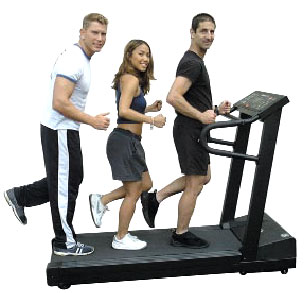
| TREADMILLS Consumers spend more money on treadmills (approximately 2 billion last year) than on any other major piece of equipment. Among the reasons: the learning curve is extremely low; the exercise walking or running--is natural; you have an almost infinite capacity to adjust the level of exertion. Here are some important buying considerations. Prices: Treadmills range greatly in price, from around $200-$400 for low-end "garbage" treadmills that fall apart, can be very dangerous, not to mention noisy and unstable. The recommended price range for an entry-level beginner treadmill is from $700-$1900 and up to $5,000 or more for an excellent quality treadmill. Advice from magazines and books that have tested treadmills also varies greatly. Some say that you should pay at least $1,000 to $1,500 for a good treadmill. Others have tested and recommended machines priced as low as $500. The major difference between a treadmill that costs, say, $500 and one that costs three times as much is durability: in the motors, the construction and the parts. A $500 treadmill is also unlikely to have a sturdy, safe frame, reliable computer, and will require much more service and expense to maintain. If only one 120-pound person is going to use the machine for walking and you don't mind the instability of a wobbly frame or higher noise level, then a treadmill under $1000 is an option. If 200-pounders are going to use the treadmill, a more durable machine will be necessary. The very best choice would be to take a moment, analyze your priorities and realize that you are investing in your health. Many manufacturers indicate weight limits for their treadmills. Without question, you should spend a little extra, and get a good quality exercise machine. Research has shown that people who purchase higher quality exercise equipment, get much more pleasure from it, use it much more, and ultimately get in better shape. If you think about it, it's a small price to pay to get in the best shape of your life while prusuing a longer, healthier and happier lifestyle! Motors: Most treadmills have two motors. One drives the belt, maintaining a constant pace. The other, the lift motor, raises and lowers the running bed to create an incline. Manual treadmills have no motors. They tend to have steep inclines and force the user to work hard to drive the belt and mainitain the pace. Manual treadmills are virtually obsolete because they are tedious to use; and can be very stressful on your back, knees, and joints. The motor that drives the belt should be at least 1.5 horsepower, but horsepower ratings can be determined a couple of different ways (peak performance rating or continuous duty rating), so 1.5 hp is at best a rule of thumb. The treadmill should be reasonablely quiet at higher speeds; the motor should not be whining or laboring; the motion of the belt should remain smooth. The motor should drive the belt at a slow start speed (from 0.5 mph to 1.0 mph). Top speed depends on your intended use; some go as fast as 12 mph (that's a 5-minute mile). Belt Widths and Lengths: Widths range from 17" to 22". Lengths typically vary from 45" to 60". Compare different sizes for comfort and price. Many people find that wider and longer belts provide a more comfortable workout. Cushioning: One of the advantages of a treadmill over running outside is that properly cushioned treadmills reduce impact and trauma to the back, knees, and joints. Cushioning is especially important for people with existing medical problems, injury, pain or joint sensitivity. The bed should absorb shock but not recoil. Nor should the belt move from side to side from the impact of moving feet. Emergency Shut-Off: Most machines have this switch, which stops the machine should you fall off it. Some machines can be turned on only by special safety keys. This allows you to control who may use the machine which is especially necessary when children have access to the equipment. Elevation Option: Most treadmills have a feature that raises the running bed, creating a steeper incline for a more intense workout. A few years ago, you had a choice between motorized or "power" elevation with controls built into the console or a manual system that requires you to stop your workout, get off the machine and adjust the elevation, however due to the popularity of the power elevation feature, manual elevation treadmills have become virtually extinct. Motorized controls cost more, but make for a much more enjoyable and productive workout. Computer Feedback and Control Console: At the very least, you'd probably like the console to tell you your speed, distance and the time expended. Much more sophisticated technology is available, which many consumers like because it provides variety, motivation, distraction from the work at hand and evidence of improving physical condition. Not only do the most advanced consoles offer you a variety of pre-programmed workouts, they allow you to create several different ones to your personal specifications. Some even have digital quarter mile oval tracks to give you a visual display of your progress as you run around a simulated track. One of the newest features on state of the art treadmills is heart rate interactive training (see next). Look for consoles that are easy to read, understand and operate. Heart-Rate Monitors and Controls: There are two types of heart rate monitors: contact monitors or sensors are those you wrap your hands around while working out. Because they must discern the impulses from your heart from those of the muscles in your hand or arm, they are less accurate (particularly when exertion is heavy) than wireless chest monitors that involve a transmitter worn in a belt around your chest that transmit the heart rate via a wireless signal back to the console on the treadmill. Contact heart rate sensors can also be inconvenient and uncomfortable for walkers and runners as the user is unable to swing their arms naturally when grasping the sensors on the front rail of the treadmill. The ultimate heart rate feature is called Heart Rate Controlled/Interactive Technology whereby the equipment will automatically adjust the machine's intensity to keep your heart rate in your Maximum Fat Burning or Cardiovascular Zone. Besides being the most scientifically efficient way to exercise, this feature prevents the user from cheating, thus you cannot "trick" the machine. For example, if the user grabs hold of the side rails for additional help because he or she is tired, thus reducing their heart rate, the machine will automatically increase the elevation until the user's heart rate returns to their Maximum Fat Burning or Cardiovascular Zone. This is not only fascinating technology but really makes sure you get the job done safely and efficiently! Smooth, Quiet Operation: Lack of noise and vibration can be important. You may want to watch TV, listen to music, or even talk on the phone. Space-Saving "Fold" Feature: Some treadmills have running beds that fold up (like a Murphy bed) for storage. When these treadmills first came out back in the mid to late 1990's, they were not as sturdy as conventional "non-folding" treadmills. However, manufacturers have developed more sophisticated engineering and patented structural designs whereby today, the best folding treadmills are just as sturdy as the non-folding type, known as "conventional treadmills." Tips on Using Treadmills: Follow the directions you receive with the machine. Once you've mastered the controls and feel comfortable walking or running on the moving belt, the principal challenge is getting used to the belt length and width and overcoming the feeling you might step off the belt. A little practice usually takes care of that. It's just like riding a bike. In no time, it will become second nature to you. Experiment with the progamming options; they really can help keep you interested and motivated--and help you get in better shape sooner. |

|