2.0
Findings
2.1 Information of Multi-split Unit Air-conditioner Systems
2.1.1
Nominal Cooling
Capacity (1 outdoor unit with 4 indoor units)
|
Manufacturer |
Model |
Nominal Cooling Capacity |
|||
|
Outdoor |
Indoor |
Total Capacity(KW) |
Individual (KW) |
Total BTU/h |
|
|
Carrier |
38ACE0025 |
42ACE0025 |
7.00 |
1.76 |
24,000 |
|
Mitsubishi |
MXY-26SV |
MSXY-9SV |
7.50 |
1.88 |
25,600 |
|
Fujitsu |
AOY24AM4 |
ASY9ANx4 |
7.04 |
1.76 |
24,000 |
|
McQuay |
MMSH66K66A |
MWMS010Fx4 |
7.50 |
1.88 |
25,600 |
Figure 1-1 Table show the nominal cooling
Capacity (Btu/h) of multi-split air-
conditioner
systems on the different manufacturers and different models.
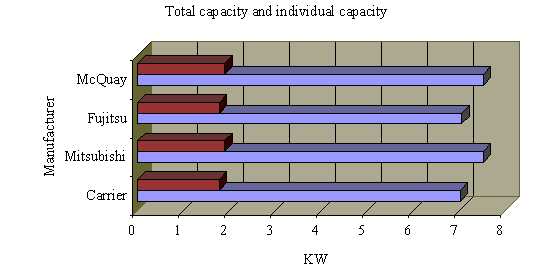
Figure 1-2 The bar chart show the total
capacity and individual capacity of the ai-
conditional
system from different manufacturer.
2.1.1.1
From the bar chart above, it
shows that the Mitsubishi and McQuay multi-split air conditioner system has
6.67% more total cooling capacity than Carrier and Fujitsu air conditioner
system. Both also has 6.38% more than
Carrier and Fujitsu air conditioner system.
The results showing that the Mitsubishi and McQuay air-conditional
system has better efficiency of the nominal cooling capacity. That means they
can provide sufficient cooling air than other systems.
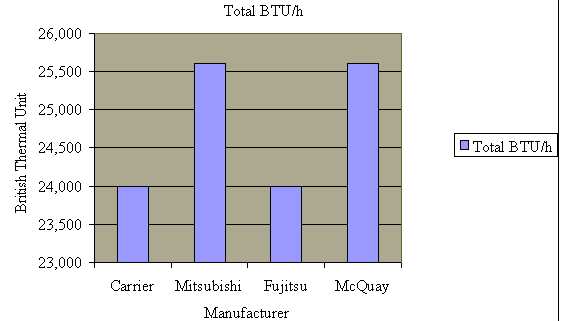
Figure 1-3 Shown
the total British Thermal Unit per hour of
Carrier, Mitsubishi,
Fujitsu
and McQuay Multi-split air-conditional system.
2.1.1.2
From the bar chart (Figure
1-3), we have know that all of them
can provide at least 24,000 BTU/h,
Mitsubishi and McQuay multi-
split air-conditional system are 6.25%
more than the other two,
they provide up to 25,600 BTU/h. That means both can provide
sufficient cooling air than other
systems.
2.1.1.2.1
Although horse power is
commonly used to indicate the capacity of an air conditioner, the scientific
measure is BTU/HR (British Thermal Unit per hour). One BTU/HR is the quantity
of heat required to raise the temperature of one pound of water one degree
Fahrenheit. The conversion from horse power to BTU/HR is as follows:
Cooling
Capacity
|
|
|
Horse Power |
BTU/HR |
|
1 |
9,000 |
|
1.5 |
12,000 |
|
2 |
18,000 |
|
2.5 |
24,000 |
Figure
1-4 Table shwon conversion of
horse power to BTU/h.
2.1.2
Air Flow Rate (1
outdoor unit with 4 indoor units)
|
Manufacturer |
Model |
Air Flow Rate (cfm) |
|
|
Outdoor |
Indoor |
||
|
Carrier |
38ACE0025 |
42ACE0025 |
240 |
|
Mitsubishi |
MXY-26SV |
MSXY-9SV |
279 |
|
Fujitsu |
AOY24AM4 |
ASY9ANx4 |
235 |
|
McQuay |
MMSH66K66A |
MWMS010Fx4 |
270 |
Figure 1-5 Table showing the multi-split
air-conditioner systems air flow rate (cfm),
on
the different manufacturers and different models.
2.1.2.1 Properly sized equipment will operate more efficiently,
dehumidify better in the summer, last longer and provide you with a more
comfortable indoor environment to live in. To determine what size of
air-conditioner you need for your house we must first determine the cooling
loads on the house. The cooling airflow
needed in Cubic Feet Per Minute (Cfm) to allow the system to operate at rated
efficiency.

Figure 1-6 Chart show the multi-split air-conditioner systems’s air flow rate (cfm),
on the
different manufacturers and different models.
2.1.2.2 The above bar chart shows that the
Mitsubishi multi-split air conditioner system, has 3.23% air flow rate higher
than McQuay air conditioner system, 11.11% higher than Carrier air conditioner
system, and 15.77% higher than Fujitsu
air conditioner system. Thus in the selection of low rate, the
Mitsubishi system tends to be the leading in this field.
2.1.3 Power
Consumption
|
Manufacturer |
Model |
Power Consumption (KW) |
|
|
Outdoor |
Indoor |
||
|
Carrier |
38ACE0025 |
42ACE0025 |
2.44 |
|
Mitsubishi |
MXY-26SV |
MSXY-9SV |
2.26 |
|
Fujitsu |
AOY24AM4 |
ASY9ANx4 |
2.44 |
|
McQuay |
MMSH66K66A |
MWMS010Fx4 |
2.36 |
Figure 1-7
Table showing the multi-split air-conditioner systems power consumption (KW),
on
the different manufacturers and different models.
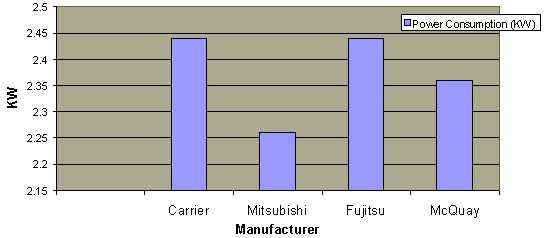
Figure 1-8 – Bar
chart showing the total power consumption in KW.
2.1.3.1 The energy saving
is considered how much of power
consumption, that air-conditioner system
is draw up
during operation period. If the system
power
consumption is higher, then the extra
energy is used and
extra costs has to be paid.
2.1.3.2 The above bar
chart shows that the Fujitsu multi-split air
conditioner
system, and the Carrier multi-split air conditioner system is used 7.4% of
energy more than Mitsubishi air conditioner system, 3.3% higher than McQuay air
conditioner system. This is showing
that the Fujitsu system required more energy to perform operation.
2.1.3.3 Mitsubishi air
conditioner system is more energy saving
than others. It has the lowest power consumption.
2.1.4 Operation
Noise
|
Manufacturer |
Model |
Noise Level
(dBA) |
|
|
Outdoor |
Indoor |
||
|
Carrier |
38ACE0025 |
42ACE0025 |
45 |
|
Mitsubishi |
MXY-26SV |
MSXY-9SV |
35 |
|
Fujitsu |
AOY24AM4 |
ASY9ANx4 |
52 |
|
McQuay |
MMSH66K66A |
MWMS010Fx4 |
56 |
Figure 1-9 Table showing
the multi-split air-conditioner systems’s operation noise
in (db) on the different manufacturers
and different models.
2.1.4.1
During operation,
air-conditioner system will produce noise.
This noise may cause unconformable living environment. For
the level of noise
is measuring by a unit call decibel (dBA).
2.1.4.2
The above table shows that the
Mitsubishi air conditioner system is the most quiet than others. It is less than McQuay air conditioner
system by 21 db, less than Fujitsu air conditioner system by 17 db, and less
than Carrier air conditioner system by 10 db.
2.1.4.3
The Mitsubishi MSXY series
units work silently to create a comfortable environment is because of quality
engineering and advanced features that provide the lowest noise levels.
|
Place |
Empty Recording Studio |
Empty Concert Hall |
Quiet
Library |
|
Noise
level (dBA) |
20 |
30 |
40 |
Figure 1-10 Table
showing the noise level in 3 different places which
have a quiet environment.
2.1.5 Total Current
|
Manufacturer |
Model |
Running Current Amp |
|
|
Outdoor |
Indoor |
||
|
Carrier |
38ACE0025 |
42ACE0025 |
10.6 |
|
Mitsubishi |
MXY-26SV |
MSXY-9SV |
10.91 |
|
Fujitsu |
AOY24AM4 |
ASY9ANx4 |
10.6 |
|
McQuay |
MMSH66K66A |
MWMS010Fx4 |
10.2 |
Figure 1-11
Table showing the multi-split air-conditioner systems running current Amp
on the different manufacturers and
different models.
2.1.5.1
From the table we known that
Mitsubishi air conditioner
system have the highest
running current. It is more than
Carrier and Fujitsu air
conditioner system 0.31 Amp, and
0.71 Amp more than McQuay air
conditioner system.
2.1.5.2
McQuay air conditioner system
have the lowest current rate
when it operate. This mean that the system would not be
over heat easily than others
air conditioner system.
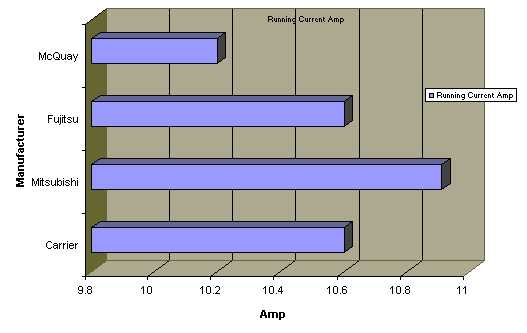
Figure 1-12 Bar
chart showing the multi-split air-conditioner systems
running current Amp on the different
manufacturers and
different models.
2.1.6 Dimensions
2.1.6.1
Indoor unit
|
Manufacturer |
Model |
Height (mm) |
Width (mm) |
Depth (mm) |
Indoor
|
||||
|
Carrier |
42ACE0025 |
295 |
1080 |
185 |
|
Mitsubishi |
MSXY-9SV |
278 |
850 |
191 |
|
Fujitsu |
ASY9ANx4 |
260 |
815 |
168 |
|
McQuay |
MWMS010Fx4 |
290 |
815 |
179 |
Figure 1-13 Table shown the physical dimension of
the indoor unit from
different manufacturer.
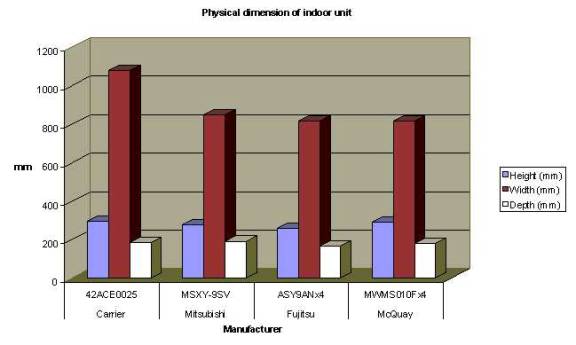
Figure 1-14 Bar chart shown the physical dimension of the indoor
unit
from
different manufacturer.
2.1.6.2 Outdoor unit
|
Manufacturer |
Model |
Height (mm) |
Width (mm) |
Depth (mm) |
Outdoor
|
||||
|
Carrier |
38ACE0025 |
590 |
800 |
300 |
|
Mitsubishi |
MXY-26SV |
750 |
900 |
300 |
|
Fujitsu |
AOY24AM4 |
700 |
900 |
350 |
|
McQuay |
MMSH66K66A |
646 |
840 |
330 |
Figure 1-15 Table shown the physical dimension of
the outdoor unit from
different manufacturer.
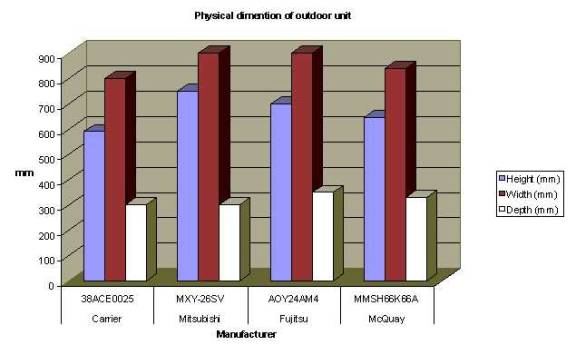
Figure 1-16 Bar chart shown the physical dimension
of the outdoor unit
from different manufacturer.
2.1.7 Price
|
Manufacturer |
Model |
Price (S$) |
|
|
Outdoor |
Indoor |
||
|
Carrier |
38ACE0025 |
42ACE0025 |
5,499.00 |
|
Mitsubishi |
MXY-26SV |
MSXY-9SV |
5,350.00 |
|
Fujitsu |
AOY24AM4 |
ASY9ANx4 |
5,788.00 |
|
McQuay |
MMSH66K66A |
MWMS010Fx4 |
5,488.00 |
Figure 1-17 Table shown the price of the multi-split
air-conditioner systems,
on the different manufacturers and
different models.
2.1.7.1 The price is a very
important factor when people want to
purchase a product. They will look into all the necessary
operation information and the
prices before they purchase
that product.
2.1.7.2 The table above
shown that the price of the four
manufacturer are different between S$11 to S$438.
2.1.7.3 Mitsubishi air
conditioner system have the most
reasonable price, which is S$ 5,350.00. Compare to
Fujitsu air conditioner system which is S$
5,788.00, it is
cheaper than it S$438.00.
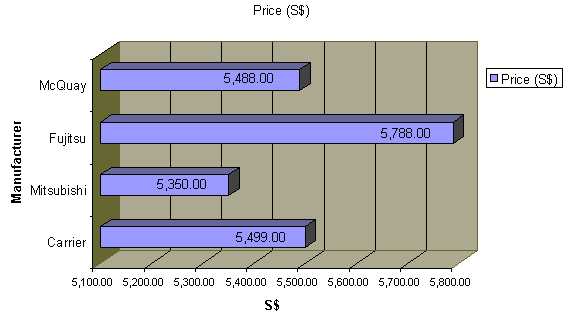
Figure 1-18 Bar chart shown the price of the
multi-split air-conditioner systems,
on the different manufacturers and
different models.
2.1.8
Air filter
2.1.8.1 Carrier air conditioner system
2.1.8.1.1
It is fitted with double
effect filter (air purifying
and
deodorizing filter) to remove odours as it
purifies the air.
2.1.8.1.2 Its
electrostatic filter remove micro-particle
including tobacco smoke, viruses and pollen
while the activated charcoal absorbs unpleasant
odours to ensure a cleaner, fresher-smelling
environment.
2.1.8.1.2
Picture not available.
2.1.8.2 Mitsubishi air conditioner system
2.1.8.2.1
The MSXY Series features both
deodorizing and air-cleaning filters as standard equipment.
2.1.8.2.2
These filters work together to
effectively remove dust particles, germs and other contaminants from the air to
keep it as fresh and pure as possible.
2.1.8.2.3
The deodorizing filter should
be soaked in water every two weeks to maintain its efficiency and replaced once
a year.
2.1.8.2.4
Under normal operating
conditions, the air-cleaning filter should be replaced every four months.
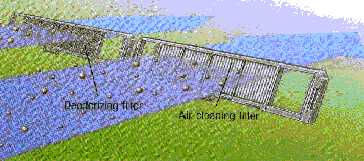
Picture 1-1 Deodorizing and Air-Cleaning Filters
2.1.8.3 Fujitsu air conditioner system
2.1.8.3.1
The Air Purifying Filter catch
various kinds of dust undetectable to the eye, mites, pollen, and cigarette
smoke, as well as other tiny particles down to 0.01mm.
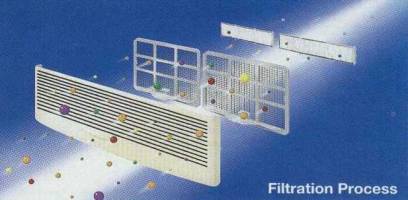
Picture 1-2 Fujitsu filtration process
2.1.8.4 McQuay air conditioner system
2.1.8.4.1
Three stage air purifying
filters.
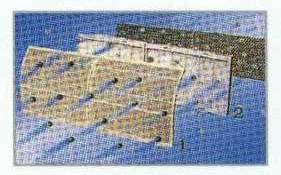
Picture 1-3 Air Purifying Filters from McQuay
2.1.8.4.2
Cleaner Air
2.1.8.4.2.1
The anti-fungus pre-filter and
blower removes comparatively large particles such as dust from the air to
ensure the cleanliness of the cool air and prevert fungus and bacteria from
breeding.
2.1.8.4.3
Purer Air
2.1.8.4.3.1
The electrostatic filter then
further enhances the purity of the air by removing microscopic air particles as
small s 0.01 micron.
2.1.8.4.4
Odourless Air
2.1.8.4.4.1
The deodorising filter removes
any unwanted odours and thus creates a healthy and pleasant living environment.
2.1.8.4.5
All filters feature a
One-Touch design that
allows them to be conveniently slid out for
cleaning.
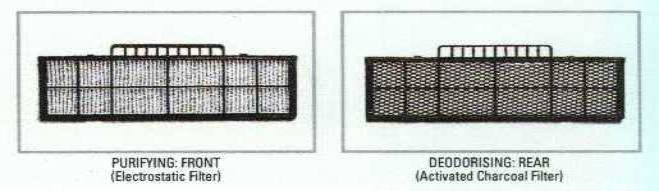
Picture 1-4
Two filter from McQuay
2.1.9
Compressor
2.1.9.1 Carrier air conditioner system
2.1.9.1.1
The newly designed twin-rotary
compressor has two cylinders (lower and upper) which provide more stable and
noiseless operation with high efficiency in the wide performance range.
2.1.9.1.2
Vibrations have been greatly
reduced by balanced compression over the range from low to high revolving
speeds.
2.1.9.1.3
Optimum design of mufflers,
valves, frame-fixing system have reduced noise to a great extent.
2.1.9.1.4
Picture not available.
2.1.9.2 Mitsubishi air conditioner system
2.1.9.2.1
The MXY Series outdoor unit
features a twin rotary compressor that provides balanced rotation.
2.1.9.2.2
The centrifugal force of one
roller is counterbalanced by the other.
2.1.9.2.3
For significanly reduced
vibration and noise.
2.1.9.2.4
It’s exactly this kind of
technology that makes outdoor units so quiet.
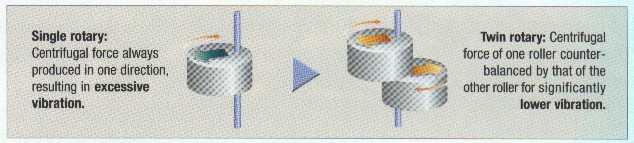
Picture 1-5 Mitsubishi Twin-Rotary Compressor
2.1.9.3 Fujitsu air conditioner system
2.1.9.3.1
This Compressor provide a
quiet and efficient performance.
2.1.9.3.2
It work at economical rate.
2.1.9.3.3
Picture not available.
2.1.9.4 McQuay air conditioner system
2.1.9.4.1
High efficiency rotary
compressor.
2.1.9.4.2
Advanced rotary compressor is
designed to work more quietly and to deliver high EER (Energy Efficiency Ratio)
to provide energy saving.
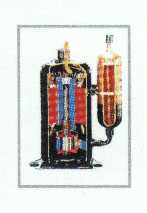 Picture 1-6 McQuay compressor