The Effects of Indian Ocean Dipole
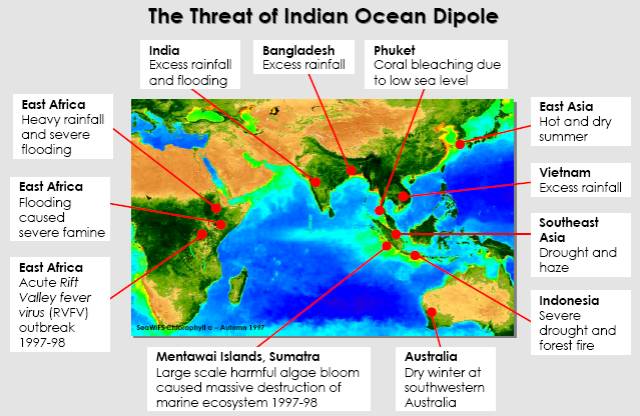
Eastern Indian
Ocean
· Drought
at the eastern Indian Ocean
o
Could
possibly cause more forest fires that lead to serious haze event.
o
Nutrients in smoke from the 1997 Indonesian wildfires
produced a large algae bloom. (http://www.redtidealert.com/TheFireTheory.html)
o
Shortage of water supply that will affect the economic
activities and daily life.
· Upwelling
and large phytoplankton bloom at the western Sumatra to southern Java
o
Death of nearly all coral and fish in a 400 km stretch of the
Mentawai Islands reef, southwest of Sumatra in Indonesia, in 1997. (http://www.redtidealert.com/TheFireTheory.html)
o
The coastal marine environment that being affected by 2004
tsunami could face serious threat again during IOD.
· Lowering
of Sea Surface Height
o Bleaching of coral at Phuket, Thailand (http://www.springerlink.com/openurl.asp?genre=article&issn=0025-3162&volume=141&issue=1&spage=21
)
Western Indian Ocean
· Heavy
rainfall
o
Unusually
heavy rainfall and flood over Kenya, Somalia and Ethiopia (http://www.nature.com/nature/journal/v401/n6751/full/401337a0_fs.html).
o
Almost 2 m —
rise in the level of Lake Victoria. (http://www.agu.org/pubs/crossref/1999/1999GL900165.shtml)
o
From late
October 1997 through January 1998, torrential rains occurred in most of East
Africa, resulting in the worst flooding in the region since 1961 and rainfall
that was 60-100 times the seasonal average (http://www.cdc.gov/mmwr/preview/mmwrhtml/00051976.htm)
o
The floods
have also caused extensive damage to crops, both in the field and in stores, as
well as losses of large numbers of livestock. Severe damage has also been
inflicted on the sub-region’s infrastructure (roads, bridges, rail lines),
seriously disrupting the movement of goods within and between countries. In
some countries such as Somalia and Kenya loss of human life has been
significant. Food assistance is currently being provided to the affected people
in these countries but substantial assistance is still urgently needed not only
in the form of food but also as logistical support in view of transport
difficulties. In the sub-region as a whole some 10 million people currently
require emergency assistance. (http://www.fao.org/documents/show_cdr.asp?url_file=/DOCREP/004/W7832E/W7832E00.HTM)
· Disease
outbreak
o
Acute Rift Valley fever virus
(RVFV) outbreak 1997-98. Estimate approximately 27,500 infections occurred, making
this the largest recorded outbreak of RVFV in East Africa. (http://www.cdc.gov/ncidod/EID/vol8no2/01-0023.htm)
o
Rift Valley
fever (RVF) is an arthropod-borne (primarily mosquito), acute, febrile, viral
disease of sheep, cattle, and goats. The disease in these species is
characterized by high abortion rates, high mortality in neonates, and hepatic
necrosis. (http://www.vet.uga.edu/VPP/gray_book/FAD/rvf.htm)
o
The
outbreaks have generally occurred in otherwise dry areas following periods of
heavy rainfall. (http://www.vet.uga.edu/VPP/gray_book/FAD/rvf.htm)
India, Bangladesh and Vietnam
· Excess
rainfall (http://www.deccanherald.com/deccanherald/mar112004/snt2.asp)
Eastern Asia
· Hot
and dry summer (http://www.deccanherald.com/deccanherald/mar112004/snt2.asp)
Australia
· Dry
winter at southwestern Australia (http://www.deccanherald.com/deccanherald/mar112004/snt2.asp)
References
Nerilie J. Abram,
Michael K. Gagan, Malcolm T. McCulloch, John Chappell, and Wahyoe S. Hantoro
(2003). Coral
Reef Death During the 1997 Indian Ocean Dipole Linked to Indonesian Wildfires. Science, Vol. 301 (5635), 952 – 955, DOI:
10.1126/science.1083841. (http://www.sciencemag.org/cgi/content/full/sci;301/5635/952)
Letters: The
Sudden Death of a Coral Reef ,Bert W. Hoeksema, Daniel F. R. Cleary;, N. J.
Abram, M. K. Gagan, M. T. McCulloch, J. Chappell, and W. S. Hantoro
Science 27 February 2004: 1293-1294 (http://www.sciencemag.org/cgi/content/full/sci;303/5662/1293b)
|
Technical
Comments: Response to Comment on "Coral Reef Death During the
1997 Indian Ocean Dipole Linked to Indonesian Wildfires", Nerilie J.
Abram, Michael G. Gagan, Malcolm T. McCulloch, John Chappell, and Wahyoe S.
Hantoro, Science 27 February 2004: 1297. (http://www.sciencemag.org/cgi/content/full/sci;303/5662/1297b)
B. Brown, K.
Clarke, and R. Warwick (2002). Serial
patterns of biodiversity change in corals across shallow reef flats in Ko
Phuket, Thailand, due to the effects of local (sedimentation) and regional
(climatic) perturbations. Marine Biology, Vol. 141(1),
21-29, DOI: 10.1007/s00227-002-0810-0. (http://www.springerlink.com/openurl.asp?genre=article&issn=0025-3162&volume=141&issue=1&spage=21
)
H. H. Saji, B. N. Goswami, P. H. Vinayachandran, T.
Yamagata, (1999). A dipole mode in the tropical Indian Ocean. Nature,
401, 360.
(http://www.nature.com/cgi-taf/DynaPage.taf?file=/nature/journal/v401/n6751/full/401360a0_fs.html)
Webster,
P. J., Moore, A. M., Loschnigg, J. P. & Leben, R.R. (1999). Coupled
ocean–atmosphere dynamics in the Indian Ocean during 1997–98. Nature, 401, 356-360 (http://www.nature.com/cgi-taf/DynaPage.taf?file=/nature/journal/v401/n6751/full/401356a0_fs.html).
David Anderson
(1999). Climatology:
Extremes in the Indian Ocean. Nature, 401, 337 – 338, doi:10.1038/43807. (http://www.nature.com/nature/journal/v401/n6751/full/401337a0_fs.html)
Birkett,
C., Murtugudde, R. & Allan, T. (1999). Indian Ocean
climate event brings floods to East Africa’s lakes and the Sudd marsh. Geophys.
Res. Lett., 26, 1031-1034. (http://www.agu.org/pubs/crossref/1999/1999GL900165.shtml)