|

Like a Stone Wall
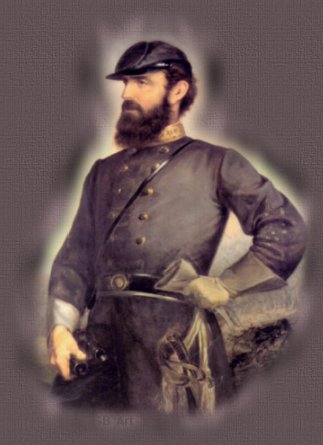
He served with distinction under Winfield Scott in the Mexican War and from 1851 to 1861 taught at the Virginia Military Institute. He resigned from the army in Feb., 1852. At the beginning of the War Between the States, Jackson, practically unknown, was made a colonel of Virginia troops and sent to command at Harpers Ferry. After J. E. Johnston superseded him there in May, 1861, Jackson was given a brigade in Johnston's army and made a Confederate brigadier general. At the first battle of Bull Run, he and his brigade earned their sobriquet by standing (in the words of Gen. Barnard Bee) �like a stone wall.�
The Valley Campaign
Jackson was promoted to major general, and in November, Johnston assigned him to command in the Shenandoah valley. Jackson's attack on James Shields's division at Kernstown on March 23, 1862, was repulsed but forced the retention of Union troops in the valley. In April, Robert E. Lee suggested that Jackson fall upon Nathaniel P. Banks's force in the lower valley, hoping that Irvin McDowell's army would thereby be diverted from joining George McClellan before Richmond. Jackson's renowned Valley campaign resulted. He first defeated part of John C. Fr�mont's force at McDowell (c.25 mi/40 km W of Staunton) on May 8, 1862, and then, returning to the Shenandoah, routed Banks at Front Royal and Winchester (May 23�25) and drove him across the Potomac. The Federal administration, fearing that Jackson would now advance on Washington, sent Shields from McDowell's army to join Fr�mont, advancing from the west, in cutting off Jackson. Stonewall, however, retreated rapidly to the head of the valley and on June 8�9 defeated his pursuers at Cross Keys and Port Republic.
Seven Days Battles through Chancellorsville
With the diversion in the Shenandoah Valley a complete success, Jackson joined Lee in the Seven Days battles. After the brilliance of the Shenandoah campaign, his service in that week of fighting was disappointing. But he soon redeemed himself. The speedy turning movement executed by his �foot cavalry� against Pope late in Aug., 1862, at the battle of Cedar Mt. set the stage for the crushing victory at the second battle of Bull Run, and in the Antietam campaign he marched promptly to Lee's aid after he had captured the Harpers Ferry garrison.
When Lee reorganized the Army of Northern Virginia after Antietam, he made Jackson commander of the 2d Corps, and Stonewall was promoted to lieutenant general. He ably commanded the Confederate right in the battle of Fredericksburg in December. In the battle of Chancellorsville, Lee and Jackson repeated the tactics of second Bull Run. Jackson's turning movement completely crumbled Hooker's right (May 2, 1863). Pressing on in the darkness, Stonewall Jackson was mortally wounded by the fire of his own men.
Following the amputation of his arm, he died eight days later on May 10, 1863, from pneumonia. His death was a severe blow to the Southern cause. Upon hearing of his death, General Robert E. Lee remarked, with deep feeling: "He has lost his left arm; but I have lost my right arm." Jackson was a tactician of first rank and, though a strict disciplinarian, had the affection of his men. His devout Calvinism, fighting ability, and arresting personal quirks make him one of the most interesting figures of the war. He was Lee's ablest and most trusted lieutenant.
The Columbia Encyclopedia, Fifth Edition Copyright �1993, Columbia University Press
When Stonewall died his last words were "Let us cross over the river, and rest under the shade of the trees."
It is said that after Stonewall Jackson's death, the angels of the Lord came down to his grave to bear his soul to Glory. But when they reached the cemetery, they found that his soul was not there. Sorrowing, they returned to Heaven, only to learn that by a rapid flank movement, Jackson had already gotten in.
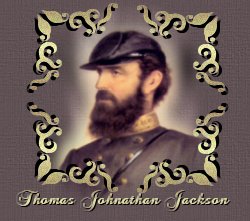
Stonewall Jackson's Way
John Williamson Palmer
1825�1896
Come stack arms, Men! Pile on the rails,
stir up the camp-fire bright;
no matter if the canteen fails,
we'll make a roaring night.
Here Shenandoah brawls along,
there burly Blue Ridge echoes strong,
to swell the Brigade's rousing song
of "Stonewall Jackson's Way."
We see him now -- the old slouched hat
cocked o'er his eye askew,
the shrewd, dry smile, the speech so pat,
so calm, so blunt, so true.
The "blue-light elder" knows 'em well;
says he, "That's Banks -- he's fond of shell;
Lord save his soul! We'll give him" -- well,
that's "Stonewall Jackson's Way."
Silence! Ground arms! Kneel all! Caps off!
Old Blue-light's going to pray.
Strangle the fool that dares to scoff!
Attention! Its his way.
Appealing from his native sod,
in forma pauperis to God --
"Lay bare thine arm, stretch forth thy rod!
Amen!" That's "Stonewall's Way."
He's in the saddle now. Fall in!
Steady! The whole brigade!
Hill's at the ford, cut off -- we'll win
his way out, ball and blade!
What matter if our shoes are worn?
What matter if our feet are torn?
"Quick step! We're with him before dawn!"
That's "Stonewall Jackson's Way."
The sun's bright lances rout the mists
of morning, and by George!
Here's Longstreet struggling in the lists,
hemmed in an ugly gorge.
Pope and his Yankees, whipped before,
"Bay'nets and grape!" Near Stonewall roar;
"Charge Stuart! Pay off Ashby's score!"
Is "Stonewall Jackson's Way."
Ah! Maiden, wait and watch and yearn
for news of Stonewall's band!
Ah! Widow read with eyes that burn
that ring upon thy hand.
Ah! Wife, sew on, pray on, hope on!
Thy life shall not be all forlorn.
The foe had better ne'er been born
that gets in "Stonewall's Way."



|
|
|
|
|
|
|
|
|
|
|
|
|