
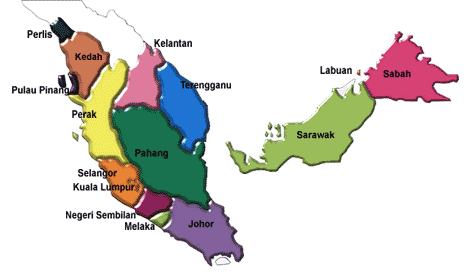
Perlis
The smallest state in
the country, Perlis was once a part of Kedah, which the Thais conquered in 1821.
When Kedah was subsequently restored to the Sultan of Kedah, Perlis was
separated from it. Perlis was then made into a separate vassal with its own
raja. Similar with Kedah, power was transferred from the Thais to the British in
1909 under the Anglo-Siamese Treaty. During the Japanese Occupation in World War
II, Perlis was returned to Thailand. When the Japanese surrendered, Perlis came
under British protection until it gained independence under the Federation of
Malaya in 1957.
Kedah
Together with Perlis, Perak, and Kelantan, this northwest state shares a common border with Thailand in the north. Known as the "Rice Bowl of Malaysia", the Kedah-Perlis rice plains produce more than half of the country's home grown rice supply.
Pulau Pinang (Penang)
Penang is made up of Penang Island and the Province of Wellesley in mainland Malaysia. The name of the state is derived from the Pinang tree
which was found in abundance on the island. The word "pulau" means island.
Originally a territory of the Sultan of Kedah, Penang was largely unoccupied
until 1786. According to the annals of history, Francis Light of the British
East India Company was very captivated by the island's immense beauty.
Foreseeing its potential as an excellent trading port, he persuaded the then
Sultan to concede the island to the British rule in exchange for protection
against his Siamese enemies.
The task of clearing the jungle was given to Light. Legend has it that Light
filled cannons with gold and silver coins, blasted them into the surrounding
jungles, and then sent workers out to clear the jungle. It got the job done!
Thanks to Light's far-sight, the island soon became a busy entry port for tea
and opium trading between India and China. Penang today is a tourist
destination.
Perak
The name of the state "Perak", which means silver in Malay, is derived from the silvery tin ore that was found and mined in abundance here until the turn of the century. In its early years, Perak underwent much turmoil and strife. Rich in deposits, it was an attractive target for foreign domination. It was first ravaged by the Achinese in the 16th Century, then the Bugis, followed by the Dutch, and finally by the British at the turn of the 19th Century. Today, this ever harmonious state is vibrant and thriving with bustling townships.
Pahang
The east coast state of Pahang is the largest in Peninsula Malaysia and is perhaps nature's gift to the country.
Pahang is rich in natural resources with two-thirds of the state covered by tropical forests.
Selangor
Selangor, with an area of approximately 8,000 sq. km, extends along the west coast of Peninsular Malaysia at the northern outlet of the Straits of Malacca. Its advantageous geographic position and rich natural resources have made Selangor the most prosperous state in Malaysia. Today it has the distinction of being the most populated state in Malaysia, with about 3.75 million inhabitants.
Negeri Sembilan
Negeri Sembilan literally
means "Nine States" (negeri=state, sembilan=nine), so named because it comprises a federation of nine states.
Negeri Sembilan is the only state which practices the tradition of "Adat Perpatih". A Sumatran tradition, Adat Perpatih
is a unique custom that emphasizes on the matrilineal system where the woman is
regarded as the head of the home. This code of ethic still filters through the
social-culture of the people here, including the system of government. The state is rich in culture and traditions. Colorful music, dance, and games like the Cak Limpong, Tumbuk Kalang, Dikir Rebana, Tarian Randai, and Bongai have been passed down through generations. Today, they form an integral part of social lifestyle especially in the rural areas
here.
Melaka (Malacca)
Melaka was founded by an exiled Hindu prince, Parameswara, from Palembang in Sumatra in 1402.
Legend has it that Parameswara and his followers were resting under a tree in a
foreign land when he suddenly witnessed a strange incident. A mousedeer had
kicked his hunting into the river. Amused, he took it as a good sign and named
the land after the Melaka tree. Historically, Melaka was a major trading center
and port-of-call for ships from the four corners of the world. It was colonized
by the Portuguese in the 16th century. Today Portuguese influence is still
present in Malaccan culture.
Johor (Johore)
Situated at the southern end of Peninsula Malaysia, Johor is the third largest state in the country. It was named after the Sungai Johor, which is the longest river in the state.
Kelantan
This northeastern
state, which means the "Land of Lightning", shares a common border with
Thailand. The state is known for its rustic fishing villages, verdant padi
(rice) fields, and languid, palm-fringed beaches. It is also the cradle of Malay culture, crafts, and religion.
Batik making, wau (a traditional kite) flying contests, traditional woodcarvings
are the norm here.
Terengganu
Terengganu's history goes back to as far as the 1st Century and has long been an important area of Malay settlement. Throughout that time up to the present day, Terengganu has been ruled by 16 Sultans.
Sabah
Located at the northeast
corner of Borneo, Sabah was known in ancient times as the "Land Below The Wind" because it lies below the typhoon belt. Sabah's terrain is rugged, with Mt. Kinabalu, at 4,101 metres, dominating the surrounding landscape. It has a wide diversity of flora and fauna, as well as one of the world's largest rainforests. Sabah's people comprise 31 different indigenous groups, including the Kadazans, Muruts, Bajaus, Kedayans, Sulu, Bisaya, Rumanau, Minokok, and Rungus.
Sarawak
Dubbed as the "Land of Natural Wonders and Friendly Hornbills", Sarawak is the largest state in Malaysia spanning 124,000 sq. km. A land of many rivers, rolling terrain, and majestic mountains, Sarawak has also been described as a "Land of Superlatives". It has the country's longest river, the world's largest flower (the Rafflesia), the world's largest cave passage and natural chamber, and evidence of the earliest known existence of man in Southeast Asia.
PREVIOUS | MALAYSIA | HOME | NEXT