My Educational Philosophy Statement

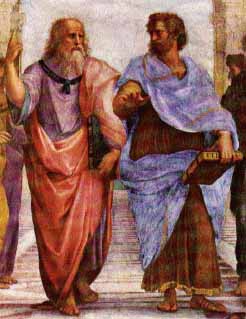
Raphael's fresco The School of Athens
URL for picture detail: http://www.newbanner.com/AboutPic/athena/raphael/nbi_ath4.html
Socrates, one of the most celebrated philosophers, taught Plato, who in turn taught Aristotle. Aristotle is the younger man in this Picture. Plato, the older man, is his Teacher and Friend. As you can see in the picture, Plato is pointing up, representing his philosophy of learning from the "ideal plane" where all of the perfect "forms" exist. As the picture illustrates, Aristotle's philosophy differs in that he believed that to learn and know true knowledge comes from the tangible imperfect forms and experiences of the world. Aristotle is pointing down, representing his philosophy of knowing and learning. Aristotle's teacher Plato had located ultimate reality in Ideas or eternal forms, knowable only through reflection and reason, Aristotle saw ultimate reality in physical objects, knowable through experience.
Aristotle is said to have said that although he loved his teacher Plato greatly, he loved the truth more.
What is my philosophy of education? It is built upon the meaning of the word philosophy itself, the love of knowledge and learning. As a teacher, I want to convey to my students my own excitement and love for learning. I love history, but as I have studied science, math, music, art, and other subjects, I see they are all interconnected. Each subject has its own value and cannot be replaced by any other. Students have varying interests, and should be celebrated for their strengths, however, a well-rounded education and exposure to new information sparks new ideas and challenges thinking.
Each child is born with an innate curiosity. They want to know about everything. Many parents grow weary of the endless barrage of questions from their own children: why, where, what, when, and how. As a child grows, their priorities change, biases are learned, they learn to like one thing and dislike another. Feedback from others strongly influences how and why a child acts. Sadly, for one reason or another, many students loose that precious curiosity. I want to reestablish in each of my students the curiosity they had "once-upon-a-time".
As a teacher, I have the responsibility to spark a student's individual interests. An effective teacher modifies the curriculum to the individual student's prior knowledge, skills, learning style, and interests. The teacher helps inspire the student to take that prior knowledge and courageously experiment, construct and invent new and even better things. History is really an opportunity to study all subjects. Many students do not find history exciting, but everyone can connect to history. When students understand that history encompasses all areas, they are able to use and learn exciting new knowledge and skills. Students will connect their interests, skills, and knowledge to history, sharing a role in instructing other learners. I will help each student realize how history will be connected directly with their future and the choices they make in their life: their careers, their future education, their family, and themselves.
The teacher's role should be patterned after one of the most studied teachers in history, Socrates. The Socratic method of questioning and probing students in an indirect, or discovery form of teaching is beneficial for students. A piece of candy, a sticker, or even an (A+) for regurgitation of information does little to achieve the ultimate goal of learning. This type of reinforcement seems beneficial, but is only temporary. Helping a student realize that they can discover the answer on their own, even if mistakes are made in the process, is the true reward, and leads to a desire for life-long learning. The student becomes the owner of that knowledge or skill, and truly can demonstrate mastery, because it is part of them. A teacher needs to provide a safe, secure, and non-threatening environment where risk-taking and mistakes are part of the learning process.
Each student needs to develop the life skills of problem solving, and proper social interaction with others. The teacher-guide should challenge the student and class to think on their own, and work and interact together, weighing the consequences of their decisions and taking responsibility and ownership for them. Eventually, learning will take place even without the teacher. Learning for the student and the classroom community will become self-motivated, self-guided, and the students' life will be self-actualized. A student discovers themselves and truly begins to philosophize, or love life-long learning.
Bryan Hatch
Click here to go to Bryan Hatch's Home Page