 |
|
|
|
|
|
|
|
|
|
|
|
|
|
|
|
|
|
|
|
|
|
|
|
|
|
|
|
|
|
|
|
|
|
|
|
|
|
|
|
|
|
|
|
|
|
|
|
|
|
|
|
|
|
|
|
|
|
|
|
|
|
|
|
|
|
|
|
|
|
|
|
|
|
|
|
|
|
|
|
UN Peacekeeping Operation: |
|
|
|
Evolution, Current Challenges and Future Trends |
|
|
|
By |
|
|
|
Soe Myint |
|
|
|
Final Paper |
|
|
|
Submitted to |
|
|
|
Professor Ambassador H.E. Ahmad Kamal |
|
|
|
Course# P11.2210: International Organizations and Their Management: |
|
|
|
The United Nations System |
|
|
|
New York University�������������������� ��� ���������� ������������������ December 2000 |
|
|
|
Table of Contents |
|
|
| UN Peacekeeping Operation:.......................................................................................................................................... 1 |
|
|
| Evolution, Current Challenges and Future Trends..................................................................................................... 1 |
|
|
| Introduction.................................................................................................................................................................. 3 |
|
|
| Background................................................................................................................................................................... 3 |
|
|
| Evolution....................................................................................................................................................................... 4 |
|
|
| Changes in Environment............................................................................................................................................. 4 |
|
|
| Current situation.......................................................................................................................................................... 5 |
|
|
| Current Challenges...................................................................................................................................................... 6 |
|
|
| Organizational challenges...................................................................................................................................... 6 |
|
|
| Strategic management challenges......................................................................................................................... 7 |
|
|
| Human resource management challenges........................................................................................................... 7 |
|
|
| Future trends................................................................................................................................................................ 9 |
|
|
| More cooperation with regional organizations................................................................................................... 9 |
|
|
| Conclusion.................................................................................................................................................................... 9 |
|
|
| Appendix I................................................................................................................................................................... 11 |
|
|
| Facts and Figures of Ongoing Peacekeeping Missions.................................................................................. 11 |
|
|
| Appendix II................................................................................................................................................................. 13 |
|
|
| References.............................................................................................................................................................. 13 |
|
|
| Introduction |
|
|
| The year 1998 marks half a century of the United Nations peacekeeping.� It was pioneered and developed by the UN as one of the means for maintaining international peace and security.� Most UN peacekeepers, often referred to as ?blue helmets?, have been soldiers, volunteered by their Governments to apply military discipline and training to the task of restoring and maintaining the peace.� In recognition of their contribution, UN peacekeepers were awarded the Nobel Peace Prize in 1988.[1] |
|
|
| UN defined "Peacekeeping" as a means of war limitation that depends, not primarily on coercion, but on the willingness of the affected states to accept a pacifying UN presence.�� It was relatively successful and member states expected more help and support from the UN.� After that successful innovation of peacekeeping, eventually more member states wanted and expected greater responsibilities and broader roles in UN peacekeeping missions.� UN was given more tough assignments without relevant resources to handle them.� While the environment around the United Nations has been changing too fast, organization was tied up with red tapes and failed to respond it in time.� In that period, many peacekeeping missions faced with failures. |
|
|
| As old saying says ?failure is the pillar of success?, Secretariat particularly Department of Peacekeeping Operation (DPKO) and its staff are working hard to build success on top of the past failures.� In this millennium dawn, UN peacekeeping operation is trying to open a new chapter by implementing necessary reform.� Secretary-General took a bold step and presented his report for requesting necessary resources and budget plan in the fifty-fifth session at the General Assembly and the fifth committee. |
|
|
| The future of DPKO and the future of United Nations are depending on the decision make by the Member States in this General Assembly.� Safeguarding international peace and security was the primary reason for the establishment of the United Nations in 1945.[2] We sincerely hope the General Assembly will approve the requested resources to reform the DPKO and strengthening related units in the UN Secretariat. |
|
|
| Therefore this report will focus on the challenges facing in implementing the reform at the DPKO and UN System as a whole. |
|
|
| Background |
|
|
| Collective security as envisioned by the UN Charter never became a reality, and even the voluntary version of military enforcement action has been attempted sparingly.�� Nevertheless, the United Nations has found other ways to remain relevant to the control of international violence.� The most significant and innovative is a UN "peacekeeping."� In a UN context the term peacekeeping was first used to describe the work of the UN Emergency Force (UNEF), created by the General Assembly during the 1956 Suez War to take temporary control of the Suez Canal area and encourage the withdrawal of invading Anglo-French and Israeli forces from Egyptian territory.[3]�� |
|
|
| Evolution |
|
|
| United Nations Peacekeeping operation has evolved from its Traditional Peacekeeping Missions to the current Multidisciplinary Peacekeeping missions. |
|
|
| In the beginning most of the peacekeeping missions have a small size with limited mandates such as observing border violations, policing a cease-fire or truce line, serving as a buffer between hostile forces, supervising troop withdrawal, and helping to monitor elections and maintain domestic order during a transition period.[4] |
|
|
| UN Peacekeeping in the 1990s has been characterized by multidisciplinary operations encompassing a wide rage of elements to enhance peace.� These include the supervision of cease-fire agreements; regrouping and demobilization of armed forces; destruction of weapons surrendered in disarmament exercise; reintegration of former combatants into civilian life; designing and implementation of demining programmes; facilitating the return of refugees and displaced persons; provision of humanitarian assistance; training of new police forces; monitoring respect of human rights; support for implementation of constitutional, judicial and electoral reforms; and support for economic rehabilitation and reconstruction.[5] |
|
|
| Changes in Environment |
|
|
| Increase in Member States: Membership has increased from 50 states at the birth of United Nations in 1945 to 189 Member States. More members surely bring more opinion with divert national interests and issues.� This environment change needs proper adjustment in institutional structure such as expanding the Security Council to reflect regional representation. |
|
|
| Imbalance in Development: Imbalance in development of the nations together with increased membership to the United Nations are underlying issues that drive the need for change. Minority but wealthy powerful developed states (North) are on one side, majority but poor developing states (South) are on another side, playing a tag of war game in many walks of life in the organization such as setting the organizational priorities. |
|
|
| End of cold war: End of cold war has opened up many independent states that need more economic and social development at the same time they need safeguarding the international peace and security due to so called power vacuum.� That is one of issue demanding more assistance and services from the world body. |
|
|
| Current situation |
|
|
| If we have to express current status of peacekeeping operations in a single sentence, we could repeat what one UN official put it "Those who are able are not willing and those who are willing are not able"[6] situation. Those states willing to support the peacekeeping operation have lack of resources, while other states having resources do not want to put their hands on it. |
|
|
|
 |
|
|
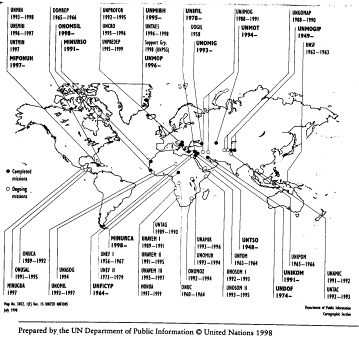
| Figure 1 Completed and Ongoing Peacekeeping Missions |
|
|
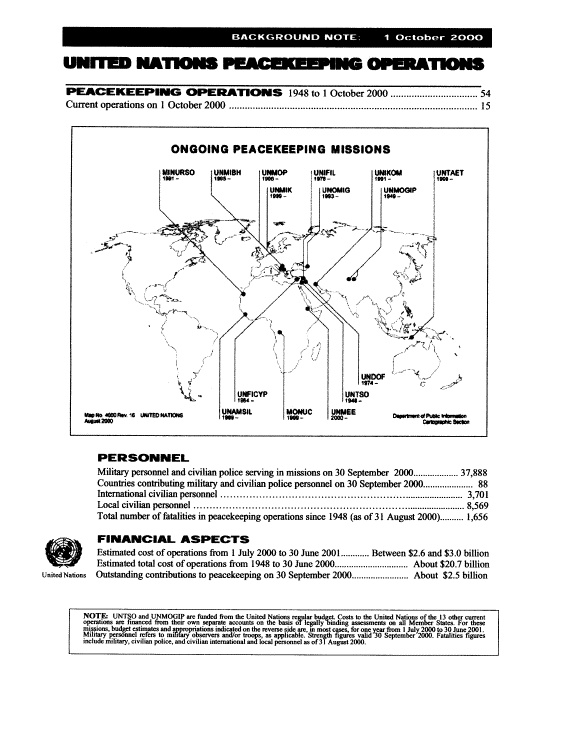
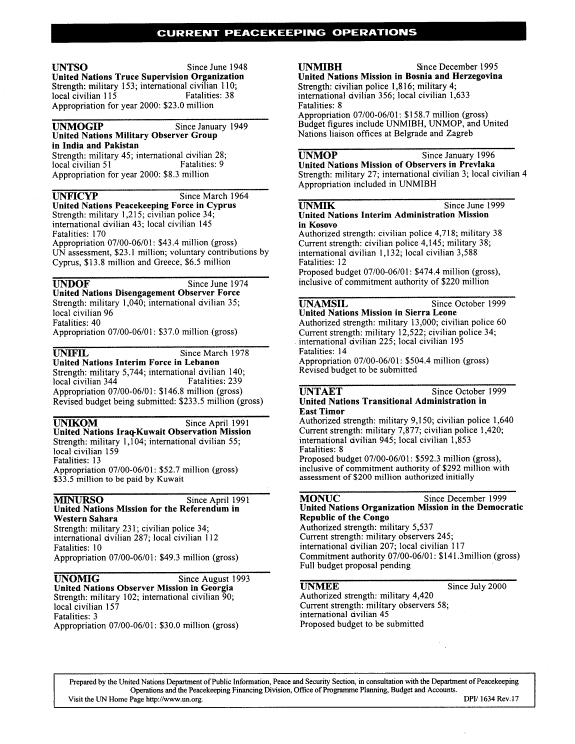
| UN is facing more demands for peacekeeping operations than before and as of 1 October 2000, there are 54 peacekeeping missions (completed and ongoing) missions around the world (see figure 1).� Currently 38,000 peacekeepers working in 15 missions around the world.� Please see Appendix I for more facts and figures of ongoing missions. |
|
|
| In another words, current peacekeeping situation is ?Put up or Shut up situation?. Therefore UN Secretary-General, Kofi A. Annan, has a good reason to ask, "If we don't want to do [UN peacekeeping] properly, should we do it at all?"[7]� To do it properly, it needs appropriate resources that include, among many others, qualified staff and well-equipped troops, with effective management team with clear achievable mandates. |
|
|
| Because of the above changes in both external and internal environments of the United Nations, the Secretary-General, Kofi A. Annan, had commissioned a Panel on United Nations Peace Operations chaired by Mr. Lakhdar Brahimi to look into the problems and advise recommendations.� The panel had submitted a comprehensive report entitled ?Report of the Panel on United Nations Peace Operations? to the Secretary-General on 17 August 2000.� Secretary-General had taken a bold step to implement necessary reform in UN peacekeeping operation and presented his ?Resource requirements for implementation of the report of the Panel on United Nations Peace Operations? to the General Assembly.� Currently it is debating in the General Assembly and Fifth Commission.� While several member states are supporting the move, others are defending not to sacrifice the development activities. |
|
|
| Assuming that the reform will be approved with appropriate resources, let us examine the challenges in implementing the reform for the UN Peacekeeping Operations. |
|
|
| Current Challenges |
|
|
| In this critical analysis of challenges facing in the implementation of the reform program was done not only based on the panel report but also other sources. It could be organized into 4 categories, such as Organization, Strategic management, Human resource management, and Member States. |
|
|
| � |
|
|
| Organizational challenges |
|
|
| 1. Challenge of Minority Coalition:[8] The major challenge in the United Nations would be the differences in value envisioned by the key stakeholder, the Member States.� While developed states (North) emphasize on peace and security of the world, developing states (South) have preference on the social economic and development.� And the biggest challenge is how do we handle the minority coalition in the Security Council. |
|
|
| 2. Challenge of UN Reform: This is the biggest challenge for the United Nations as a whole.� Unresolved issues that are critical to peace operations and that only the Member States can address.� They are a) the disagreements about how assessments in support of peacekeeping operations are apportioned and b) about equitable representation on the Security Council.� This would be the biggest challenge for the UN to resolve these issues. |
|
|
| 3. Challenge of Organizational Image Lifting: From the organizational point of view: ?Its failures in Rwanda, Srebrenica, Sierra Leone had dwarfed its successes in public mind?.[9] It is an organizational challenge to lift its image by reach out to civil society and to strengthen relations with NGOs, academic institutions and the media.� |
|
|
| 4. Challenge of Accepting Reform by Key Stakeholders: Reform has targeted to two groups: Member States and Secretariat.� It won't occur unless Member States genuinely pursue it and actively advanced by the Secretary-General and implemented by his senior staff. |
|
|
| Strategic management challenges |
|
|
| 5. Challenge of Clear Chain of Command: Troop contributors must ensure that the troops they provide fully understand the important of Chain of command, the operational control of the Secretary-General and the standard operating procedures and rules of engagement of the mission. It is essential that the chain of command in an operation be understood and respected, and the onus is on national capitals to refrain from instructing their contingent commanders on operational matters.� The problems of command and control that recently arose in Sierra Leone are the most recent illustration of what cannot be tolerated any longer. |
|
|
| 6. Challenge of Change Management: Reform may need to be adjusted to fit within the overall UN plan.� It will not be accomplished overnight; some require urgent action with possible resistance to change.� Challenge to Secretary-General to lead the reform. It depends on how Secretariat?s priorities and culture will need to be challenged and changed.�� It was recommended by the panel to appoint a senior official with responsibility for overseeing the implementation of the recommendations contained in the present report. |
|
|
| 7. Challenge of Staff Management: As it is very important, I just quoted exactly what the panel had said. ?In short, we believe that a very high standard should be maintained for the selection and conduct of personnel at Headquarters and in the field. When United Nations personnel fail to meet such standards, they should be held accountable. In the past, the Secretariat has had difficulty in holding senior officials in the field accountable for their performance because those officials could point to insufficient resources, unclear instructions or lack of appropriate command and control arrangements as the main impediments to successful implementation of a mission?s mandate.� These deficiencies should be addressed but should not be allowed to offer cover to poor performers. The future of nations, the lives of those whom the United Nations has come to help and protect, the success of a mission and the credibility of the Organization can all hinge on what a few individuals do or fail to do.� Anyone who turns out to be unsuited to the task that he or she has agreed to perform must be removed from a mission, no matter how high or how low they may be on the ladder.?[10] |
|
|
| Human resource management challenges |
|
|
| 8. Challenge of Staff Recruitment/Development: It should be considered seriously.� Managers at all levels beginning with the Secretary-General and his senior staff, seriously address this problem on a priority basis, reward excellence and remove incompetent staff.� It is a management challenge.� |
|
|
| 9. Challenge of Cultivating Organizational Value and Culture: It should be done with all staff from General Service position to the top ones.� It is very important and challenging in addressing the UN personnel in the field missions with the spirit of what it means to be an international civil servant, sacrificing themselves to work in war-torn lands and dangerous environments to help improve the lives of the world's most vulnerable communities. |
|
|
| 10. Challenge of Behavior Change: Organization's Mission staff should respect local norms, culture and practices.� They all must treat one another with respect and dignity, with particular sensitivity towards gender and cultural differences. All mission staff should have a briefing about these before sending to the mission area. |
|
|
| Member States related challenges |
|
|
| 11. Challenge of Share Responsibility: Member States must recognize that the UN is the sum of its parts and accept that the primary responsibility for reform lies with them not only Secretariat alone. Because most of the occurred because the Security Council and the Member States crafted and supported ambiguous inconsistent and under-funded mandates. |
|
|
| 12. Challenge of Cultural Change: UN main virtues is that it provides a forum for 189 member states to exchange views on pressing the global issues, but dialogue alone is not enough for billion-dollar peacekeeping operations, vital preventive measures or critical peacemaking efforts succeed.� Expressions of general support in the form of statements and resolutions must be followed up with tangible action. |
|
|
| 13. Inconsistent Attitudes of Delegates:This issue is critical for US Secretariat which is acting based on the support of the member states.� And member states do not keep their words and denying financial support during the implementation.� UN Secretariat should deal this issue in very diplomatic way. |
|
|
| 14. Challenge of Building Commitment: It is very important to affirm that the world leaders' Commitment to the ideals of the United Nations, to commit as well to strengthen the capacity of the United Nations� to fully accomplish the mission "to help communities engulfed in strife and to maintain or restore peace". |
|
|
| 15. Challenge of behavior change in Security Council: Thai is external to the Secretariat to change the behavior of Security Council members dealing at various political levels.� Are they going to send them to the conflict negotiation courses and effective-communication courses? How UN Secretariat will handle this issue is really challenging. |
|
|
| 16. Challenge of Trust Building: Member States uphold their treaty obligations and pay their duties in full, on time and without condition.� It is related with the point 11. |
|
|
| Future trends |
|
|
| There would be no future, if the Member States were failed to support the United Nations politically, financially and operationally.� Without these three vital supports of the Member States, there would be neither peacekeeping missions nor the United Nations. |
|
|
| As UN membership has been extended from 50 states to 189, majority of developing member states have been demanding United Nations to reform the Security Council with proper regional representation.� Eventually the Security Council would be changed so that UN peacekeeping operations would have more regional influence and participation. |
|
|
| Ending of the cold war made member states feel more secure against possible world war, hence demanding to pay more attention for social economic development than peace and security.� Eventually if developing states could manage to lift up the second pillar of the United Nations as high as the first pillar, it is possible of getting shorter on the first pillar. This means Peacekeeping operation would be trim down to affordable size and make the emergency operation only could be achieved in the available budget and capacity. |
|
|
| More cooperation with regional organizations |
|
|
| Co-deployment with other international organizations such as the Organization of American States (OAS), the Organization of African Unity (OAU), the Economic Community of West Africa States (ECOWAS), the Organization of Security and Cooperation in Europe (OSCE), the Commonwealth of Independent States (CIS), and the North Atlantic Treaty Organization (NATO) will be emphasized.� Operations such as the Unified Task Force (UNITAF) and the Implementation Force (IFOR) and Stabilization Force (SFOR) of NATO, and CIS Collective Peacekeeping forces, will more and more assume Chapter VII enforcement responsibilities, while UN peacekeeping will focus attention on matters requiring more even-handed Chapter VI socio-political and economic issues.[11] |
|
|
| Conclusion |
|
|
| The United Nations was founded, in the words of its Charter, in order ?to save succeeding generations from the scourge of war.? Meeting this challenge is the most important function of the Organization, and, to a very significant degree, the yardstick by which it is judged by the peoples it exists to serve. Over the last decade, the United Nations has repeatedly failed to meet the challenge; and it can do no better today.[12] |
|
|
| Although leaders of the world assembled at the Millennium Summit and renewed their commitment to the ideals of the United Nations, current status is still far away to reach the total peace and secured world.� We can see the obvious improvement along the way.� Creation of the League of the Nations was an initial step toward world peace and security.� Even World War II could not destroy the common interest of world peace and security; the United Nations was formed with the same sense of common interest. |
|
|
| United Nations should consider seriously reviewing its mission to support ?Balanced and sustainable distribution of equity between Peace and Security activities and Social Economic Development activities.?� It would shorten the distance between wealthy North and poor South. |
|
|
| Without significant institutional change, increased financial support, and renewed commitment on the part of Member States, the United Nations will not be capable of executing the critical peacekeeping and peace-building tasks that the Member States assign it in coming months and years. There are many tasks which the United Nations peacekeeping forces should not be asked to undertake, and many places they should not go. But when the United Nations does send its forces to uphold the peace, they must be prepared to confront the lingering forces of war and violence with the ability and determination to defeat them.[13] |
|
|
| In conclusion, Peacekeeping operations is the primary business of the United Nations and its success and failure could be interpreted as the achievement of the organization.� To rum peacekeeping operations successfully, DPKO needs necessary reform and institutional adjustment and appropriate resources.� Secretary-General had presented the his report asking necessary resources to the fifth committee and General Assembly.� Now it is time to see how Member States will answer the urgent request.� Approving the required resources by the Member States is the first step to begin the journey with full of challenges.� All staff at UN System have to work hard to prove that they are accountable to accomplish their goal ? safeguarding the International Peace and Security.� In this journey, Member States have to support them politically, financially and operationally.� If those conditions were met with competent management, the success is within a reach. |
|
|
|
- - - - - |
|
|
|
Appendix I |
|
|
|
Facts and Figures of Ongoing Peacekeeping Missions |
|
|
|
(as of October 1, 2000) |
|
|
 |
|
|
 |
|
|
|
Appendix II |
|
|
|
References |
|
|
| ________ Agenda for Peace, Preventive diplomacy, peacemaking and peace-keeping, 17 July 2000. (A/47/277-S/24111) |
|
|
| ________ Resources sought for Brahimi initiatives would make significant difference to peacekeeping abilities, Secretary-General tells fifth committee, 27 November 2000. (Press Release GA/AB/3414) |
|
|
| ________ Multidisplinary Peacekeeping: Lessons From Recent Experience, United Nations, April 1999 http://www.globalpolicy.org/security/peacekpg/lessons/lesson.htm 11/3/00 |
|
|
| ________ Report of the Secretary-General on the implementation of the report of the Panel on United Nations peace operations, 20 October 2000. (A/55/502) |
|
|
| Brahimi, Lakhdar et al, Report of the Panel on United Nations Peace Operations, 17 August 2000 (A/55/305-S/2000/809) |
|
|
| Hoagland, Jim,� Who Wants Peacekeeping? Put Up or Shut Up, Washington Post / International Herald Tribune , August 3, 2000 |
|
|
| Hoyos, Carola, Once-Bitten UN Shies Away from Trouble, Financila Times, July 4, 2000 |
|
|
| Levitte, Jean-David, The Millennium Summit: The U.N. Today and Where It?s Headed, Lecture delivered at New York University, March 20, 2000. |
|
|
| Ziring, Lawrence, Robert Riggs, and Jack Plano, The United Nations ? International Organization and World Politics, Third Edition, Harcourt College Publishers. |
|
|
|
Foot notes |
|
|
| [1] Coverpage of 50 Years of United Nations Peacekeeping Operations, http://www.un.org/Depts/dpko/50web/50years.htm |
|
|
| [2] Ziring, pg. 142 |
|
|
| [3] Ziring, pg. 171-172 |
|
|
| [4] Ziring, Pg. 172 |
|
|
| [5] Multidisciplinary Peacekeeping, Pg. 2 |
|
|
| [6] Hoyos, Financial Times, July 4, 2000 |
|
|
| [7] Washington Post/International Herald Tribute, August 3, 2000 |
|
|
| [8] Levitte, Lecture Note at NYU |
|
|
| [9] Press Release, GA/AB/3414 |
|
|
| [10] Report of the Panel on UN Peace Operations, para. 273, pg. 46 |
|
|
| [11] Ziring, Pg. 202-203 |
|
|
| [12] Panel report on UN Peace Operations, pg. viii |
|
|
| [13] Brahimi Report, Pg. 1 |
|
|
|
- - - - - |
|
|
|
Go Back to My Home Page |
|
|
|
Send me your comments |
|
|
|