 |
|
|
|
|
|
|
|
|
|
|
|
|
|
|
|
|
|
|
|
|
|
|
| NYU-A6-SM�������������������������������������������������������� Soe MYINT������������������������������������������ October 29, 2000�� |
|
|
| International Organization and their Management������������������������ Professor Ambassador Ahmad Kamal |
|
|
| Assignment #6: |
|
|
| Give three suggestions, in order of priority, for re-formatting the international financial system. |
|
|
|
_________________________________________________________________ |
|
|
|
Suggestions for re-formatting |
|
|
|
The International Financial System |
|
|
| Both globalization of economy and the information revolution have been changing the nation-state, especially in domestic fiscal and monetary politics, foreign economics policies, and control of international business.� Recent financial crises clearly indicate the need to re-format the International Financial System.� Here are my suggestions, in order of priority, for re-formatting the international financial system. |
|
|
| 1. Participation of developing countries in the reform process |
|
|
| Encourage the increased participation of developing countries in the work of the international institutions dealing with the reform of the international financial architecture in particular the International Monetary Fund (IMF), as well as the Financial Stability Forum and the relevant committees affiliated with the Bank for International Settlements. We should encourage the efforts of those institutions to give more representation to developing countries and welcome the work being undertaken by the IMF to design a quota formula that better reflects current economic realities.� |
|
|
| Thus, the developing countries could bring alternatives to the problems such as reducing the vulnerability of the poor to financial shocks; and the current situation regarding the enhanced Heavily Indebted Poor Countries (HIPC) initiative and its overall financing.4 |
|
|
| 2. Establishing appropriate international financial architecture |
|
|
| It needs for moral, legal, and economic rules that are accepted and enforced throughout the global economy.� A central challenge, therefore, is the development of international law and supranational organizations that can make and enforce rules for the global economy.3 |
|
|
| It would create an environment -- at the national and global level alike -- which is conducive to development and to the elimination of poverty, inter alia, through good governance within each country, as well as good governance at the international level and transparency in the financial, monetary and trading systems.6 |
|
|
| It would mobilize in a coherent manner all sources available for the provision of international financing for development, such as, private capital flows, official development assistance, market access for goods and services from developing countries and external debt relief.� It would resolve the excessive volatility of short-term speculative capital flows and the contagion effects of the behavior of financial markets in time of crisis. |
|
|
| 3. Develop appropriate framework for the involvement of private sector in the prevention and resolution of financial crises |
|
|
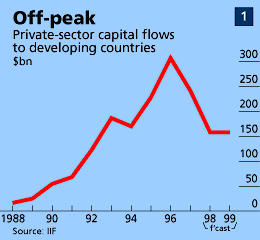 |
The ideological shift towards free markets in the developing economies, coupled with their need for external capital, drew new participants into the international finance arena. During the 1990s, governments, banks and companies from an ever more exotic range of emerging economies raised money abroad.� Private sector financial flows to developing countries shot up (see chart 1).� Even so, the "emerging-market" asset remains a tiny share of overall financial assets.7 |
|
|
|
| The report of United Nations Conference on Trade And Development (UNCTAD) stated that an effective framework for greater private sector involvement would need to have three key elements: i) provisions for an automatic standstill on debt servicing which would give the debtor the "breathing space" required to formulate a debt reorganization plan, ii) maintaining debtor's access to the working capital required for the continuation of operations, and iii) arrangement for the reorganizations of the debtors' assets and liabilities, as well as at distributing equitably the costs among creditors.5 |
|
|
Reference:
1. Barber Conable, World Bank President (1986-1991), World Bank (A): Under Siege, Harvard Business School, 9-797-022, Rev. November 11, 1996.
2. James D. Wolfensohn, President of the World Bank Group, Building an Equitable World, Address to the Board of Governors, Prague, Czech Republic, September 26, 2000.
3. Peter F. Drucker, The global economy and the nation-state, Foreign Affairs, Sep-Oct 1997 v76 n5 pg. 159(13).
4. Press Release ECOSOC/5886, Economic and Social Council holds high-level meeting with Bretton Woods institutions, 18 April 2000.
5. Press Release GA/EF/2915, Second committee takes up financing development, including net transfer of resources between developed and developing countries, 6 October 2000.
6. Mexico and Nigeria, on behalf of the Group of 77 and China, Draft resolution on Agenda item 92(e): Macroeconomic policy questions: financing of development, including net transfer of resources between developing and developed countries, A/C.2/55/L.2, Fifty-fifth session, second committee, General Assembly, 10 October 2000.
7. Zanny Minton Beddoes, Time for a redesign?, The Economist Newspaper Group Ltd, http://www.economist.com/PrinterFriendly.cfm?Story_ID=183887. |
|
|
|
- - - - - |
|
|
Go back to my homepage |
|
|
|
|
|
Click here to send me your comments |
|
|
|
|
|
|