| Mary Austin About Freddie Mercury | |
|
OK Magazine - March 17 2000 - (issue 204)
|
|
|
Freddie
Mercury would dominate a huge stage with all the force of a hurricane. In
fact, |
|
|
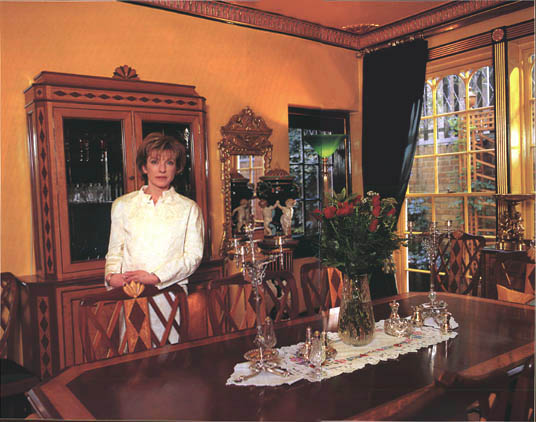
That woman was Mary Austin, whom he had described in the past as the 'love of his life'. Mary had been the rock star's lover for six years before he decide he preferred male partners. Shortly before his death, he became anxious toprovide her and her two children with some security. For this reason, he decided to leave her his most prized possession - his 'dream home'. Having agreed to be godfather to her eldest son Richard, now aged nine, he liked the idea of his house one day becoming a family home. Much of Freddie's personal life was as dramatic as his stage performances. His wealth and stardom did not help with matters of the heart. 'Love is the hardest thing to achieve and the one thing in this business that can let you down the most,' he said. 'I have built up an immense bond with Mary. She has gone through just about everything and always been there for me.' Not only did Freddie leave his magnificent Georgian mansion, in London's Kensington, to Mary, but also the bulk of his multi-million pound fortune, with an income for life from his vast recording sales and publishing. The house stands behind an expansive walled Japanese Garden. Freddie was particularly fond of Japanese art and had encouraged his last boyfriend Jim Hutton to create the garden, which is still filled with flowering trees and multi-coloured roses. Freddie always had a flair for style and spent a fortune transforming the house into a splendid palatial home. Even his adored five cats were of the exotic variety! Mary talked to OK! In the music room, which is dominated by his black grand piano, on which he composed many of Queen's hits. The top of the piano is covered in silver framed pictures of Mary and her family, and many with Freddie which capture the happy days she shared with him.The main focus of the room is a massive window which filters the daylight onto a gigantic, exquisitely cut chandelier and mirrors. The house has lovely marble and wooden floors, and mahogany staircases. Each of the sitting rooms and the spacious hall are bedecked with fine Japanese and Chinese furniture and art, oil paintings and the Dresden china Freddie collected. He would like nothing more than to tour the King's Road antique markets near his home to see what beautiful pieces of china he could discover for his beloved home. Freddie's master bedroom is hidden behind a mirrored hallway leading to two bathroom suites - one with a Jacuzzi, the other with a bath large enough for two people. The yellow bedroom is Roman-styled with a balcony, and an illuminated ceiling which can be switched to sunset, twilight. There is a dramatic minstrel gallery where Freddie used to sometimes hide and unsuspectingly watch with amusement the behaviour of his party guests in the large drawing room below, furnished in gold and peony red silks. Nothing in the house has been changed. Mary has kept the decor and furnishings exactly as they were when Freddie died. Her feeling was that he had impeccable style, so why change it. But when Freddie first told Mary he intended to leave her his wonderful home with all its glorious contents, her immediate reaction was of shock. In fact she was so terrified of taking on such an enormous responsibility that she urged him to place the house in a trust as a museum. But Freddie was adamant. Mary had been his bedrock and a particular comfort in his final years, leading up to his death in 1991. Mary juggled looking after her then partner, Piers Cameron, with attending to Freddie as he suffered the final stages of AIDS. At the same time she was preparing for the birth of a second baby, Jamie, now eight. Long before he told any of his close friends or the fellow members of Queen that he had AIDS, Freddie confided his secret to Mary. From that moment she was there each day to try to comfort him as he gradually became more ill. Realising he was starting to lose his sight and with his body becoming so weak that finally he couldn't even get out of bed, Freddie decided to face up to dying by refusing to take his medication. 'It was Freddie's decision to finally end it all. He chose the time to die,' Mary recalls in a whisper. 'He knew it was coming. The quality of his life had changedso dramatically and he was in more pain every day. He was losing his sight. His body became weaker as he suffered mild fits. It was so distressing to see him deteriorating in this way. One day he decided enough was enough and stopped all the medical supplements that were keeping him going. The overwhelming thing for me was that he was just so incredibly brave. He looked death in the face and said, "Fine, I'll accept it now - I'll go." But it was peaceful and he died with a smile on his face.'
|
|
|
|
After his death on November 24, 1991, Mary moved into his palatial home, but as she wandered through the huge galleried sitting rooms, surrounded by Freddie's treasures, her feelings were of confusion and loneliness. 'It was theloneliest and most difficult time of my life after Freddie died,' she says. 'I knew I was having trouble coming to terms with his death and everything he had left me. I was best left to myself in order to come out of it.'
|
| Subheading Goes Here | |
|
He was always very protective of me. I only realised, after he died, quite how protective he'd been. If something happened, he'd say, "Oh darling, don't worry - we'll get over that." He was uplifting. At other times, when he was aware he had AIDS and only had a limited time to live, there'd be the odd serious conversation when he'd say to me, "Let's go and sit, we don't know how long we have."' Mary dealt with the enormity of Freddie's generosity by becoming more of a recluse within the secure walls of the rock star's home. 'I felt very much out of my depth really,' she explains. 'Freddie's staff had beenlike family to me, but after his death most of them had left because he'd been so financially generous to them. I had sleepless nights worrying abouteverything. I felt as if I'd done something wrong and paranoia set in. Some of the fans even told me I was only the keeper of the house. That hurt' It was eight years after Freddie's death before Mary received the bulk of his money from the will. 'It was a worrying time,' she admits. 'The taxman had been paid, but without the money coming through I didn't know if I could afford to keep the house. I felt under a lot of pressure.' In contrast to the outrageous rock idol, Mary is totally unassuming. Petite and slim, with green eyes and fair hair, she is shy and gives the impression that she lack confidence in herself. Completely the opposite to the flamboyant Freddie. His death clearly left a void in her life. 'I lost somebody who I thought was my eternal love,' she confirms. 'When he died I felt we'd had a marriage. We'd lived our vows. We'd done it for better or worse, for richer for poorer, in sickness and in health. You could never have let go of Freddie unless he died - and even then it was difficult.' The couple's closeness had always caused difficulties with others. None of the boyfriends Mary took after she stopped living with Freddie in 1980 lasted very long. They soon came to realise that they were sharing her affections with an extraordinary rock star and that their special bond of loyalty and close friendship could never be penetrated by a newcomer. Mary was 19 when she first met Freddie. Until then her life had been deprived. Her parents were poor. Her father worked as a hand-trimmer for wallpaper specialist and her mother was a domestic for a small company. Both parents were deaf and communicated through sign language and lip-reading. It was while working as a customer PR at the trendy Biba store in London, where her customers included Paul McCartney and Mick Jagger, that she met Freddie and Queen drummer Roger Taylor, who ran a stall in nearby Kensington Market, selling old clothes and Freddie's artwork. Mary still has one of his excellent drawings of Jimi Hendrix. Although Freddie was quite intimidating, Mary found herself fascinated by this 'wild-looking artistic musician'. She says, 'He was like no one I had ever met before. He was very confident and I have never been confident. We grew together. I liked him - and it went on from there.' 'I felt very safe with him,' she adds. 'The more I got to know him, the more I loved him for himself. He had quality as a person which I think is rare in life these days. One thing which was always constant was the love. We knew w could trust each other and we were safe with each other. We knew that we would never hurt each other on purpose.' She says. 'One Christmas he bought me a ring and put it in the most enormous box. I opened the box and inside was another box, and so it went on until I got to this very tiny box. When I opened it, there was this beautiful Egyptian scarab ring. It's supposed to bring good luck. He was very sweet and quite shy about giving it to me.' Everything changed one day when Freddie told her he had something important to say, something that would change their whole relationship forever. Mary explains, 'Being a bit naive, it had taken me a while to realise the truth. Afterwards he felt good about having finally told me he was bisexual. Mary decided to move out, but Freddie insisted she shouldn't move too far from him. 'Eventually I found a place nearby, which he wanted me to have. It was perfect for a single person such as myself. His music publishing company bought it for me at £30,000. I could see Freddie's flat from my bathroom. I thought, "Oh, I'm never going to get away!" 'But I didn't mind. I was happy there. It was small, but I'm quite happy with small places.' Mary, whose life is no longer such a struggle, today shares her magnificent house with Nick, the London business man she married two years ago. Without telling anyone, they wed on Long Island with just Mary's two sons, Richard and Jamie, by their side. Mary admits, 'I think Nick was very brave to take me on, really. I come with a lot of baggage, a huge chapter in my life. At first, because of the past and the broken affairs, I wasn't entirely sure about marriage. Then someone said, "You don't know until you try." A happy and contented Mary adds, 'But as life unfolds, I can now be happy with him. I can appreciate what I had and what I now have and move on with my life. I could only have moved on by meeting somebody. by Lorraine of Errol Douglas, make-up by Sue Moxley OK Magazine - March 17 2000 - (issue 204) |
|