 |
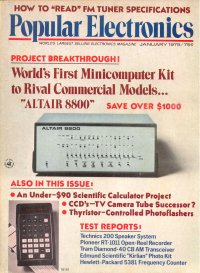
| The Altair 8800, from Micro Instrumentation Telemetry Systems (MITS) of Albuquerque, NM, was first featured in the January 1975 edition of Popular Electronics. It is considered by many to be the first mass produced personal computer, although they were called micro-computers in those days.
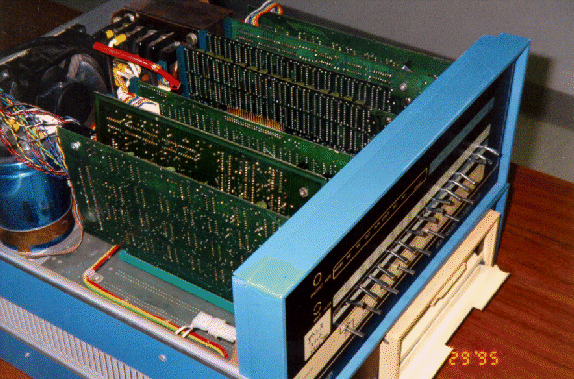
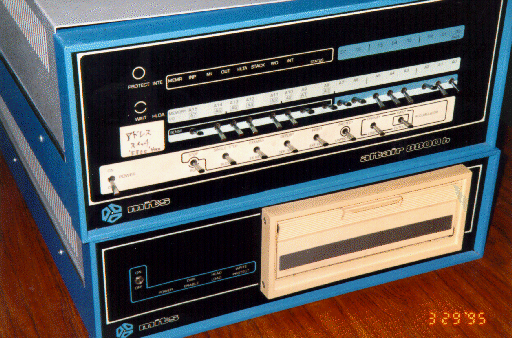
The Altair was initially offered only as a kit - it took many days and nights of careful soldering and assembly to hopefully create a working Altair. Only true hackers would undertake such an endeavor. The Altair is comprised of a case, a power supply, a front panel and a passive motherboard with 16 expansion slots. All of the circuitry - the CPU and memory, are on cards which plug into the expansion slots, which MITS called the Altair bus. This became a very popular method of making computers, and the Altair bus became an industry standard, but MITS didn't appreciate it being renamed as the S-100 bus. Numerous computers from other manufacturers were designed around the S-100 bus - the IMSAI 8800 was the first - the first computer clone. Since no keyboard or monitor was necessary, or cheaply available, users flipped switches on the front panel, writing their own programs in machine language, and watching the LEDs on the panel light up in response to their commands. Bill Gates and Paul Allen saw an opportunity and wrote Altair BASIC, a true programming language, and the first commercial Microsoft computer product. Due to the unlimited variety of S-100 cards soon available, a keyboard, TTY, monitor, printer and data storage can all be added to increase the Altair's usefulness. Available S-100 cards include: CPU memory video card printer port serial interface floppy disk controller cassette tape interface |
| MITS Altair 8800 Introduced: January 1975 Price: US $395 as a kit US $495 assembled CPU: Intel 8080, 2.0 MHz RAM: 256 bytes, 64K max Display: front panel LEDs Controls: front panel switches Expansion: card-cage with 16 card slots Storage: external Cassette or 8" floppy drive OS: CP/M, BASIC |
 |
Why call it "Altair"? There are two versions, the first and most popular, that the name came from Star Trek the TV series, is apparently false, but is sounds good. The story is, that Les Solomon, the (then) technical director of Popular Electronics magazine (and a great story teller), asked his daughter about a name, and she suggested "Altair", because "that's where the Enterprise is going in this episode" - she was watching Star Trek, the science fiction TV series. (Actually, Altair is a real star - Altair VI - Alpha Aquilae, and was mentioned in only one Star Trek episode: "Amok Time", episode 34 - original airdate: 9/16/1967.) Alternately, Forrest M. Mimms III states in the November 1984 issue of Creative Computing that the Altair was originally going to be named the PE-8 (Popular Electronics 8-bit), but Les Solomon thought this name to be rather dull, so Les, Alexander Burawa (associate editor), and John McVeigh (technical editor) decided that "It's a stellar event, so let's name it after a star." McVeigh suggested "Altair". Remember, there really is a star called Altair - it's the 11th brightest star in the sky. Even though MITS shipped up to 1000 Altairs a month, and did $13 million in busines in 1977, the company was sold to Pertec, which continued producing Altairs through 1978. They did a very poor job of it, and the Altair disappeared into history. |
| 1 |
| 7 |
| 9 |
| 5 |
| In September 1975, the very first issue of BYTE magazine was issued. On the cover they proudly state: "Computers: The worlds greatest toy!".
|
 |
 |
 |