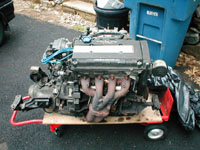
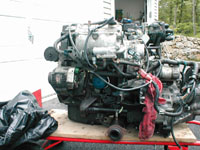
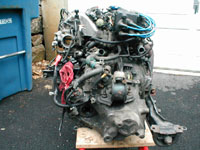
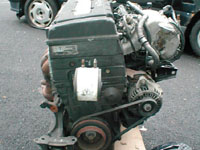
I found a 94 GSR engine swap for just $2100 shipped. Unfortunately, there were many hidden problems and details that were discovered when it was rebuilt.
First of all, the engine was located in New York City. It is a 1994 Acura Integra GSR swap that was removed from a wrecked car. I went down there to look at the engine and I was satisfied with its visual condition. It had a 2001 Integra Type R exhaust manifold and it had a ACT HDSS clutch. We agreed on $100 for delivery. So the total for the whole swap was $2100.
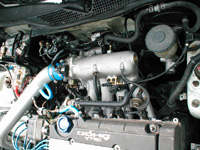
Even with paperwork with mileage, I did not believe the previous owner on the mileage of the engine. So I decided to do a full rebuild with new belts, water pump, bearings, rings, gaskets and a fresh hone. I figured that I would take care of upgrades I would normally do with the engine out of the car. I added a set of P30 pistons from a JDM B16A2, shot-peened GSR rods, and a Skunk2 intake manifold. The pistons increased the compression ratio from 10.0:1 to 11.8:1. The shot-peened rods will allow the engine to rev at higher rpm at lower risks of fatigue failure.
The first problem encountered was that the driver side mount had only one fully threaded bolt out of three. One had been stripped and the other had a broken bolt stuck in it. This was fixed with a bolt remover and a Timesert kit.
The second problem found after driving the car, was that the transmission was from a non-VTEC Integra. This transmission made the acceleration of the car feel very sluggish.
Problem three was that a bolt had broken inside one of the cam caps. A harmless slot was ground into the head to remove it. Other than that, the engine was fine. The head was recently rebuilt from the previous owner, so it was in excellent shape and very clean.
Fourth problem was minor. The shifter bushing was damaged and the hardware was missing. Shifting like this was horrible. A new bushing and hardware from Honda made this an easy fix.
Fifth problem was that the axle seal was ripped completely and the boots were held on with zip ties. Also for some odd reason, the axles and halfshaft were from a 90-93 Integra which made obtaining the axles seal a difficult task. I bought brand new GCK axles to fix the boot problem.
It was missing the upper timing belt cover, lower transmission brackets, lower transmission cover. One of the torque mounts was torn completely, and one stud from the valve cover broke, and the special bolt for that stud was obviously missing. All of these small problem were fixed painlessly with new parts from Honda.
The timing did not line up properly for reasons beyond my knowledge. Honda technicians informed me that it happens and that it is normal. I used adjustable cam gears to correct this problem.
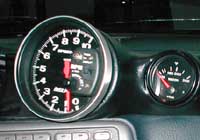
An Autometer tachometer and some VDO gauges were added to the dash. Looks very cheesy, but I felt I needed that tachometer for 8100 RPM shifts.
A Crane ignition and coil were added for the soft touch rev limiter. A chipped P28 ECU was later swap in place of the P72 ECU. The ECU came with three different chips of my choice. I got a stock GSR, Feels, and a J's chip. All came with 9.9K fuel cuts because I used the ignition to safely limit the engine speed.
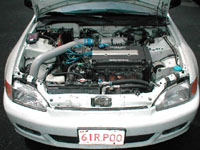
A Type R fuel pump was swapped in because it is more capable of pump the volume of fuel that the GSR engine needs. The Type R fuel pump flows at 190lph. A cold air intake was added with a K&N cone filter. The intake is 2.75" in size and the tubing is aluminum.
The car felt significantly stronger with the new engine even though LS transmission greatly hindered the overall performance. It is still nothing like my good old CRX that can also be seen on this website. Unfortunately, no NA Honda will live up to that car. The old engine that I swapped out, the D16Z6, was separated, torn down, and sold. I actually made all my money back from that engine and still had several parts left, including the short block to build for another project.
I decide to add some bolt-on upgrades for the head. I bought a set of CompCams 57200 cams and Port Flow valvesprings and titanium retainers. With this combination, the engine makes more power all the way up to 8600 RPM and the maximum engine speed was raised to 9100 RPM. A 64mm overbore H22 throttle body was added to increase air flow into the engine.
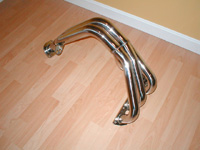
I finished things up, with a stainless steel 4-2-1 header.
A high flowing exhaust and catalytic converter, and a shorter geared transmission would have helped greatly, but I was ready to sell the engine and I did not want to put anymore money into this project. I have first gotten to experience the power of a fully turbo car with my CRX. And now, after this engine, I have a good idea of what a fully built naturally aspirated car would feel like. This is pretty much the end of my work on my Honda. Everything is sold and I now have a 1.9L B18B that I fully rebuilt. This engine is not the greatest, but it feels wonderful inside a civic. Certainly, I have nothing to complain about.
|| Back ||
My � 2002. All Rights Reserved.