PRINCIPLE
OF RADIO FREQUENCY ALLOCATIONS
IN
THE UNION OF MYANMAR
The
main purpose of this course is to provide spectrum manager in all departments to
have powerful management procedure.
It
is clear that spectrum manager in all departments should have spectrum
management knowledge to support their work but they are loaded by their duties. It is
more appreciate to learn by web and they have ability to explain others about
it.
This course is mainly for teaching we have tried to be training by web.
In
Myanmar, we teach this course three times a year for spectrum manager in the
field of telecommunications at Telecommunication and Postal Training Centre
under one of Government operator (MPT). Explaining lecture with video clip and
handout will include in the course. Up to now it is impossible to provide
face-to-face workshop format.
The radio frequency spectrum management is one of the superior integral parts of telecommunication management. Spectrum management, itself, is the combination of administrative, scientific and technical procedures necessary to ensure the efficient operation of radio-communication equipments and services without causing harmful interference. Simply stated, spectrum management is the overall process of regulating and administrating use of the radio frequency spectrum. The goal of spectrum management is to maximize spectrum usage efficiency and minimize interference. (
See details)Trainees will probably be in Bachelor in Science, and will be familiar
in radio frequency in the field of telecommunication.
The
principle of frequency allocation in the union of Myanmar course will run over a
period of 8 weeks, and the average trainee is expected to spend about 15 hours
per week in study, making a total of 120hours overall.
○ After the course, trainees should be able to contribute actively to his organisation of a principle of frequency allocation in the Union of Myanmar and to lead or to participate effectively in the work.
○ At the end of the course, each trainee should, together with possible group members, have licensing procedure concerning with radio frequency .
○ Trainees shall know how to maintain their frequency and safeguard them .
○ Trainees shall commence on e-learning as well as using software .
There
will be 8 weekly lessons as shown below.
|
Week |
Course |
Activities |
|
1 |
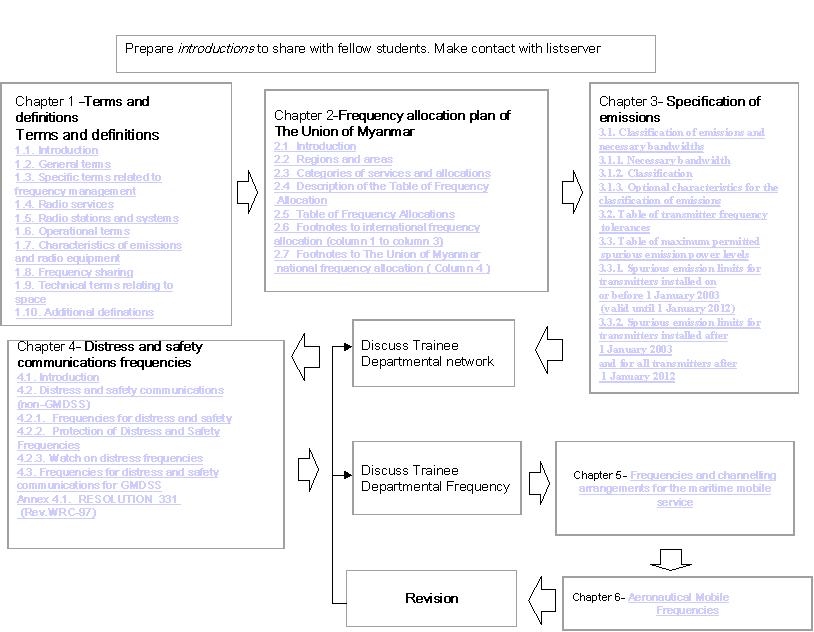
Prepare
introductions to share with fellow students. Make contact with
listserver |
Work
out when /where you will study |
|
2 |
Chapter 1 -Terms and definitions |
Send
first message to Listserver and discuss about chapter 1. |
|
3 |
Chapter 2-Frequency allocation plan of
The Union of Myanmar |
Send
message to Listserver and discuss about chapter 2. |
|
4 |
Chapter 3- Specification of emissions |
Draw
communication diagram in student organization and discuss about chapter 3. |
|
5 |
Chapter 4- Distress and safety
communications frequencies |
Discuss
frequency usage in the allocated band and discuss about chapter 4. |
|
6 |
Chapter
5- Frequencies and channelling
arrangements for the maritime mobile service |
Send
message to Listserver and discuss about chapter 5. |
|
7 |
Chapter 6-Aeronautical
Mobile
Frequencies |
Send
message to Listserver and discuss about chapter 6. |
|
8 |
Revision |
|
2.3 List of principal technical / specialist terms used
Common
Glossary / more
|
DECT |
Digital
enhanced cordless telephone |
|
DSC |
Digital
selective calling |
|
GMDSS |
Global
Maritime Distress and Safety System |
|
HAPS |
High
altitude platform station |
|
ISM |
Industrial,
scientific and medical |
|
MSI |
Maritime
safety information |
|
NBDP |
Narrow-band
direct-printing |
|
SOLAS |
Safety of
life at sea |
|
VSAT |
Very
small aperture terminal |
|
WRC |
World
Radio communication Conference |
Web will account for 50% of the time the students are studying by
themselves. It is essential half by half for web and non-web to the course.
The Website will be made up of four Modules, and trainees will receive
clear guidance on the recommended study path:
○
the main instructional
module,
which will take the trainee through a step-by-step sequence of activities in
building up a development plan
○
a reference manual,
with links going from the main instructional module to relevant parts which
trainees are required to read; audio clips of mini-lectures by the original
authors of the manual are included at key points
○
a module of activity
questions
with model answers, to help trainees assess their understanding and progress
○
a module of synopses
giving summaries and overviews
Permissions for use of the material in the Reference Manual have been
obtained from the authors, who will also record the audio clips; there are no
plans for making links from the course material to external Websites or
resources.
The
course will make available a listserver that will enable trainees to keep in
contact with each other, and to undertake some group work. The listserver will
have the email address of everyone on the course, and have a facility for
uploading and downloading files.
The
facilitators
is a person who explain Each trainee the
terms of this course with video clips.
Each
trainee should have a mentor
- someone with an influential position iin the organisation, who can facilitate
access to information and resources, and to whom you will be required to make
regular progress reports by email, written reports, or presentations.
The
Tutor is person who keeps an eye on the students progress. The
tutor will have had many years experience in this field, and will be in close
contact through the conferencing system.
Assessment will be organised on a case-by-case basis within the
trainee's organisation, and will be based mainly on the regular progress reports
and final plan submitted by each trainee to his / her mentor.
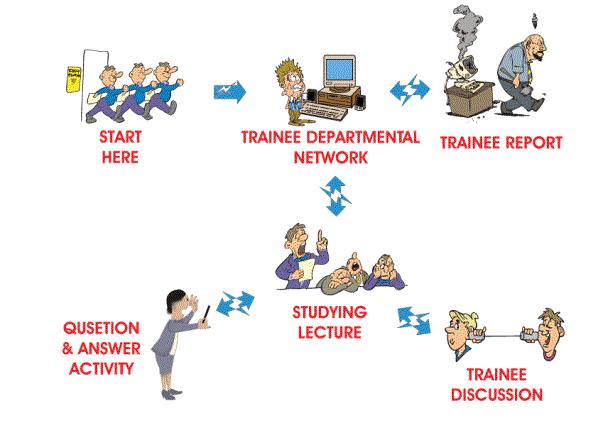
The course map illustrates how the
course works. The main focus should be with a reference manual.
There
are three levels of evaluation.
1
Self-evaluation, using the self-assessment questions built in to the
course
2
Informal weekly evaluations, arising when the tutor reviews each
student’s progress
3
Given that this course is about both acquiring skills and developing the
correct attitudes for this kind of work, the tutor will liaise with the mentor
to assess progress.
○
people: subject-matter experts, technical staff.
This course is for spectrum
managers in the field of radio communications. They should be given free access
to almost anyone in the senior management team, and it is the duty of the
student’s mentor to see that this happens.
○ information: resource materials and information for the course such as lecture notes, reference books, slides, tapes. Taking into accounts work experience for the previous five years.
○ equipment: such a PC computer which can access internet , scanners if they can , digital cameras, printers.
○ software: MS office and those provided by trainer
○
funds, estimated development costs
The equivalent of half the students working time should be spent on this course.
Trainees
will need to negotiate and agree with their organisation the necessary technical
resource (a networked PC), a place where they can study undisturbed, and
sufficient blocks of time each week away from their day-to-day duties and tasks.
Each trainee or group of trainees within the same organisation will need to
identify and gain the support of a mentor to whom they will be required to make
progress reports on the development of their Plan..
The
course is planned to run over a period of 8 weeks. Course development will
consist of converting existing paper-based material to web format, a process
that is estimated to take 10 days.