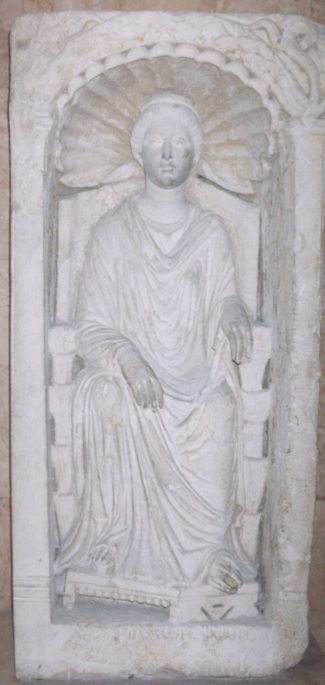
Writen under this statue: Huna Tarkud al ma'soof ala shababeha Martama.
Here rests the perished youth and body of Martama
Ever since
I was a child, I was in love with the name Marta. There was no explanation for
my passion attached to this name. Perhaps it was the feeling of familiarity
springing onto my childhood from the remnants of a previous life.
Then one day, I was roving among the statues in the second floor of Aleppo
museum when my eyes were mesmerized at the sight of a statue of a woman. A
couple of long minutes later, I realized that I had been staring at the silent
beauty that has been preserved by the hand of time from the hands of time.
“This is Martama,” deeply rang the poetic and dramatic voice of a man,
whose name later I learned was Mohammed, and whose position also later to be
learned, was the assistant director of the museum. “huna tarkud al ma'souf ala
shababeha Martama” (Here rests the perished youth and body of Martama) came
his deep voice again, as if he were reciting from the unseen books of time as
the pages unfolded in the eyes of a mysterious beholder, and captivating a vast
audience of the witnesses of history.
Then he continued, “Nizar Qabbani was
once visiting the museum, and I happened to be his guide. He stopped for a long
while in front the majesty of her grieved beauty, just like you did. After a
brief moment of majestic silence whose echoes filled the worldly space around
us, the old man started reciting, “La’an wakaftu amama mihrabe jamaleki
sametan, fal samtu fi harame al jamale jamalu.” (If I stand
silently in front of your sanctuary, silence in front of the sanctity of beauty
is a beauty in itself.”
Since then, Martama and I had been soul mates. Since that day, I cannot think of
a trip that I made to Aleppo without having stopped to pray in her sanctuary.