About Discovery Point
Discovery Point tells the exciting story of Scott of the Antarctic and his ship, the Discovery. The story unfolds at the Discovery Point centre with graphics and 3D audio, visual presentations.
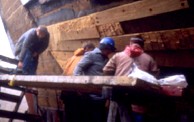
RESTORATIONDiscovery was one of the last wooden three-mastered ships built in Britain and the first to be constructed specifically for scientific research. Since Discovery returned to Dundee a major programme of restoration has been undertaken by Dundee Heritage Trust. This has included replacement of some of the ship's inner and outer planking, replacement of the lower masts, and replacement of the stem and stern posts. She has been re-wired for lighting and power. A ventilation system and electrically operated bilge pumps have been installed.
Discovery has been in dry dock at least twice, and new technologies in ship restoration, such as the steam sterilisation of infected timbers, have been carried out by the Imperial College of Science Technology and Medicine in London. Some of these treatments are firsts in ship restoration and have attracted international interest
Owing to conservation issues, it has not always been possible to use original materials. Woods such as opepe have sometimes been used in place of elm, oak and green heart.
All of the restoration work has been carried out under the supervision of the Maritime Trust. They continued to own Discovery until 1995, when they transferred ownership to Dundee Heritage Trust for the princely sum of £1. A one pound note dating from 1901, the year of Discovery's launch, was handed over to conclude the bargain!
ANTARCTICA
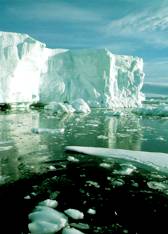
In 1901 the Discovery set sail for the Antarctica, the last great wilderness. The continent is a huge domed ice cap varying in depth between 6,000 and 12,000 feet. The surface of this ice cap forms the largest and highest plateau in the world, and roughly at its centre lies the South Pole
Antarctica is one of the coldest and most inhospitable places on earth. Even in summer the temperature rarely rises much above -20°C, while the average temperature in winter is a dangerous -60°C. It is an immense continent, twice the size of Australia. Unlike the Arctic, it is not just frozen ocean; there are land and mountains chains under the ice cap, making it three times higher than any other continent. In places, the land can be as much as 2.5 miles beneath the ice cap. Some of the ice may be 200,000 years old.
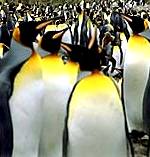
Owing to the severity of the climate, there is very little wildlife. The largest creature to live there during the winter is a tiny insect, but during the summer the coastal areas are visited by many animals including whales, penguins and seals.
Today, the scientific research pioneered by the Royal Geographical Society and other bodies still continues. The politics of Antarctica has resulted in a number of international treaties, with the interests of science having so far taken precedence over the claims of competing countries to ownership of the continent.
The British Antarctic Survey carries out research into a wide range of disciplines including geology, conservation, ecosystems, climate change, continental drift and geospace.
In 1998, Dundee Heritage Trust and the British Antarctic Survey reached a memorandum of understanding, whereby the Trust is able to access advice and materials, including exhibits for display and educational use. In undertaking this, the British Antarctic Survey recognised the importance of Discovery Point in the provision of information about Antarctic science to the public and to the educational system in Scotland.
CAPTAIN SCOTT
Robert Falcon Scott was just 33 when he was given command of the National Antarctic Expedition. When he set sail from Britain on 6 August 1901 in the new, purpose-built Discovery, he discovered a fascination with the Antarctic that would stay with him for a lifetime ...
Robert Scott was born on 6 June 1868 at Outlands, Devonport into a family steeped in naval tradition. He was a delicate child, and there was some doubt whether he would be physically fit for a naval career. However, he attained a cadetship when he was thirteen and later served as a midshipman. Sir Clements Markham, Secretary and later President of the Royal Geographical Society, was already planning a British Antarctic expedition when he observed the young Scott winning a boat race in the West Indies, aged eighteen years. Knowing that a future leader would come from this age group, Sir Markham placed Scott on his list of possible candidates. Their paths crossed again in Gibraltar in 1897, when Markham wrote, "I was more than ever impressed by his evident vocation for such a command". When the time finally came for Sir Markham to select a leader for the National Antarctic Expedition, Scott was Torpedo Lieutenant on HMS Majestic, flagship of the Channel Squadron. He was appointed to the command of the Expedition in June 1900 and, by the end of the month, was promoted to the rank of Commander, Royal Navy. He was present at the launching of Discovery in Dundee nine months later on 21 March 1901. Other members of the ship's company were to include Sub Lt Ernest Shackleton and Dr Edward Wilson, surgeon, zoologist and artist.