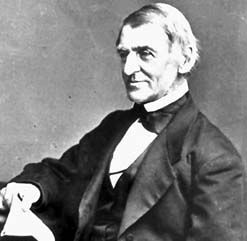
RALPH
WALDO EMERSON
The
son of a Unitarian minister, Emerson spent a sheltered childhood in Boston.
During his youth the publications of the German Higher Critics and their
progeny, as well as translations of Hindu and Buddhist poetry, were causing
controversy in American academic circles. Emerson's class at Harvard Divinity
School was affected by these
 influences; consequently, upon assuming the pastorate of a Boston church in
1829, Emerson experienced many doubts concerning traditional Christian belief.
He resigned from his pulpit in 1832, moved to nearby Concord, and then spent the
next few years studying and traveling in Europe. After visiting a Paris
botanical exhibition, Emerson resolved to be, as he termed it, a
"naturalist." Upon returning to the United States, he began his career
as a lecturer in the country's new lyceum movement. During the late 1830s and
early 1840s, Emerson published the works that present his thought at its most
idealistic and optimistic. The lyrical essay Nature (1836), a pamphlet
repudiating both materialism and conventional religion, declares nature the
divine example for inspiration and the source of boundless possibilities for
humanity's fulfillment. The American Scholar, an address delivered before
Harvard's Phi Beta Kappa Society in 1837, attacks American dependence on
European thought and urges the creation of a new literary heritage. Emerson's
Divinity School Address, delivered at Harvard in 1838, caused tremendous
controversy for renouncing the tenets of historical Christianity and defining
Transcendental philosophy in terms of the "impersoneity" of God. The
doctrines formulated in these three works were later expanded and elaborated
upon in his Essays (1841) and Essays: Second Series (1844), of which
"Self-Reliance," "The Over-Soul," and "The Poet"
are among the best-known.
influences; consequently, upon assuming the pastorate of a Boston church in
1829, Emerson experienced many doubts concerning traditional Christian belief.
He resigned from his pulpit in 1832, moved to nearby Concord, and then spent the
next few years studying and traveling in Europe. After visiting a Paris
botanical exhibition, Emerson resolved to be, as he termed it, a
"naturalist." Upon returning to the United States, he began his career
as a lecturer in the country's new lyceum movement. During the late 1830s and
early 1840s, Emerson published the works that present his thought at its most
idealistic and optimistic. The lyrical essay Nature (1836), a pamphlet
repudiating both materialism and conventional religion, declares nature the
divine example for inspiration and the source of boundless possibilities for
humanity's fulfillment. The American Scholar, an address delivered before
Harvard's Phi Beta Kappa Society in 1837, attacks American dependence on
European thought and urges the creation of a new literary heritage. Emerson's
Divinity School Address, delivered at Harvard in 1838, caused tremendous
controversy for renouncing the tenets of historical Christianity and defining
Transcendental philosophy in terms of the "impersoneity" of God. The
doctrines formulated in these three works were later expanded and elaborated
upon in his Essays (1841) and Essays: Second Series (1844), of which
"Self-Reliance," "The Over-Soul," and "The Poet"
are among the best-known.
Emerson
became identified with the Transcendental movement in the 1840s, serving as its
spokesperson, and as founder and guiding force of that group's quarterly
periodical, the Dial. Conceived as "a medium for the freest expression of
thought on the questions which interest earnest minds in every community,"
the Dial was published for a small readership from 1840 to 1844, when it folded.
Introducing the public to the writings of Amos Bronson Alcott, Margaret Fuller,
and Henry David Thoreau, a group who shared Emerson's philosophy, the journal
also published Emerson's first poems. The merits of his poetry, collected in
Poems (1847) and May-Day, and Other Pieces (1867), are subject to much critical
debate. Prominent among them are "The Rhodora," "The
Sphinx," "Brahma," "The Humble-Bee," and
"Threnody." But the poem best known to the American public is one of
his earliest works, the "Concord Hymn," which celebrates "the
shot heard round the world" of the Battle of Concord, during the American
Revolution.
Emerson's
poetry written from the era of the Dial onward, as well as his prose works
dating from Essays: Second Series, chart a steady decline in the author's
idealism and give rise to an emerging recognition of mortal limitations. The
Conduct of Life (1860) perhaps best expresses his humanistic acquiescence to the
reality of worldly circumstances. Other important later works include
Representative Men: Seven Lectures (1850), a series of essays on the men who
most closely fit Emerson's ideals--including Plato, Napoleon, and
Shakespeare--and English Traits (1856), a work hailed by his friend Thomas
Carlyle as an accurate portrait of English social manners in the midVictorian
era. Society and Solitude (1870) marks the beginning of Emerson's decline as an
essayist. He spent his last years in Concord, writing little, but recognized
throughout America as a philosopher of great stature.
Many
American authors, including Herman Melville, Walt Whitman, Emily Dickinson,
Nathaniel Hawthorne, and Thoreau are indebted to Emerson's thought. While some
critics find in him the eternal naif, a writer of pleasant-sounding but
ultimately impractical essays, containing ideals that stale with the age of
Emerson's works, others note his energizing influence on inquisitive minds as
evidence of his lasting greatness.
WRITINGS:
· Nature
(essay), Munroe (Boston), 1836.
· (Editor and author of preface) Thomas Carlyle, Sartor Resartus, Munroe, 1836.
· An Oration, Delivered before the Phi Beta Kappa Society, at Cambridge, August
31, 1837 (lecture), Munroe, 1837, also published as Man Thinking, 1844, also
known as The
American Scholar.
· An Address Delivered before the Senior Class in Divinity College, Cambridge,
Sunday Evening, 15 July 1838 (lecture), Munroe, 1838, also called The
Divinity School Address.
· Nature: An
Essay, and Lectures on the Times, Clarke (London), 1844.
· Orations, Lectures,
and Addresses,
Clarke, 1844.
· Essays (first
series), Munroe, 1841, enlarged edition, 1847.
· Essays: Second
Series, Munroe, 1844.
· Poems, Munroe, 1847, enlarged and revised, Houghton, 1884, revised again,
Houghton, 1904, also published in enlarged and revised edition as Selected
Poems, 1876.
· Nature: Addresses
and Lectures
(lectures), Munroe, 1849, also published as Miscellanies: Embracing Nature,
Addresses, and
Lectures,
Phillips, Sampson (Boston), 1856, also published as Miscellanies, Macmillan,
1884.
· Representative
Men: Seven Lectures (lectures), Phillips, Sampson, 1850.
· (Written and edited with William Henry Channing and James Freeman Clarke)
Memoirs of Margaret Fuller Ossoli, two volumes, Phillips, Sampson, 1852, issued
in three volumes, Bentley (London), 1852.
· English Traits
(travel essays), Phillips, Sampson, 1856.
· The Conduct of Life
(essays), Ticknor and Fields (Boston), 1860.
· May-Day and Other Pieces (poetry and essays), Ticknor and Fields, 1867.
· Society and
Solitude, Twelve Chapters (essays), Fields, Osgood (Boston), 1870.
· (Editor) Parnassus, Osgood, 1875.
· Letters and Social Aims, Osgood, 1876.
· Emerson's Complete Works, twelve volumes, Houghton, 1883-1893.
· The Correspondence of Thomas Carlyle and Ralph Waldo Emerson 1834-1872, two
volumes, edited by Charles Eliot Norton, Osgood, 1883.
· Miscellanies, Houghton, 1884.
· Lectures and Biographical Sketches, Houghton, 1884.
· Natural History of Intellect and Other Papers (essays), Houghton, 1893.
· Two Unpublished Essays: The Character of Socrates; The Present State of
Ethical Philosophy, Lamson, Wolffe, 1896.
· A Correspondence between John Sterling and Ralph Waldo Emerson, edited by
Edward Waldo Emerson, Houghton, 1897.
· Letters from Ralph Waldo Emerson to a Friend, 1838-1853 [Samuel Gray Ward],
edited by Charles Eliot Norton, Houghton, 1899.
· Correspondence between Ralph Waldo Emerson and Herman Grimm, edited by
Frederick William Holls, Houghton, 1903.
· The Complete Works of Ralph Waldo Emerson (essays, lectures, travel essays,
and poetry), twelve volumes, Houghton, 1903- 1904.
· The Journals of Ralph Waldo Emerson (journals), ten volumes, edited by Edward
Waldo Emerson and Waldo Emerson Forbes, Houghton, 1909-1914.
· Records of a Lifelong Friendship, 1807-1882: Ralph Waldo Emerson and William
Henry Furness, edited by Horace Howard Furness, Houghton, 1910.
· Uncollected Writings: Essays, Addresses, Poems, Reviews and Letters, Lamb,
1912.
· Emerson-Clough Letters, edited by Howard F. Lowry and Ralph Leslie Rusk,
Rowfant Club (Cleveland), 1934.
· Young Emerson Speaks: Unpublished Discourses on Many Subjects, edited by
Arthur Cushman McGiffert, Jr., Houghton, 1938.
· The Letters of Ralph Waldo Emerson, six volumes, edited by Ralph Leslie Rusk,
1939.
· The Early Lectures of Ralph Waldo Emerson, volume one, edited by Stephen E.
Whicher and Robert E. Spiller, Harvard University Press, 1959, volume two,
edited by Whicher, Spiller, and Wallace E. Williams, Harvard University Press,
1964, volume three, edited by Spiller and Williams, Harvard University Press,
1972.
· The Journals and Miscellaneous Notebooks of Ralph Waldo Emerson, sixteen
volumes, edited by William H. Gilman and others, Harvard University Press,
1960-1983.
· One First Love: The Letters of Ellen Louisa Tucker to Ralph Waldo Emerson,
edited by Edith W. Gregg, Harvard University Press, 1962.
· The Correspondence of Emerson and Carlyle, edited by Joseph Slater, Columbia
University Press, 1964.
· The Collected Works of Ralph Waldo Emerson, edited by Alfred R. Ferguson and
others, Harvard University Press, 1971.
· The Poetry Notebooks of Ralph Waldo Emerson, edited by Ralph H. Orth and
others, University of Missouri Press, 1986.
Credit
and source: Camden County Free Library (Vorhees, NJ)
Article
is from The Works of Ralph Waldo Emerson website. RWE.org
presents Ralph Waldo Emerson's Works, Essays, Books, Lectures, Addresses,
Commentary, PalmPilot Readable Docs, Poems and Uncollected Prose.
Visit their site: http://www.rwe.org