|
1) MYTH,
LEGEND AND HISTORY
To know Easthaven, you should know its history. Your
starting-point,
therefore, is here. This is a tale given by Easthaven storytellers
to welcome new arrivals at Fairharbour.
Deep and dark is the story of Easthaven.
Firstly; our land was not always so called. Analem, in the old
tongue, was its first given name; given from the earliest days,
when humanity first appeared on Aldara. Many still choose to use
it.
Those ancient settlers were navigators then as we are now; and
Analem, with its cool, temperate southern shores, its limitless
coastal nooks, channels and crevices to the east and west, and
the eerie chill of its northern reaches, offered delight and challenge
in equal measure to our ancestors of four thousand years past.
And from this time comes the story of what we did - that which
might have riven asunder the world of Aldara at its very birth.
The myth of our disobedience, of our brazen challenge to the Gods
and the Mages, may or may not be true, but upon it our reputation
and our history are forged. Of it we are by turns proud and ashamed
- because by turns it shows us how high humanity can reach, and
how low it can stoop.
Let me tell you more; this is the story.
We moved on. Our seafaring, our skills and our resources enabled
us to trade widely and prosper rapidly. And from our travels we
returned with new, exciting theories and ways of understanding
the world.
The Mages gave moral rule and order to the world created by the
Gods. Certain things were encouraged, others permitted, a few
- a very few - forbidden. We knew this, of course, but what we
brought into our land encouraged us to experiment. The fusion
of ideas, the heady mixture of magic and science that we were
discovering and exploring, led us to understand that the very
process of creation was open to us, and the stuff of the world
was ours to play with. We realised that it was possible to circumvent
that which the Mages had prescribed.
The world was young, and so were we. Like children confronted
with something enticing but forbidden, we played in secret. Perhaps
we were even led on by the Rogue, the betrayer, the outcast Mage;
one obscure tale describes his journey through our land at that
time. We may have consciously set out to disobey, we may simply
have overreached in our playing; no-one knows.
Likewise, no-one knows who finally brought all things together,
or precisely when it happened - though there are still those amongst
us who claim they know how. What we do know is this; for an instant
of time and at one spot in the depths of Analem, the constrants
that govern the workings of the world were broken.
Energy burst forth in a single shaft of light that pierced the
clouds. Some ventured forward, the bravest daring to reach within
it and finding themselves unharmed. Moreso, those with cuts, bruises
or scars withdrew from the beam to find them healed. Those who
were elderly found themselves refreshed - not magically rejuvenated,
but healthier and heartier in their old age.
Our courage grew. The power seemed benevolent to life yet ruthless
to inert things. Stone, wood and metal became as malleable as
clay within its cold, fearsome glow, and hardened again to their
natural state when removed from it. It was creative energy, and
it responded to the creativity of living, thinking beings. We
had unearthed a wonder, a marvel.
We could do as we wished. Again, we reached out and prospered.
We built a complex of mirrors and prisms to reach across the whole
land. They deflected small shafts of light from the main beam
and were directed wherever we would. There was no decay in the
strength of the beam, nor in that of its subsidiaries.
This was the force of life itself. This was power. Power to shape
the world around us, the potential for dominion far beyond our
boundaries. For a hundred and fifty years, we planned and dreamed
of ruling the world.
Then, for we who were but children, the worst possible thing happened.
Our plaything was taken from us.
Our mistake was to think that what we had would never leave us.
We believed that power which was limitless would also be timeless;
that, though it had a beginning, it would have no end. Again,
there is much that is uncertain. Did the Gods intervene, or the
Mages? Did the world heal itself from the wound we had made? We
do not know.
In century and a half, the beam had become our lifeline as well
as our toy; and as swiftly as it had once appeared, it was gone.
The collapse of our nation was as rapid and spectacular as its
rise. Without the discipline of long and careful thought, without
the opportunity to learn over time from small, gradual mistakes
as other societies do, we could not cope. We had gone from wooden
barns and huts to mountain-sized edifices of crafted rock in the
blink of an eye, and within a few generations we had forgotten
even what we first knew. Our pride had that effect on us.
We descended into chaos and savagery. No-one helped us, and for
that we do not blame them; we had, after all, sought to subsume
the world, and the world knew it. We became but feral creatures
roaming the magnificent shells which we had fashioned and had
lorded over in splendour. The mighty were fallen; we had challenged
Creation itself. We were now reaping the consequences. We could
barely feed or clothe ourselves. Our numbers dwindled and the
land descended into darkness.
Myth, legend, or history, honoured visitors - which do you say?
The truth lies in what you will see in this land. Do not mistake
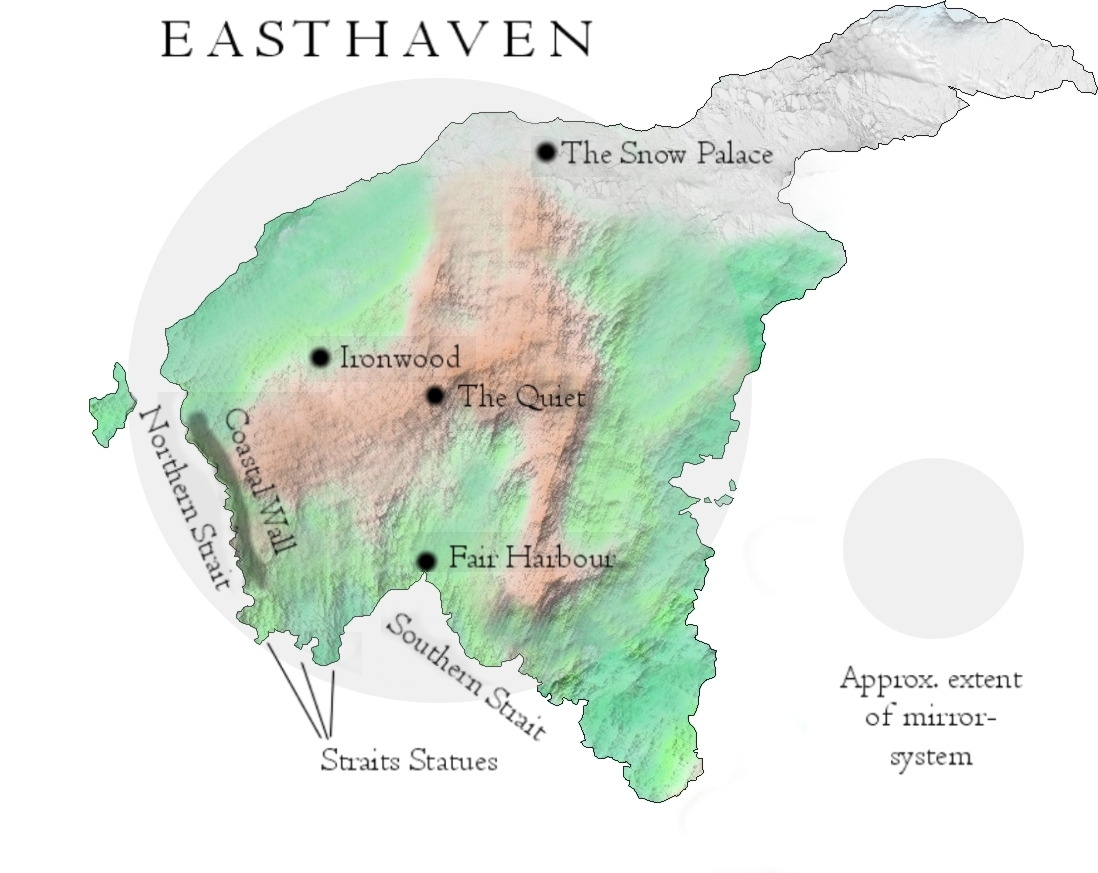
me; good has come from that time. Ironwood City and its Fortress,
the Snow Palace, the Coastal Wall and the Straits Statues have
remained intact from that day, defying two hundred generations
of wind, rain, conflict, and the extremes of neglect and over-use.
The mirror-system still serves as a bringer of good and bad tidings,
though we now use gentler daylight instead of the wild light of
creation.
And there is the Quiet. In the heart of this land is a place no
larger than a ploughed field. Nothing grows in it or lives on
it, because nothing can; science and magic have no effect within
its boundaries; and to venture into it is to know that you have
momentarily removed yourself from the created world, and must
return to it within the instant if you value your life and your
soul. The mirror-system describes a huge, rough circle, and the
Quiet is close to its centre. If there is compelling evidence
of the truth of our story, it is to be found there.
You will see these things, gentle guests, and you will marvel.
Whatever our speculation, the truth is that our ancestors built
them and we do not know how. But we have slowly, slowly restored
our land. We are able to prosper again and to pursue peace at
least partly because these wonders are here. We know humility
and a way of cooperating with the world. We value the present
because we understand our past, and we can aim for a better future.
We discovered, we prospered, we fell, we have recovered. Such
is the story of Analem in a single sentence. You will find that
which I have told you here to be least of what you will experience
in Easthaven. I wish you well in discovery, in travel, in rest
and in return. Your stay here comes with our blessing.
TOP
|
2) A TIMELINE
FOR EASTHAVEN
(all dates prior to 2600 are estimated)
| YEAR |
EVENT |
| 0 |
Earliest recorded history of Analem. Where the first settlers
originally came from is not known. Early settlements established
along southern and south-western coastlines. |
| 800-1100 |
Expansion of seafaring capabilities. First exploration of
neighbouring countries and islands. |
| 1100-1400 |
Age of Discovery; seafaring allows Analem people to explore
much of Aldara |
| c. 1500 |
(mythological) Acquired knowledge allows the discovery and
harnessing of wildlight - "the light of creation". |
| 1500-1650 |
Explosive growth of the Wildlight Culture: development of
the Mirror-System, building of Ironwood and the Ironwood Fortress,
the Snow Palace, the Coastal Wall and the Straits Statues.
Conquests and invasions on a large scale are planned. |
| c. 1650 |
(mythological) Extinction of wildlight, leaving the area
known as The Quiet.
|
| 1650-2000 |
Collapse of Wildlight Culture. Virtually no records survive
from this period. Descent into barbarism, catastrophic decline
in population. |
| 2000-2600 |
The Warrior Monarchs. Analem splits into provinces - more
than thirty of them at any one time, each ruled by a warlord.
No central governance, provinces vary widely in size and population.
Conquest and invasion constantly change the political geography
of the country. |
| 2600-2800 |
Traius (r. 2610-2661) and Kresina (r. 2608-2665) reign
over the two largest provinces of their time for over half
a century. Each takes control of a number of other provinces.
Their influence, and that of their successors, leads in time
to amalgamation of the provinces and the forming of the East
and West Kingdoms in 2792; the former based at the Snow Palace,
the latter at Ironwood. For historians, this marks the end
of Analem's thousand-year "Dark Age". |
| 2800-3200 |
East and West Kingdoms flourish independently of one another,
with strong leadership and in relative peace. There are a
few border skirmishes and one more significant conflict, but
these are spread over a 400-year span. To all intents and
purposes, the two Kingdoms function as separate nations during
this period. |
| 3200-3300 |
Until this time, Analem has effectively been exiled from
the outside world since the Wildlight collapse, though the
Kingdoms have traded on a rough and ready basis with other
nations. Anjika (r. 3211-3242) of the Western Kingdom begins
formally to restore links of trade, diplomacy, learning and
culture. Tyron (r. 3257-3300) later does the same for the
East. |
| 3300-3400 |
Magicians, scholars and scientists enter Analem in numbers
for the first time in 1600 years. They find and name it "The
Land Without Magic"; it is spiritually dark, lifeless
and threatening. This is further evidence of the truth and
consequences of the Wildlight collapse. |
| 3400-3600 |
Restoration and Reunion; a key period in Analem's history.
Rulers of both Kingdoms encourage the presence of outside
influences in an attempt to heal and restore the "Spirit
of Analem". Through this guidance and wisdom, a consensus
is reached that Analem must again be one nation. |
| 3601 |
The Quiet Council declares the Act of Union. Xalda of the
West and Cheron of the East abdicate their thrones in favour
of their children, who have married each other, as co-rulers
of the united Analem. |
| 3600-4000 |
A sustained period of modernisation - an "Enlightenment"
of its time and place. International influence is widespread
throughout the country, the development of learning and culture
is paramount. Analem becomes formally known as Easthaven at
the end of this period, though most of the population use
the old name, and still do to the present. |
| 4000-4300 |
The Gathering extends and supersedes the modernisation.
For three centuries, Easthaven monarchs follow a self-imposed
discipline of exploration, discovery and learning to bring
the best of the new world to their shores. Immigration, trade,
industry and the exchange of ideas are encouraged on a huge
scale. Modern opinion is that the desire to discover how Analem
accomplished what it did during the Wildlife Culture was behind
this movement; if this is the case, it did not succeed. |
| 4300-4600 |
The development of Teknos as a discipline
particular to Easthaven. |
| 4600-present |
Consolidation. An increased sophistication in politics,
intelligence and military strategy means that the old ways
of doing things (monarchy, heirarchical government, the semi-feudal
distribution of resources) may at some stage be under threat.
Conversely, there are also influential groups of enthusiasts
for the Ancient (ie. Wildlight) ways; there is something in
the Easthaven psyche which is desparate to recapture this
aspect of what has gone before. These tensions, if nothing
else, make for interesting times. |
| 5003 |
The here and now... |
TOP
3) THE LAND,
ITS WILDLIFE AND PEOPLE
Aldara is Earth-sized,
and there are maps on the RDNA Aldara forum which are
helpful in showing this - go here
to see them. The map at post #13 of that thread provides
a direct comparison of the two geographies.
For Easthaven, the geography has close parallels with
Earth. If Greenland could be moved a thousand miles south
and 180 degrees west, it would be a close approximation
to Easthaven - in climate and in rough size and shape.
This gives a huge variety in geography with a lot of potential.
Comparatively, you could start, say, in southern England
or northern France and go through Scottish highlands and
Scandinavian fjords before ending up in wild Siberian
wastes.
Easthaven is the eastern, and slightly
smaller, of the two main Mist Haven Islands. Because of
its size and shape (longer than it is broad), it has a
wide variety of climate.
The southern peninsula and south-western regions are temperate,
with warm summers, cool winters and defined autumns and
springs. This pattern begins to change in the Ironwood
region, and gets worse further north; the climate becomes
much colder and the human population thins out. The human-habitable
area of Easthaven more or less ends at the northern point
of the mirror-system and the Snow Palace. That area is
already ice-locked for nine months of the year, and further
north the land is permanently so.
Fish is the principal crop of the south, with many edible
species available in great numbers around the peninsula
and the south-west. The Southern Strait is one of the
world's principal sea-farming areas. Wheat and grain harvesting
takes place in the southern regions; it is possible further
north, but becomes difficult.
Forestry is the north's main industry and export. The
forest around Ironwood gives that city its name. It is
a huge area of massive trees, 1000 feet high and 200 broad
when fully-grown, dead-straight, with branches only starting
100 feet from the top. The wood is, as its name suggests,
extremely hard and durable. It is therefore ideal for
construction and building work, but the trees are very
carefully conserved. Only one may be cut down and processed
at any one time; but as this provides half a million cubic
feet of usable wood, it is not too much of a hardship.
Wildlife is plentiful in the south and south-west. Many
animals - dogs, horses, sheep, cattle - have been domesticated
and are part of the region's farming and agriculture.
There are many species of migratory and resident birds,
and a full complement of insects, small mammals and reptiles,
and freshwater fish. Wolves and snowfoxes occasionally
venture south during harsh winters.
Again, though, the north is different. As with the human
population, the wildlife population thins out at higher
latitudes. There are fewer mammals, but they tend to be
larger - deer and elk form large herds, and wolves prey
on them. Snowfoxes prey on the smaller mammals that live
in the region.
In the far north, there is only one main predator - the
bearwolf. It lives where no other mammal can. It fills
the same niche as polar bears do on Earth, but is slightly
smaller, faster and more mobile. On Earth, bears and dogs
are thought to have a common ancestor, and on Aldara,
the bearwolf is that animal. It hunts the northern waters
and ice-floes in extended family groups, and is extremely
aggressive, highly intelligent, and fiercely protective
of its young.
Lastly, there are rumours of ice-giants at the very tip
of Easthaven, inhabiting the polar ice-fields. There are
no reliable reports of this, but these creatures have
been a part of Analem and Easthaven myth and legend throughout
history. What type of being they are or their detailed
appearance is unknown; all that exists is the suspicion
that they are there.
The People of Easthaven
On Earth, Haveners would look very similar to Scandinavians
or Icelanders. As in all worlds, the region's climate
has worked its influence on its inhabitants. Haveners
therefore tend to have light-coloured skin and fair hair.
There is, however, quite a lot of variation. Immigrants
from other human populations have been mixing with native
Haveners for several centuries; the Gathering Monarchs
(see Timeline) actively encouraged
this as a way of restoring Easthaven to something like
its former status. A wide mix of racial characteristics
can therefore be seen in Easthaven, and Fairharbour in
particular has the deserved reputation of being one of
the most cosmopolitan human cities on Aldara.
The Cities
Easthaven is a very large country, and the population
is still quite thinly-spread. There are large clusters
of people, though, in the three principal cities - Fairharbour,
Ironwood and Snow Palace.
Fairharbour has been the capital of Easthaven since the
Union; it was deliberately chosen away from the old Eastern
and Western capitals. It has a lot of advantages; it is
coastal, temperate, and accessible. The darkness of Easthaven
has an attraction for curious and adventurous visitors,
but Fairharbour is everyone's starting-place, offering
comfort, friendliness and warmth to guests.
Ironwood is the heart of modern Easthaven in many senses.
Links between it and Fairharbour are long-standing and
well-established, and transport between the two cities
is easy and direct. All the specialised industry and commerce
which Easthaven has as its own is here; the ironwood industry
itself, the drawing in of commerce and skills from the
peripheral mirror-system towns, and the immense township
of Ironwood Fort - an entire city within a city itself,
and the largest single concentration of people in the
whole of Easthaven.
Snow Palace is a little smaller than Ironwood Fort, but
not by much. Thousands of people live within it, and there
is space for as many again. As long as its trade routes
are kept open (not always easy in the depths of winter),
the Palace is a starkly beautiful place to live. The Wildlight
people who built it did so with an understanding of insulation
and conservation of heat and light which puzzles people
even now. But occasionally the routes are snowbound, the
system breaks down... and life at Snow Palace becomes
survival.
TOP
4) MAGIC,
SCIENCE, TEKNOS
The Dark Land, the Land Without
Magic...
As it climbed, struggled and fought its way
out of a thousand-year Dark Age, the one thing
all of Anelem held on to was the need for caution.
There was never to be a return to the reckless ways
of the Wildlight times; they had reached too far and
lost too much for that ever to be risked again. So
they developed that most natural of disciplines;
Science.
Science is often frowned upon on Aldara as
a thoroughly unsophisticated way of getting things
done - a brute-force approach to solving life's
puzzles and problems - but, while the magic was
absent, there was little alternative.
During the Restoration and Reunion, then, the
scientific way of understanding the world held
sway. Analem was desperate to regain a measure
of credibilty and respect across the nations,
and it found it in science and industry.
It was seen as a quirk and an oddity by the rest
of the world, but by being unusual, it was also
distinctive. Analem could, for a while, provide
something different; and it had the resources
still in existence from the very earliest times
which they could learn from. During this period,
if you wanted, say, a pair of glasses, a telescope,
a microscope... you went to the new industrial
towns dotted around the perimeter of the Mirror
System. A new mainmast for your ship? Order it
from Ironwood - simply the best.
So science did some good. But magic was on the
move, creeping back into hearts and souls and
lives across both Kingdoms. As caution was the
watchword after the Dark Age, so unity became
the word which sparked the full flow of magic
and life and health back into the broken body
of Analem.
Magic would come and science would go, everybody
said. All expected it; most probably hoped for
it. But it didn't happen. The two grew alongside
each other, and added a third dimension. Restoration
and Reunion also saw the rise of art in Analem, where
so much before had been utilitarian at best and crude
at worst.
And there rose up a group of people during the
Gathering who seemed to have a gift of synthesising
the three into a heady mixture that was all of
Science, Magic, and Art, and yet was none of them.
Watch your pride, warned the conservatives. Yes,
but this might be how we were - this is what we
could be, responded the radicals. So, from seven to
four hundred years ago, this groups, their disciples,
their followers and successors, forged once again
in Easthaven something different.
The wildness of magic, the freedom of art, and
the discipline of science - these are the three
things which give Teknos its unique qualities.
Haverners are not the greatest artists, nor the
most esteemed scientists, nor the most powerful
magicians in the world - but the fusion which
they have brought to each of the three is perhaps
the real promise of the future for Easthaven.
There is this about Haveners; they seem to
enjoy the idea of being dangerous... (Anon.)
TOP
|
5) LANGUAGE
There are three
languages with which an inhabitant of Easthaven
will be familiar - their own native language,
the common Aldaran trade language, and the ancient
Analem Tongue.
The Ancient Tongue has, remarkably, survived almost
unchanged in four thousand years, despite the
fragmentation of the country for a long period
of its history.
As with a lot of Analem's history, its roots lie
in the Wildlight Culture. The stories from that
time show a people with a remarkable unity of
purpose and thought, bound together in their language.
There's even some speculation that the Light -
if it existed - may have enhanced this; not in
making the people telepathic, but somehow drawing
them closer together in thinking and action. The
single word "Analem" therefore generalised
to describe the place, its people, and their language
- I come from Analem, I am Analem, I speak Analem.
There must have been a group of people (a scholarly/religious
order or society, perhaps?) who maintained the
language through the Dark Age and beyond. There
is no record of them, but they did their job well.
We know that, somehow, the Ancient Tongue survived
intact from the Wildlight collapse to the establishment
of the Two Kingdoms, when it was again adopted
as the national language - a period of over 1100
years.
But much has changed now, of course; the place
is Easthaven, the people are Haveners (pronounced
more like "Havveners"), and the language
is Havenish.
Restoration, Reunion and Gathering brought this
about. As Analem moved out of its self-imposed
exile into the wider world, outside influences
made a real difference - in the area of language
as in many others. The Ancient Tongue was and
is still studied and taught; it has held, and
always will hold, a place of honour in Easthaven
society. But the language of the common people
was allowed to change and develop. It still has
recognisable Ancient roots, but in conversation,
you wouldn't be able to work out one from knowing
the other.
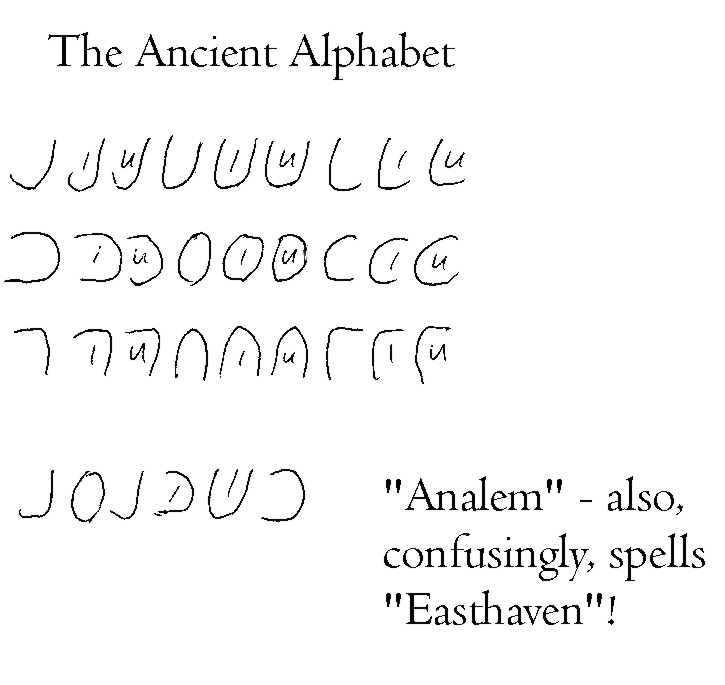
Writing is different, however. The written alphabet
remains as it always was. This makes translation
difficult, because pronunciation, syntax and meaning
have shifted so much. But the basic idea of letters
based on a grid pattern is so simple that it has
lasted through time and change.
TOP
|
|
|
6) THE REAL WORLD
- INFLUENCES ON EASTHAVEN
And finally... you may or may not be interested
in this, but here's a list to give you an idea of where I'm
coming from with Easthaven. The influences definitely tend more
towards science-fiction than fantasy, but the ones listed here
tend to blur the line, or cross the border, between the two.
I've not imported complete ideas wholesale into the Easthaven
environment; it's more the 'feel' of the stories, and the worlds
they're set in, that have been influential.
AUTHORS
Fiction
Ursula K. LeGuin's The Left Hand of Darkness and Always
Coming Home.
Gene Wolfe's Book of the New Sun
Mervyn Peake's Gormenghast trilogy
Joan D. Vinge's Snow Queen cycle
Robert Sliverberg's Majipoor Chronicles
Roger Zelazny's Nine Princes In Amber
Frank Herbert's Dune cycle
C.S. Lewis' Chronicles of Narnia
Stephen Donaldson's Chronicles of Thomas Covenant
Iain M. Banks' Culture novels; especially, here, Inversions
Neal Stephenson's Quicksilver
Non-Fiction
Dougal Dixon's Biology of the Future series (After
Man, etc.)
GAMES
The Myst series
Zork Nemesis
OTHER SOURCES
The Christian Bible and New Testament Greek
TOP
|
|