|
|
Research | |
| Tips | ||
Design Brief- MTPV
|
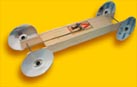
Your team must design and build a Mouse Trap Powered Vehicle that will travel the farthest in a competition. Your car will be powered by the energy supplied by one mousetrap. You may use any materials available to build your design. To solve this problem, you must use the design process. Use the "Design Process Problem Worksheet" found on the Tech Ed website. Save it to the your Stuff folder on the hard drive. Fill it out as you work. DPPW's must be complete prior to racing. |
|
Your car will have 5 races, adding the 3 longest distances traveled together will give you your score. This is a distance competition, make sure your car "tracks" straight. If it curves left or right, you might lose distance.
1. There is no size limit to your car. It may be any size. 2. Your design will be driven by the power supplied by 1 small mousetrap. 3. You may use any material available to create your car- wood, Styrofoam, foam board, etc. 4. Plastic wheels are available to you, but you may bring in your own. Wheels can be made from materials that float. 5. You must experiment and choose how the mousetrap will cause the wheels to turn. 6. You may use any size wheel axles that you deem necessary to work with your choice of wheels. 7. you may not alter the mousetrap, but you may add extensions to the bail. 8. Fill out a web outline using Inspiration on the topics- "Mousetrap Cars-How Do They Work? and Basic Propulsion Theory." |
Work list:
|
| Research
Start your Research- step 2. This involves understanding two topics:
Search for these topics on Doc Fizzix. Devour this link, and research the info to create an "Inspiration" web outline. This can be used during your end of activity MTPV quiz. Print and pass in your "Research". The "Inspiration" program is found in Start/ Programs/ Inspiration k-12. Be sure to save in your stuff folder. |
|
5 |
3 |
1 |
|
| Design Process Problem Worksheet | neat and complete | missing no more than 2 items | missing more than 2 items |
| Rough sketch | neat, has measurements | sloppy, unable to build from | not done |
| Competition | races 3 x | cannot complete race | DNR |
| Research | complete, both areas covered, fine content | only one topic completed | not completed |
| MTPV | neat, works, looks like the rough sketch | works, bares some resemblance to the rough sketch | does not work, and/ or does not look at all like the rough sketch |
| Quiz | 85% or higher | 70-84% | below 70% |
| Cooperation | Works and helps out in all ways | works 70% of the time | Works less than 70% of the time |
A 28-35 B 22-27 C 17-21 D 12-16 F 0-11