
Design Brief- MMS Rally 500 :
Your team's challenge is to design a vehicle that will travel over a 500 cm race course in the fastest time. The course will include flat, sand and water areas to traverse. The winning team car will be a combination of artistry, speed and engineering. To solve this problem, use the Design Process Problem Worksheet . Fill out the info as you work. Your research topic will be the sport of Rally Car Racing. Find info on the internet and create a web outline using "Inspiration" software. Store your DPPW and Web outline in your "stuff" folder on your computers' hard drive. |
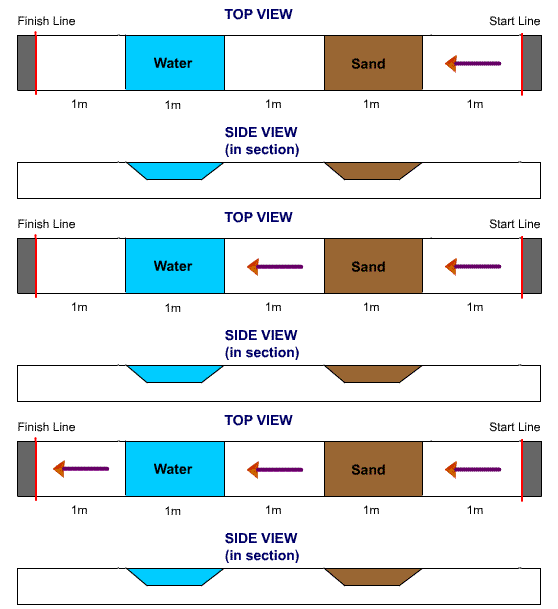
The course will be set up between some benches in the Wood Lab. The water and sand areas are 2.5 cm deep. The measurements are approximate.
|
1. Final size of your design can be no larger than 12" long, 12" wide or 12" high. 2. Your design will be driven by only one 9 volt DC electric motor given to your team. It can be powered by 1 or 2 of your 9v batteries. 3. You may use any material available to create your car- wood, Styrofoam, foam board, etc. 4. Plastic wheels are available to you, but you may bring in your own. Wheels can be made from materials that float. 5. You may use gears, pulleys or a direct drive transmission to move your car. You must experiment and choose which transmission will work for you. 6. You may use any size wheel axles that you deem necessary to work with your choice of wheels. 7. Your car must be designed according to an artistic theme, and will carry a driver that is associated with this idea. Examples: baseball, Shakespeare, music groups, etc. Drivers can be action figures, beanie babies, painted soda cans etc. 8. The finished car must have its name attached using a banner or flag. 9. There will be only one car per theme. Brainstorm your theme quickly, before others pick it before you. 10. Fill out a web outline using Inspiration on the topic- "Rally Car Racing." |
11. Lastly, record any changes you would make for the better, or figure out why your design did not work. List these in step 8- Re-Design. 12. skip step 7- communicate. Take the end of activity Quiz. You may use your "Inspiration" outline for help in answering the questions. |
| Research
Start your Research- step 2. This
involves Understanding the Sport of WHAT IS A ROAD RALLY? and SCCA Road Rally Read these 2 links, and research the info to create an "Inspiration" web outline. This can be used during your end of activity MMS 500 Rally quiz. Print and pass in your "Research". The "Inspiration" program is found in Start/ Programs/ Inspiration k-12. Be sure to save in your stuff folder. |
|
1.00 Designs must be powered by an electric motor (see rule 1.00E). Other stored energy is allowed for non-propulsive purposes only. It is legal to get assist from water, wind, sun, gravity. 1b Each design must measure no more than 12" long, 12" high and 12" wide at the start and end of each race. During the race it can exceed these dimensions. 1.00E A car can use only one (1) 9 volt DC motor. This can be powered by a maximum of two (2) 9 volt batteries. The motor and batteries can not be modified. You must provide your own batteries. 1.000D The name of your design must be visible to average human eyes from 10 ft. It may be on each side of your vehicle or on a sign, flag or banner. 1.03C Designs must not be inherently dangerous to the team members, or to anyone else in the world. Pointy things, such as nails, screws, and hooks are dangerous and are disallowed. Flames are not allowed. 2.00 All special terrain equipment must be on board your design at all times when traveling the course. This includes flotation equipment, special tires, and so on. 2.01a All designs must have the required equipment (listed below) on board at all times when traveling the course. This equipment includes:
2C or not 2C Mom's high anxiety Rule: A check in there will be a safety and compliance inspection to insure that all the other rules is followed. 3.00 Team members must be human. There must be fewer than 4.35 humans on a team. 3.1a Hand Rule. No one can touch your vehicle between start and finish except as in rules 3.1415926 and 7-1/2. 3.1415926 Drift Law: If a design get stuck in the sand or water, after 20 seconds a member of the team can move it to the end of the of water or sand, which ever it is stuck in. 3.14etc Pinky rule: The team member in 3.1415926 can only use one pinky finger to help the car. 3.2 Roll in/out rule: cars must be propelled unassisted into, through, and out of the sand and water except as noted in the two previous rules. 3.7 Maximum time. The maximum time a design can spend on the course is 1 minute. When 1 minute is reached, timing will stop, the design must be removed from the course and the judges will record the final location. 4f Harassment of race officials can result in a 10 minute penalty, or banishment. Disgrace is liberally awarded in all such cases. 4x Team members and officials will not involve themselves in incidents of kicking, biting, scratching, or fisticuffs. Anyone engaging in such outrageous activities will be banished. 5 This space intentionally left blank. 6.02b The ET ruling: No radio control, remote control, psychic control or other means to guide the vehicle externally will be allowed. 7-1/2 The Agony of Defeat Law: If a design leaves the course, a member of the team can replace it at the point it leaves the course. Ten (10) seconds will be added to the time for each time this occurs. If it occurs in a way that makes the judges laugh, points may be added to the artistic theme score. If it makes the engineering judge cry, points may be deducted from the engineering score. 8: In case of rain, the race shall be run in the rain. 10.00 No obscene or offensive sculptures in the eyes of the judges. 10.3c A judge¹s word is final. 10.4 No design will race without a completed Design Process Problem Worksheet, done except step 8. |
|
JUDGING The artistic theme is important in MMS 500 racing. Artistry judging is based on the creative craftsmanship of the entire design "experience" and includes such things as use of color, 2 and 3 dimensional artistic designs (including "gratuitous" moving parts), humor, theatrical appeal, thematic role playing, costumes worn by the team members, songs sung, music played, poems read, etc. Engineering will be determined by the total of the engineering score received from each judge divided by the number of judges. Judges may score each design from 0 (worst) to 10 (best). Engineering judging is based on the creativity of the design for dealing with various course obstacles, ingenious ways of solving problems, imaginative use of materials, and quality of construction. A design falling apart or failing to negotiate an obstacle leaves a definite negative impression. |
|
5 |
3 |
1 |
||
| Design Process Problem Worksheet | neat and complete | missing no more than 2 items | missing more than 2 items | |
| Engineering Score* | first place (second) | second place (3rd, 4th) | entered a working car | |
| Artistic/ Theme Score* | first place (second) | second place (3rd, 4th) | entered a working car | |
| Speed/ Time Score* | first place (second) | second place (3rd, 4th) | entered a working car | |
| Cooperation | helps out the team in all ways | helps out and works 70% of the time | works less than 70% of the time | |
| Research | completed, good content | lacks good content on topic | not completed | |
| rally car prototype | works, has flag 7 driver | works, no flag and/or driver | DNW | |
|
over 85% | 70% to 84% | less than 70% |
34-40 A, 28-33 B, 25-32 C, 18-24 D, 0-17 F
* depends on the number of participants