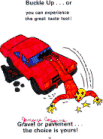
Design Brief- Crash Test Dummies
|
"The EggMobile"
Safety engineers work on passenger restraints and energy absorbing devices that are installed in automobiles. These items include seat belts, air bags, shoulder harnesses, roll cages and front bumpers. Such devices save many lives in today's automotive society. Your team of safety engineers must design a vehicle that includes some of these very devices. The car must roll down 3 test ramps of different heights, crashing into an immovable object, and protect its occupant (a raw egg) from injury during both attempts. If your car is successful in these test ramp collisions, it will be propelled by CO2 gas fuel into a brick wall to simulate a roll-over accident. To solve this problem you must follow the design process. Simply follow the Design Process Problem Worksheet. Simply save it electronically into a folder for your team and save it in the STUFF Folder on the desktop. Each team of engineers will pick a topic associated with the automotive industry. This quarter's research will be automotive manufacturers. For example, Ford, Porshe, etc. Find info on this area, and develop a Web Outline using Inspiration Software. |

|
Car Specs 1. All cars will have 4 wheels. Small plastic wheels are available, however you may bring in, or "cut " your own from any available material. 2. All completed cars must fit into a "size" box, for their length and width. This allows all engineers to build a similar size car. Vehicle that do not fit in the box will not be tested. 3. Your car must include:
4. You may add any materials you feel necessary to keep the passenger "safe", per Mr. G's discretion. See Rule 9 and 10, below. |
|
1. All cars must fit in the size box, or they will not be tested. 2. All research papers must be completed before building. 3. Test Dummies must be enclosed in a "body bag" (zip lock plastic bag) during testing. 4. Teams must provide their own eggs, 1 per engineer. 5. Test Dummies may be decorated or animated. 6. Cars failing the roll tests will not be CO2 power tested. 7. Design Process Problem Worksheets must be completed prior to testing. 8. The Test Dummy must be "seated" behind a "windshield/ dashboard" with no less than 1/3 of his/her body exposed. 9. The Test Dummy cannot be taped or glued into his/her seat. 10. The Test Dummy must be "raw". |
|
Links
|
|
Work list:
|
Grading
|
5 |
3 |
1 |
|
| Design Process Problem Worksheet | Neat & complete | missing no more than 2 items | missing more than 2 items |
| Research | good content easy to understand, neat | Missing content, messy | not completed |
| Safety Vehicle | completed and tested | completed, not tested, or tested , not completed | no car |
| Restraint System | Test dummy securely held during testing | Test dummy broke loose, but survived | Test dummy succumbed to injuries |
| Front Bumper System | car not affected during testing | car disabled | no system |
| Cooperation | helps out team in many ways | helps out and works 70% of time | works less than 70 % of time |
Extra points: up to 5 points each
decorated car
decorated Crash Test Dummy
CO2 Test- pass
23-30 A, 17-20 B, 14-16 C, 10-13 D, 0-9 F