| The Alanya Museum And The Ruins The History Of Alanya Alanya was settled down on a small peninsule with Taurus Mountains on the north, Mediterranean on the south.As it was on the line between Ancient Pamphylia And Klikya border, sometimes it was called city of Klikya and sometimes Pamphylia The documents describing periods of Alanya in ancient times are quite limited.The studies made by Prof. Dr. K�l�� K�kten in 1957 in Kadrini Cave 12 kms away from city center indicated that the region extends until Upper Paleolitical period (B.C. 20.000 - 17.000). It is not yet known the time of founfation and the of Alanya.The oldest name of the city known is " Coracesium " . During Byzantium period it was called " Kalonoros ".Upon invasion of the cartle by Alladdin Keykubat I of Seljuki in 13 century (1200-1237) , the name of the city was changed into " Alaiyye ". Atat�rk gave the name of " Alanya " to the city. When he visited the city in 1935. The first person mentioning Coracesium is Skylaks, one of the geographer of Antic Age in B.C. 4th century. During this period the city was under reign of Pers civilizations invading most part of Anatolia. The ones seeing and then mentioning the city name in their books contain Strabon , Pir-i Reis , Traveller �bn-i Batuta and Evliya �elebi . We don't have sufficient information about history of the city during Byzantine period. In A.D. 7th century during Arabic attacks the city defence gained more importamce. And in order to defence the city against attacks castle construction was given priority. Therefore most of the castles and churches in Alanya and surrounding are dated from A.D. 6th and 7th century. Alladdin Keykubat I , one of sultans of seljuki defeated Kyr Vart dynasty having reign in Alanya Castle in 1221 and invaded the castle. The sultan built a house in his name there. Seljuki Empire used Alanya as a second Capital city in addition to Konya and used the city as winter center and made improvement activities therein. Mongol attacks in 1243 and Entrance of Egyptain Memluks into Anatolia weakened Seljuki Empire. Seljuki Empire was divided in 1300, and the region passed under reign of karamano�ullar� in 1427 Alanya was sold to memluk Sultan for five thousand gold, and then in 1471 the city was included in borders of Ottoman Empire by Mehmet II (The Conqueror) . Alanya together with Tarsus was affiliated to Cyprus State in 1571. In 1864 it became apart of Konya Province. In 1868 the city was affiliated to Antalya and in 1871 bacame a district of this Province. Alanya Castle and Monumental Arts Alanya Castle has always been subject to settlement because of its accessibility difficulties from sea and land, and is only one of the castles decorating Anatolia and surviving until present. The castle was castle wall of 6.5 km length, 140 towers, about 400 cisterns, doors with inscriptions and is in the view of open air museum reflecting Seljuki art in the best manner and showing the fascination of Seljuki art. The ramparts start from K�zkule extends down from Ehmedek, ��kale, Adam Ataca��, Cilvarda Burnu, Arap Evliyas� Rampart and Esat Rampart and passes through Tophane and Tersane and ends at K�z�lkule at the starting point. The first consturction date of the castle is in Hellenistic Period but in fact the construction was turned into its fascinating and monumental from during Seljuki Empire. The sea height of the part called inner castle and located at the highest place of western corner of the peninsule is about 250 meters. It was surrounded by walls from four sides as it was the centre of administrative and military organisation. Two Seljuki period cistern made of bricks located in middle part of inner castle are still in good condition at present. Main buildings in inner castle were constucted in a way leaning on castle walls expect western part. During recent years Turkish scientists have been making archaeological excavations in major building groups extending to south-west. the recent findings indicated that it could have been palace. While walking around in inner castle today, other buildings that can be seen are believed to be military purpose barrack, dormitory and store. About in the middle of the inner castle , there is a small Byzantine Church which indicates that the castle had been used quite before consturction. In addition surviving until present indicates that Seljuki Empire had respected the ones from different religions and the worshipping places of them, and in this connection they are among the buildings requiring or protection. Large drum center consisting of deaf niches and vaulted round windows surrounded the church. From the remained parts it is understood that the church was decorated with frisks. It is dated from Xth century from the architectural characteristics. Alaaddin Keykubat also made some monumental buildings integrating the castle. K�z�lkule, one of unique art works of Seljuki , is the symbol of Alanya with its plan and magnificent looking integrating with the castle. It was built in order to keep harbour under control permanently the diameter at the ground is 29 meters, height is 33 meters. It has hexagonal design. the architect of the tower built in 1226 is inscribed as Ebu Ali from Halep as understood from the inscription facing north. The seven line inscription has writings boasting A. Keykubat. During consturuction materials from Antique Age were used.Grids at each face, observation windows,holes with rubber in the front used for pouring asphalt and boiling water over the enemies provide a speicial beauty. The dockyard symbolising the first meeting of Seljuki with mediterranean remains in solid from with its fascinating view and integration with the castle. the building consists of five arched vault and is in 57 metres length and 40 metres depth. The inscription at the entrance have Sultan's seal and is decorated with rosettes. There is a room by the door which was used as praying place in some scientists' opinion. While as storehouse according to the others'. the room at the end of dockyard is believed to be allocated for dockyard officials. Seljuki accessed to mediterranean through this harbour which was the second marine base following the harbour in Sinop. the building date is 1227. Tophane with two storeys thought to be made for security of the dockyard indicates a rectangular design in 14x12 metre size. The building is made during reign of A. Keykubat. Archaeology Museum It has two sections where archaeological and ethnographical arts are exhibited and opened for visits in 1967. Increase in number of arts found in the region required opening of new museums,and the Archaeological Museum was opened. At the open date of the museum works of art from Ancient Bronze,Urartu,Frygian and Lidia Periods from Ankara Anatolian Civilisation Museum for exhibition. the inscription dating from B.C. 625 and discovered around Alanya incsribed in Fenike language is one of the oldest works of the art and is exhibited here. Besides, ruins from Hellenistic, Roman and Byzantine,made of bronze,marble,baked soil, glass and mosaic and inscription in karamnlica language and coins from Classical (B.C. 7-5th century) , Hellenistic, Roman, Byzantine, Seljuki, Ottoman and Republic Times are also exhibited here in a separate section. In ethnographical section, Turkish-Islamic arts and the others delivered by Directorate of Primary Education and collected from surrounding and reflecting features of the times, y�r�k rugs, red sacks, daily utilisation containers,jewellery, hand writings and writing tools are exhibited in a room arranged in the form of the Alanya house. Furthermore, stone works and mosaic exhibition from Roman, Byzantine and Islam Times are exhibited in the yard of the museum. |
 |
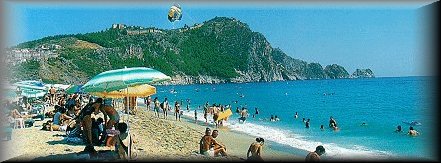
| INFO ABOUT CLEOPATRA BEACH AND ALANYA |

|
| Designed By Matelot and Spider |
 |
 |
 |