Southern
Comfort {
1982 }
Director : Walter Hill
It doesn't take long to r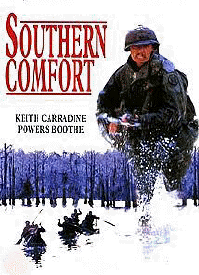 ealize
that Southern Comfort { should it have been Southern Discomfort } is a
clever allegory on the Vietnam War. After which, each and every
scene is clearly recognisable as some part of that traumatic era in
American history. Every element is in place, in some way or
other, from the eclectic group of National Guardsmen, the lack of
training, the indiscipline and the lack of perception at what they are
getting into, are all there in spades. The Louisiana bayou
doubles as the South-East Asia rain-forest and the Cajun inhabitants
are as deadly and elusive as the Vietcong. Right from the start,
the Guardsmen alienate the Cajuns, treating them and their way of life
with contempt and are surprised when the Cajuns strike back with every
means at their disposal. The arrogance of the Guardsmen places
them in an alien environment, surrounded on all sides by an implacable
enemy who know the swamps like the back of their hands and the
soldiers flounder and fumble their way around, their initial mission
abandoned in a race for survival. They soon find that their
reliance upon being better armed and better trained than their
opponents is negated by guerilla tactics and the soldier's initial
hubris slowly turns into fear and confusion. ealize
that Southern Comfort { should it have been Southern Discomfort } is a
clever allegory on the Vietnam War. After which, each and every
scene is clearly recognisable as some part of that traumatic era in
American history. Every element is in place, in some way or
other, from the eclectic group of National Guardsmen, the lack of
training, the indiscipline and the lack of perception at what they are
getting into, are all there in spades. The Louisiana bayou
doubles as the South-East Asia rain-forest and the Cajun inhabitants
are as deadly and elusive as the Vietcong. Right from the start,
the Guardsmen alienate the Cajuns, treating them and their way of life
with contempt and are surprised when the Cajuns strike back with every
means at their disposal. The arrogance of the Guardsmen places
them in an alien environment, surrounded on all sides by an implacable
enemy who know the swamps like the back of their hands and the
soldiers flounder and fumble their way around, their initial mission
abandoned in a race for survival. They soon find that their
reliance upon being better armed and better trained than their
opponents is negated by guerilla tactics and the soldier's initial
hubris slowly turns into fear and confusion.
The Cajun township is as alien to the soldiers as a Vietnamese village
must have been to the average American soldier and just as deadly and
their reliance upon helicopter rescue has resonant echoes.
There are probably many references I have missed and if you regard the
film from n allegorical point of view then you may spot many
more. On another level, the movie works as a pursuit movie in
the " and then there were none" style, so it offers plenty
to a wide audience.
Keith Carradine stands out from a great cast list, in his usual
diffident style but Powers Boothe is another story altogether.
Charisma, matinee-idol looks, good acting ---- Boothe draws the eye
each time he's on-screen. Which begs the question why he has
never made the a-list of Hollywood or made a truly memorable classic
and gone onto join that coterie of stars who never really make it to
the top of their profession.
Ry Cooder's atmospheric score and Walter Hill's expertise go to make
up a great adventure movie with style and sub-plot.
Salvador
{ 1986 }
Director : Oliver Stone
Film as entertainment, film as an art form,
film as a social commentary and film as political commentary ---------
Oliver Stone's hard-hitting film ticks all those boxes but mostly it
relates to the last on the list, political commentary, in which the
director is courageous enough to criticize United States' foreign
policies. The choice of El Salvador for the source of the action
is also a courageous selection given that it is an unpalatable fact
that most of us know very little about the place and dismiss it as a
South American backwater riven with interminable internecine
quarrels. 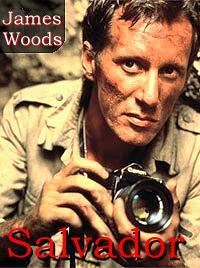
James Woods' portrayal of the manic and self-destructive Richard Boyle
and John Savage's portrayal of a dedicated war photographer is a study
in itself of a particular breed of men whose stock in trade is
bringing back footage from the most dangerous places on earth.
Despite their slovenly appearance and freelance, devil-may-care
attitude, it is quite apparent that these men are in reality providing
the world with historical insights and truth via their camera lenses
while in complete contrast, the elected and immaculately dressed
representatives of the USA are either incompetent, impotent or just
trigger-happy.
Although we like to think of the United States as some benevolent
world policeman bringing peace and order amidst chaos, the fact is
that in Salvador, America is guilty of interfering in the governing of
another country simply to protect its own ends. Oliver Stone
makes the point very forcibly that the Right Wing junta of Salvador
which utilises death-squads, disappearances, torture and repression,
has the military backing of the United States ---chosen in preference
to a down-trodden peasantry fighting with antiquated weapons and even
cavalry charges. Everyone likes the underdog but not in this
instance when the peasantry are Marxist led and America's paranoia is
quite apparent. To be fair to the director, he also makes the
point that the peasants, when given the opportunity, are just as cruel
as their enemies.
Based on a true events, one of the defining scenes is Archbishop
Romero's sermon from the pulpit, using his exact words as he spoke
them. Oliver Stone
illustrates that the real heroes are the martyrs to peace when Romero
is shot down and John Savage's photographer is also killed.
Stone doesn't do happy endings but he does do a thought-provoking and
a courageous analysis of US foreign policy which leaves some
uncomfortable questions hanging in the air.
Films such as this are not great box-office but will one day have
their place in the classroom as valuable historical dramas.
The
Field {
1991 }
Director : Jim Sheridan
A man trying
to defend his heritage in the face of capitalist progress, the stark
beauty of the west coast of Ireland, a Ya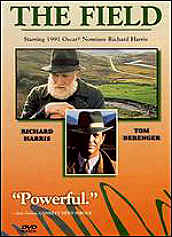 nk
back in his homeland -------- all the clichés are there in
abundance which is possibly why the The Field didn't just go "off
the radar" but never appeared on it in the first place. At
first glance, it does appear to be yet another in a long line of
stereotypic homages to "Auld Ireland and its eccentric but
loveable inhabitants" but on closer inspection, a cast list which
includes John Hurt, Richard Harris, Brenda Fricker, Sean Bean and Tom
Berenger is unlikely to produce anything less than impressive.
Add to the mix a director born in Dublin, with My
Left Foot and In the Name of the Father
on his C.V. and the expectations of a well-acted, intelligent film go
up immeasurably. nk
back in his homeland -------- all the clichés are there in
abundance which is possibly why the The Field didn't just go "off
the radar" but never appeared on it in the first place. At
first glance, it does appear to be yet another in a long line of
stereotypic homages to "Auld Ireland and its eccentric but
loveable inhabitants" but on closer inspection, a cast list which
includes John Hurt, Richard Harris, Brenda Fricker, Sean Bean and Tom
Berenger is unlikely to produce anything less than impressive.
Add to the mix a director born in Dublin, with My
Left Foot and In the Name of the Father
on his C.V. and the expectations of a well-acted, intelligent film go
up immeasurably.
The setting is the glacier-scoured west coast of the 1930's where all
may be rugged beauty, but for the inhabitants who scratch a meagre
existence from the unforgiving landscape it's nothing but a harsh and
hand-to-mouth existence ---made even harsher by the presence of the
glowering Bull McCabe { Richard Harris }. Bull is the
reincarnation of an Old Testament prophet, scowling and scathing to
everyone and everything, prejudiced and stubborn he has one
single passion which is his obsessive devotion to his beloved
Field. Even in this wild place there is a hierarchy ----the
tinkers are at the very bottom of the pecking order, the farmers are a
middle-class of sorts, the priest is tolerated rather than venerated
and towering over all of them is Bull whose physical presence is
enough to strike fear into their hearts.
On the rare occasion when they all come together for the village
dance, the tension is palpable and the dance itself is reminiscent of
a pagan mating ritual. There's an underlying aggression in the
stomping rhythms which recalls a time when the dancers wore skins and
painted their faces. It's not generally appreciated that
American barn-dancing and other forms of frontier dance have their
origins in Irish, Lancashire and Scottish folk dances and the
similarity to the well-known dances of the westerns is unmistakable
------ take a look at the dance scene in The
Long Riders and you will see that it's
virtually indistinguishable from the dance scene in the Field.
The Field is a slow starter and gathers pace as it goes along but it
never becomes boring due to the fine acting on display. Richard
Harris's depiction of "Bull" is immense and Brenda Fricker
speaks hardly two words in the whole film but has that indefinable
presence of all the greats. John Hurt comes dangerously close to
imitating John Mills's village idiot in Ryan's Daughter but after a
while he brings his character to life in his own inimitable manner,
but of all them, Sean Bean as the enigmatic son of Bull catches the
eye each time he's on screen. Bean understates the role of Tadgh
who says very little and because of that it's difficult to assess his
intelligence. He appears to be pondering matters deeply but
there is a suspicion that in reality he is in a state of total
bewilderment ---there's also a suspicion that his true persona has
been so suppressed that it exists only in some murky recesses of his
mind. Tadgh appears to be living his life constantly gazing into
an impenetrable fog which may or may not be a sign of a lack of
intelligence but the suspicion lingers that it is solely down to the
constant state of fear engendered living in the shadow of the fearsome
Bull.
The real focus of the film is not the eponymous field at all but the
flawed Bull whose tragedy is that his formidable strength of character
has been misdirected and misused to the detriment of everyone around
him when it could so easily have been a force for good. His
obsessive nature fails to recognize that none of us really own
anything in this world and like everything else his field was just on
loan.
| Several
films featured here are subject to accents and dialects and a
badly done accent can spoil the best of films. The
examples of this are legion : the vastly over-rated
Audrey Hepburn clearly demonstrates her lack of knowledge of
working-class Londoners in My
Fair
Lady
and East Enders must have died laughing at her execrable
performance. Robin Williams prides himself on doing an
English accent but anyone British can detect the fault lines
while the best that can be said of Brad Pitt's Irish accent is
that most Americans might fall for it but anyone in Ireland
would not be fooled for one moment. Such are the nuances
of regional accents in England that even respected British
actors fall flat on their faces ----Robert Carlyle's scouse
{ Liverpool } accent in 51st
State
might be acceptable elsewhere but any Liverpudlian will
identify it as a fake right away. The prize for the
worst British accent of all time goes to Dick van Dyke in his
cringe-making performance in Mary
Poppins
which
in itself must rank high as one of the worst films ever made
----even little kids have been known to walk out on this
one. Nobody bothered to tell Van Dyke just how bad he
was so he went on to repeat the performance in the arguably
worse Chitty,
Chitty, Bang, Bang. This
story is repeated over and over again and in My
Kingdom, Lynn
Redgrave may sound authentic to outsiders but to a Scouser
it's easily detected as false ----fortunately, she has few
lines. It should be written into actors contracts that
Brits will not do American accents and vice-versa and until
that day comes the faults will go on. In May, 2008, Anna
Friel [ Pushing Daisies } was highlighted by U.S. audiences
for her dreadful American accent. |
Rounders
{ 2001 }
Director : John Dahl
Rounders is an unusual film in that it is multi-layered and works on
every level. Firstly, it is a film built around the game of
poker and the people who play the game, so if you have never walked
home with what appears to be a rock in your stomach after losing a
week's wages on a 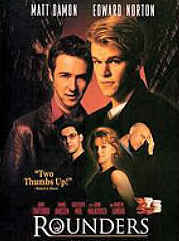 Friday night, then much of the film will be lost on
you. According to a reliable source, the poker games are so
authentic that the film has turned into a cult movie for aficionados
of the game. Friday night, then much of the film will be lost on
you. According to a reliable source, the poker games are so
authentic that the film has turned into a cult movie for aficionados
of the game.
In keeping with the poker theme, Rounders is also a fine example
of modern film noir and is packed with a cast of Runyonesque
characters with the same colourful names but minus the charm,
inhabiting a smoke-filled, subterranean world where violence is just
the turn of a card away. Their latent viciousness and the ever-present
threat of serious reprisals for insults, real or imagined, gives the
poker games an added edge. At the heart of this gambling
empire-Manhattan - style, is Teddy KGB, a name which could be quite
comical but for the fact that, played by John Malkovitch, Teddy is a
brooding, humourless Russian Mafia boss who hates to lose.
None of the other characters are men to be trifled with and there is a
suggestion that the smoky poker-games, while played for high stakes,
are just a distraction in between more serious activities.
But most of all, Rounders is about the nature of friendship which is
where the dream-team of Matt Damon and Edward Norton come into their
own. Edward Norton as the aptly named Worm is the kid tha t you
were always told to keep away from ----"he'll get you into
trouble" ---and that's precisely what he does to Mike { Matt
Damon }. The mercurial Worm lives his life on the edge and
falling deeper into his murky world with each passing day, he courts
disaster at every turn ---defying the gangs and committing the
ultimate sin of cheating at the table. Worm drags Mike into his
sleazy world which Mike reluctantly enters and is gradually dragged
down with his friend. Most people will recognize someone who has
presumed upon their friendship and this is what Worm does best and
Mike loses his girl, his money and his reputation as he pulls Worm out
of one disaster after another. How he can finally fulfil his
obligation and return to his former life-style leads Mike into
confrontations which must be faced before he can extricate himself
from the weasel words and faux-macho posturing of Worm who seems bent
on self-destruction. t you
were always told to keep away from ----"he'll get you into
trouble" ---and that's precisely what he does to Mike { Matt
Damon }. The mercurial Worm lives his life on the edge and
falling deeper into his murky world with each passing day, he courts
disaster at every turn ---defying the gangs and committing the
ultimate sin of cheating at the table. Worm drags Mike into his
sleazy world which Mike reluctantly enters and is gradually dragged
down with his friend. Most people will recognize someone who has
presumed upon their friendship and this is what Worm does best and
Mike loses his girl, his money and his reputation as he pulls Worm out
of one disaster after another. How he can finally fulfil his
obligation and return to his former life-style leads Mike into
confrontations which must be faced before he can extricate himself
from the weasel words and faux-macho posturing of Worm who seems bent
on self-destruction.
A glance at John Dahl's C.V. is nothing to write home about but in
Rounders he has created a minor masterpiece.
My Kingdom
{ 2001 }
Director : Don Boyd
When it
comes to film directors, the name Don Boyd hardly trips off the
tongue---in fact you might be hard pressed to name another film he has
done. Nevertheless, he has been working for quite a while now
and if he has struggled in the past, it all comes together in My
Kingdom. The film is a grim tale of a crime family and
translates well from its King Lear roots ---- it always helps to have
a screenplay already written by an established author. The
setting is Liverpool and although it's almost compulsory to use the
run-down dockland areas, to his credit he also makes use of some
colourful scenes elsewhere in the city. The story of a gangland
family imploding is triggered by the
death of Mandy Sandeman { Lynn Redgrave } and gathers momentum
as the film goes along ----although it was Sandeman
{ Richard Harris } himself who was meant for death in a bungled
assassination.
Mandy's funeral is followed by a "reception" in which the
whole crime family arrive to pay their last respects to Mandy.
The 3 daughters who are immediately recognisable as Goneril, Regan and
Cordelia, are dressed as if for a session at a night club which
is what they turn the occasion into. The highlight of this
celebration of bad taste is when Tracy { Lorraine Pilkington } takes
the mike and proceeds to mangle the song "Mandy" in a
grotesque homage to her mother. The most disturbing part of all
this is that none of the mourners think there's anything out of the
ordinary and Kath, her sister { Goneril } just wishes she had thought of it.
Lorraine Pilkington manages to steal this scene completely and is
electric throughout the film as the nymphomaniac and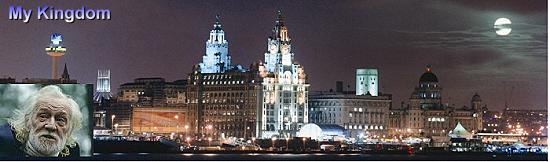 homicidal Tracy
---- Regan revisited. homicidal Tracy
---- Regan revisited.
Richard Harris's Sandeman is on the receiving end of his families'
hatred and is reeling under the attacks he comes under and looking
weary for much of the film -----this was Richard Harris's final film
before his death in 2002 but he still put in an excellent
performance. Harris was one of those actors who improved with
age and his portrayal of the aging crime-lord, about to lose it all,
is riveting.
There is a part in the film in which "The Chair" { Colin
Salmon } points out that if Mandy was killed by a druggie then
Sandeman himself is to blame as he has flooded the streets with drugs
-----Sandeman looks stunned and like many another celluloid criminal
sees his "business" as just that ---a legitimate
business. In common with many another gangster, Sandeman seems
impervious to the the outside world and he is shocked when it impinges
on his life in such a dramatic way.
Gangster films are always engrossing but whether they are British,
American, French or any other nationality they are ultimately
depressing portrayals of people whose dubious talents are channeled
into making money. The common denominator of all film crime
families seems to be the inability to use their ill-gotten gains
in a meaningful manner and their acquisition of kitsch is
unending. Invariably, they can never have enough money and the
obtaining of money turns into an end in itself. all these
factors are present in most gangster films and this one is no
different even as the whole venomous nest of vipers tear themselves to
pieces. If Shakespeare had seen this film he would have recognised
immediately many of the characters and events such as the blinding of
Gloucester and he would perhaps have noted that whether it's gangsters
or Kings nothing much has changed over 500 years.
Shooting
Dogs {
2006 }
Director : Michael Caton-Jones
Any story about the Rwandan holocaust of 1994 is bound to invite
comparison with Hotel Rwanda and cynics
may suspect some cashing in on that film's popularity, but Michael
Caton-Jones's pedigree as a director demands respect, in particular
for the perceptive This Boy's Life. Given
the success of Hotel Rwanda the preceding year, it says a lot about
the director's confidence that he could revisit the subject and
produce something of the same quality. However, the truth is
that while it is inevitable that there will be similarities ---- the
subject matter is after all confined within narrow parameters ------
Shooting Dogs is in many ways a superior film. Hotel Rwanda is
memo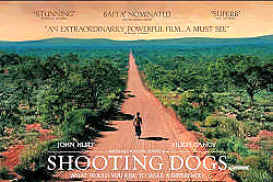 rable for the standout performance of Don Cheadle and to a lesser
degree the vulnerability of the winsome Sophie Okonedo but in the
process of relating the grim tale, Michael Caton-Jones explores many
themes that Hotel Rwanda ignores. rable for the standout performance of Don Cheadle and to a lesser
degree the vulnerability of the winsome Sophie Okonedo but in the
process of relating the grim tale, Michael Caton-Jones explores many
themes that Hotel Rwanda ignores.
The film is based upon the dreadful days of 1994 when the Tutsi were
hunted down by a rag-tag army of crazed Hutu tribesmen and focuses upon the slaughter of 2500
Tutsi at the Ecole Technique Officielle where they had gathered for
protection under the wing of a small U. N. contingent and the school
teachers. The Tutsi men, women and children within the confines
of the school are surrounded by a mob of baying tribesmen whose
casual, uncomprehending cruelty as they hack their victims to death is
the stuff of nightmares. Their extreme danger is all-encompassing and the only
thing between them and their bloodthirsty enemies are the blue-capped
United Nations soldiers. If there is anything that illustrates
the manner in which films have evolved, it is the fact that where once
it would have been unthinkable for the soldiers to leave the Tutsi and
they would have circled the wagons and fought until reinforcements
arrived, the reality is that in this film and in real life, the United
Nation's soldiers left the innocents to their fate. The question
as to why the soldiers abandoned the Tutsi is left hanging in the air
but the answer is made plain by the U. N. commander's frustration at
his orders and the politico-babble of his political masters.
The
role of the Christian church is also brought into question in the
guise of John Hurt's priest with an unquestioning faith in the
love of God and a pragmatism which ultimately saves the lives of a few
dozen children ---the only survivors. The Tutsi's belief in
their Christian upbringing is quite touching but their faith is
betrayed by the defection of Joe, played by Hugh Dancy, who is unable
to live up to the tenets that he has been declaiming. Very
slowly, his affection for the Tutsi and his faith in the Church are
eroded by the sight of the bloody machetes at the gates and he leaves
with the U. N. troops ---- a nice performance here which begins with
the idealistic Joe " starring in my own Oxfam ad" and ending
with his will crumbling completely.
Shooting Dogs is first and foremost entertainment but the role call of
survivors who took part in the film is a chilling reminder that the
massacre at the school was real and the bestial hacking to death of
such a great number of people was only a fraction of the total 800,000
who died such terrible deaths. Perhaps such events are of
necessity presented as entertaining dramas, otherwise very few people
would want to see them, but films such as Hotel Rwanda and Shooting
Dogs are in their own way a more powerful indictment of such genocides
than any number of documentaries. It may seem morally dubious to
present such horrific events as on screen dramas but the fact is that
they have far more power to grip our emotions than any number of
documentaries and as such are a valuable means of reminding us of
man's inhumanity to man. There is a strong case for films such
as this being preserved at some time in the future as historical
documents.
Black
Book {
2006 }
Director : Paul Verhoeven
The impression is that the director who is more famous for his
Science Fiction films and the famous Sharon Stone scene in Basic
Instinct, returned to his Dutch roots to revisit some childhood
impressions he had about the Nazi occupation of his country.
Starting out with the best of intentions, it's fairly obvious that
Verhoeven has succumbed to temptation and included some racy sex
scenes and a sprinkling of action scenes. In a way it's
difficult to blame him because most Resistance tales on film are
fairly plodding affairs and inevitably include crackly radios, a
traitor in the camp, a virginal agent forced to sleep with a
high-ranking Nazi for the cause, and no self-respecting Resistance film
would be without its betrayal of hidden Jews. This film is no
different and includes all those elements but Verhoeven's
determination to make it different 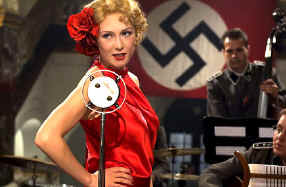 to
all the others has produced a strange chimera of a movie and frankly
if not for the presence of Carice Van Houten the whole thing would be
nothing but a formulaic Resistance movie. to
all the others has produced a strange chimera of a movie and frankly
if not for the presence of Carice Van Houten the whole thing would be
nothing but a formulaic Resistance movie.
Carice Van Houten is a virtual unknown in Hollywoood circles and her
previous career has been confined to Dutch movies but when Verhoeven
chose her for his leading lady in Black Book he backed a winner -----
whether he chose her because they are both from near Leiden is not
known. Black Book is overlong at two and a half hours and Carice
is rarely off screen but she carries the whole thing along with an
electrifying performance which combines excellent acting, a screen
charisma and a rare sexuality which Verheoven exploits to the
full. In fact, the director wastes no opportunity to have our
heroine in various states of undress and at times the film descends {
or ascends, according to your tastes } into unadulterated soft porn.
Carice enters into the spirit of the thing with gusto but Verhoeven
has done her a disservice as she is a great little actress who could
and should go a long way. In a way, it's a shame that Verhoeven
has overdone the sex scenes because apart from undervaluing a great
little actress it also undervalues the whole film and although it's
watcbeable for her performance alone the remainder of the film has
little of merit ---unless you are one of a select group of Dutch
Resistance buffs.

Comments/questions
welcome
but if I have inadvertently trashed your favourite film
please remember it's not personal and it wouldn't do for
all of us to be the same.
|


 If
you thought Eclectica was about films rarely seen, then unless you
have devoted your life to the cinema to the exclusion of all else, then
some of the following selection will be a complete revelation.
Others may be vaguely familiar but none of them
are block-busters ---they are more likely to be films which you may
have missed or steered clear of because the title is not very inspiring or the subject is not
to your taste.
If
you thought Eclectica was about films rarely seen, then unless you
have devoted your life to the cinema to the exclusion of all else, then
some of the following selection will be a complete revelation.
Others may be vaguely familiar but none of them
are block-busters ---they are more likely to be films which you may
have missed or steered clear of because the title is not very inspiring or the subject is not
to your taste.