 |
 |
 |
 |
| This page contains a list a a brief description of the equipment I use. It includes large pieces, like bodies and lenses, and it also contains smaller things like filters and film. If you have any questions or commenst about these items, you can e-mail me and I'll tell you what you need to know. Thanks for checking it out! |
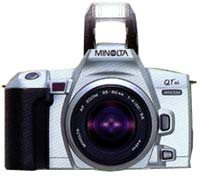
| MINOLTA QTSI This camera is essentially for beginners, so naturally, it was the first one I got. It offered 5 picture modes and 3 flash modes. It took excellent pictures, but lacked creative quality. Shutter speeds and aperatures were not customizable and you had to rely on the picture modes to try and get the creative style you wanted. It was very difficult to take a bad picture with this camera, but it was also difficult to tinker with options. I would recomend it to anyone just starting out, but there are better cameras out there that offer the simplicity of this one, but can then turn into an advanced system. |
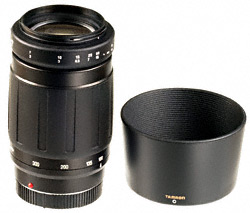
| TAMRON 100-300MM This was the first telephoto lens I bought, and It was my only telephoto lens for over a year. The macro cababilities were decent, but the minimum focusing distance was awful (over 4.5 feet). It's weight wasn't unacceptable, but the length was slightly large for a lens that started at 100mm. Though when using this lens at 300mm, you could really appreciate the zoom, only being able to retract to 100mm got a bit tedious and I soon found myself using a 35-80mm more often than this one when there was the possibilty I would need a landscape shot. |
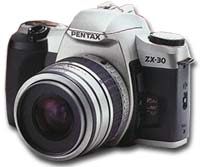
| PENTAX ZX-30 This is my current camera. The second one I've bought and definetly the best. It has the cabability to run like the Minolta camera (through green mode) but can also be fully manual. Not only that, but this camera displays the shutter speed and aperature no matter what picture mode your using. It also has five other pre-set picture modes (which I rarely use). I beleive this camera has frame advance at 2 fps. Also, the crowning feature on this camera for me was the double exposure mode. I used this frequently with an older camera (not featured on this site) and was glad to see it back in an easier form. This camera body is one I highly recomend to someone who wants all the features, but doesn't want to spend a lot. |
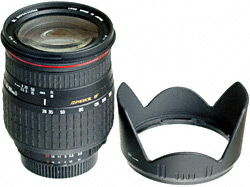 |
| SIGMA 28-300MM Though a bit on the pricey side, this was definetly the lens for me at this time. With a hyper zoom range of over 250mm, I can use this lens for both landscapes and close-ups. The only drawback to a lens like this is that since the max zoom is 300mm, it's best to shoot with a shutter speed of 1/300 or greater. This limits my options a little, and also prevents me from getting good depth of field with a smaller aperature. The macro on this lens is outstanding, since the minimum focusing distance is close to 1.5 feet. I can't think of any lens I'd rather have right now (with the exception of a fisheye). |
 |
 |
 |
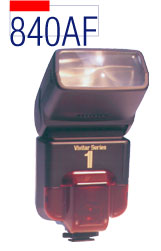 |
| VIVITAR 840AF I bought this flash dedicated for the Pentax AF camera. It wasn't the first flash I looked at, but ended up being the best one for me. At an affordable $125, it definetly allowed some breathing room in the price department. Although the guide number is only 20, it has an internal zoom of 28-80mm, which completely covers my smaller Tamron lens. It has a very simple interface, all you do is choose between TTL full auto, full power, or 1/16 power. It couldn't get any easier, and until I start shooting more occasions where I'll need an advanced flash, this one worked out just fine. I'd recommend it to anyone who needs an accesory flash, but doesn't want to go through the trouble of learning an advanced metering system just to use it. |
| PIECES COVERED: Minolta QTSI camera Tamron 100-300mm lens Pentax ZX-30 SLR camera Sigma 28-300mm lens Vivitar 840AF flash |