Colonel Bogey March
Presented by Anne Dawley and Nicole Makarek
Lieutenant F.J. Ricketts, who was a military bandmaster in the early 1900's, composed the piece "Colonel Bogey March". Ricketts published "Colonel Bogey" and several other pieces under the pseudonym Kenneth Alford. The story beind the name "Colonel Bogey" goes like this. The composer ofter played golf on a course near Inverness, Scotland, where a very eccentric colonel also played. Rather then using the traditional call of "fore" to warn others of an incoming ball, the colonel would whistle the notes that would later become the first few notes of the later famous march.
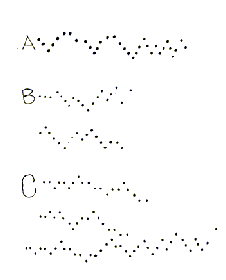
"Colonel Bogey March" is a piece composed in Rondo form, which means that it is ABACA, where A is a repeated melody, B differs from A, and C differs from A and B. If you were to use this piece in a curriculum area other than music, it could fit into a Social Studies class that was studying ranks in the military or any battles or wars. The movement used in this piece to help with active listening could also be used in a Physical Education class.
A sketch of the listening guide is shown below. Using several different icons for the three different parts will help students recognize the switch from each part to the next. A solider and his footsteps can be ued to show the contour of part A, a drum and a straight line can be used to show the contour of part B, and a feather from the soldier's har and a dashed line can be used to show the contour of part C. When having the students participate in active listening activities, they can play a "drum" for part A, march for part B, and bob up and down for part C. |