|
|
|
|
|
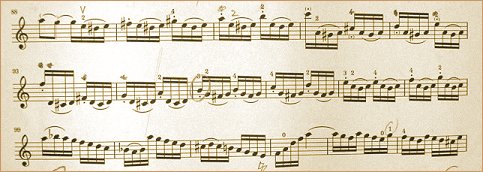
Samples & Analysis: Bach The whole piece, as is obvious from the title, is in A minor. Bach doesn't modulate or change key abruptly or anything like that- he's far too subtle for that. Well, okay, he does add a few accidentals here and there and ends on an E (so he must have modulated), but he doesn't do anything drastically. There are three sections to this piece, all following almost exactly the same pattern. There aren't really any huge leaps or jumps in the notes Bach uses- any travelling is done via steps or small repeating patterns that gradually work their way up. (Fig. 01)
Fig. 01
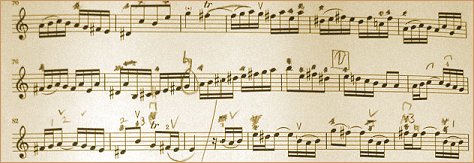
The first half of the first section is written with an orchestra accompaniment in mind- when the solo comes along, the tune is much more pronounced and stands out against the rest of the ensemble- exactly what a concerto is designed to do. In bars 77 and 78 (also repeated in bars 164 and 165), we get a scale that runs directly onto the end of the phrase. (Fig. 02)
Fig. 02
Bach's phrases are very clear, along with the rhythm and time signature. Many notes are slurred into groups of three, giving an almost triplet-esque feel to parts of the piece. It's quite difficult to play. Many phrases begin with a half up-bow and have to quickly join on to the three-note groupings with only one separated from the group (Fig. 01) and although no dynamics are marked in the manuscript, the player still has to keep the listener interested in what he or she is playing. The piece doesn't really change mood- almost all of it is written in semi quavers or quavers, generally in groups of four notes. Like so many of other Bach's works, this is an interesting and beautiful piece, and should be played with care and not rushed.
|
Navigation & index & baroque & samples & site |
|