 |
 |
||
Home | Vocabulary | Perform | Listen | Compose | Sales | Links
Africa: The Djembe
|
|
||
The
Djembe drum is West Africa’s most popular drum. It has a remarkably flexible
range of tones, produced by its thin goat skin, shape and tight tuning. Today,
this drum is gaining popularity throughout the world as a great addition to
drumming circles, rituals, and gatherings or to play alone.
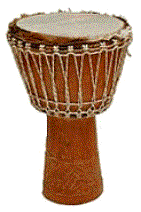
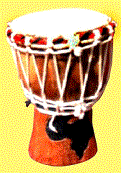
A djembe
is a unique goblet or chalice shaped drum, usually carved from a single piece of
wood. It originated in West Africa and is generally considered to have roots in
the Manding people of the early Mali Empire. It stands approximately 20-30"
high and is covered with goat or antelope skin, usually held on and tuned by
lacing of cord in a pattern called the Mali weave.
The
Djembe originated in Guinea, West Africa. I'm told the word means
"everyone come together in harmony" which is phonetically pronounced
"J"
"EM" "BE"
Making
a drum
Traditional
djembes have a plain shell without any special carvings. The djembe drum is
carved from a single piece of wood.
m.
They are soaked in ash and water overnight, then soaked in a mixture of water
and tree bark or maize stalks, to stain them various colours. After this, they
are laid out in the sun to dry.
It
takes about 15 minutes to measure and make the metal rings for the drums. There
are three on each djembe, two at the top rim and one on the bottom. The skins
are fumigated before fitting and then soaked again to make them more pliable and
to ensure a tight fit.
A
twisted length of hide are wrapped around the metal rings to cover them, and
then comes the complicated threading and tying of the tensioning rings.
Loosening or tightening the leather cords alters the tensioning of a djembe.
Playing
technique
The
proof of any drum is in the playing. Drum making in Ghana is a skill, which is
passed down from generation to generation.
The bass is played with an open hand in the centre of the drum producing an
incredibly deep and resonant note.
The tone is played near the rim of the skin on the drum with a firm hand,
producing a high pitched note.
A pivoted open hand plays the slap on the rim of the drum, by
throwing the fingers forward to slap the skin. This produces a crisp, sharp
note, which can cut through the loudest music.
<back>