
1.
The Serialist way of composing deliberately contradicts the
traditional music style where melodies and accompaniments are built on
scales and chosen chords.
2.
Serialist musicians would use all the black and white notes from C to
the next B. Traditional music has a key centre built on scales has some
notes used more often than others and some chords used more than others. For
example the note C is used the most often in most tunes that use the notes
of C major. It is the key centre.
3.
Serialist music seeks to avoid a sense of key centre. The best way to
do this is to avoid repeating notes. So, all the notes have to be used
before any are repeated. You will need to sort out the order in which the
notes are used before you start composing.
This is called the TONE ROW.
Here are all the notes
from C to the next B. There are 12 notes altogether.
A chromatic scale
Copy example 1. Be
very careful to write in the sharps and flats correctly to the left of each
note and so that the centre of the sign in exactly opposite the note head.

Example 2 below shows
the 12 notes on a keyboard, which can be used to play the above tone row
Find and play all the notes found in example 1 on a keyboard. The keyboard in example 2 shows all the notes including the black as well as white notes
Examples 3a and 3b
below shows a tone row. The notes in example 1 have been shuffled into a new
order. Notice also that C (or the original note 1 has been moved to a higher
C. This is not essential but movements of any of the notes up or down to the
same named note is also allowed in this style.
Now
all that is needed is to re-number the shuffled notes so that they can more
to help when using them in this order in the composition.
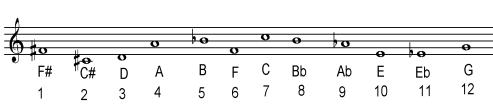

When the order of the notes has been decided
then attention should be turned to the time signature and the rhythm.
Serialist compositions often have the same rhythm, dynamics and articulation
used in traditional music and we will keep the time signatures simple at
this stage.
Write your own
tone row: Write all the notes in example 1 but shuffle them into a different
order. First write down the numbers under the stave in your new order. All
the notes should be used but only once. You should then have your own tone
row from which you can begin to compose.
Tone Row 1
(numbers and notes -order
chosen from example 1)

__ __ __ __ __ __ __ __ __ __ __
Tone row 1
(finished numbering)

Copyright © 2003 David Hayes