11.
C major and G major
SHARPS
Read the following:
| In
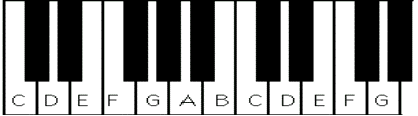
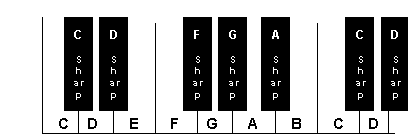
example 4 some of the notes are coloured black on the keyboard. Example 30 shows
the names of these notes. |
EXAMPLE
29
EXAMPLE
30
Exercise 30a
Copy out the piano keyboard
as in example 5 and write down the names of the black notes. Use a pencil and
ruler.
|
|
Exercise 30b
Complete the table below:
C
sharp is higher than C but lower than D
D sharp is higher than D but
lower than __________________
F _______is _______than
______but ________than ______.
G
__________________________________________________
A
__________________________________________________
Read the following:
| Example
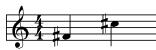
6 below shows the short way to write the word Sharp by putting the special sign
# in the front of the note. Example 6 shows F sharp and C sharp |
EXAMPLE
31
Exercise 31
Name the following notes.

____
____ _____
____ ____
_____
Read the following:
| All
the tunes you have written so far have used the notes of C major scale. Example
32 shows the Scale OF C MAJOR. This
scale starts on the note C and goes up to the note C above it. Look at the piano
keyboard and look at the notes of C major. You will see that there is one note
between the first two notes of the scale of C major. The note between the notes
C and D there is a C sharp) |
EXAMPLE
32

Exercise 32
There are two pairs of notes
in the scale of C major which do not have a note between them. These are the
notes E and F. The other pair is _____________
Read the following:
|
When
there are two notes without a note between them the distance in pitch
(interval) is called a semitone. Where there is a note between the
pitches the interval is called a tone. Example
8 shows the order of tones and semitones found in C major scale. The same order
is found in any scale called a major scale |
EXAMPLE
33

Exercise 33
Add the tones and semitone
indications on the G major scale below taken from example 8. Play the scale and
you will notice how it sounds very similar to C major scale.
Scale
of G major

Copyright © 2002 David Hayes